
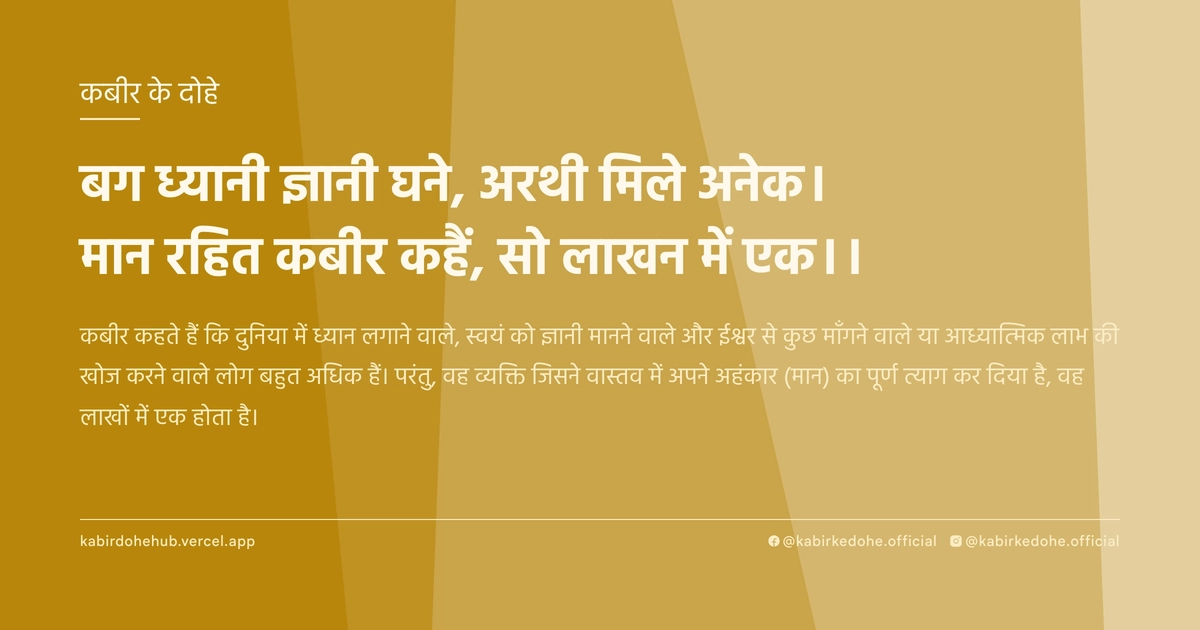
बग ध्यानी ज्ञानी घने, अरथी मिले अनेक।
मान रहित कबीर कहैं, सो लाखन में एक।।
Bag dhyani gyani ghane, arthi mile anek. Maan rahit Kabir kahein, so lakhan mein ek.
इस पृष्ठ पर इस कबीर दोहे का अर्थ (meaning), हिंदी व्याख्या और अंग्रेज़ी अनुवाद, दार्शनिक विश्लेषण और व्यावहारिक जीवन सीख दी गई है। यह दोहा विनम्रता (Humility) विषय से जुड़ा है — Kabir doha meaning and explanation in Hindi and English.
अर्थ (Meaning):
कबीर कहते हैं कि दुनिया में ध्यान लगाने वाले, स्वयं को ज्ञानी मानने वाले और ईश्वर से कुछ माँगने वाले या आध्यात्मिक लाभ की खोज करने वाले लोग बहुत अधिक हैं। परंतु, वह व्यक्ति जिसने वास्तव में अपने अहंकार (मान) का पूर्ण त्याग कर दिया है, वह लाखों में एक होता है।
Kabir observes that the world is crowded with those who practice meditation, those who claim profound knowledge, and those who seek spiritual or material gains. However, the individual who has truly annihilated their ego and exists without the sense of 'I-ness' is a rare find, appearing perhaps once in a million.
व्याख्या (Interpretation):
इस दोहे का शाब्दिक अर्थ है कि साधकों और विद्वानों की भीड़ बहुत है, लेकिन अहंकारमुक्त व्यक्ति दुर्लभ है। यहाँ 'ज्ञानी' और 'ध्यानी' उन लोगों का प्रतीक हैं जो आध्यात्मिक यात्रा को एक उपलब्धि या पहचान के रूप में देखते हैं। कबीर यहाँ 'मान' (अहंकार) को सबसे बड़ी बाधा बताते हैं। यह निरगुण भक्ति का सार है, जहाँ ईश्वर किसी बाहरी क्रिया में नहीं, बल्कि अहंकार के विसर्जन में मिलता है। जब तक 'मैं' जीवित है, तब तक ब्रह्म का अनुभव असंभव है क्योंकि अद्वैत वेदांत के अनुसार, आत्मा और परमात्मा के बीच केवल अहंकार का पर्दा है। यह विरोधाभास है कि ज्ञान की खोज अक्सर एक नया अहंकार पैदा कर देती है, जबकि वास्तविक ज्ञान स्वयं के मिटने में है।
Literally, the verse states that while practitioners and scholars are numerous, the ego-less soul is rare. 'Dhyani' and 'Gyani' symbolize those who treat spirituality as a trophy or a social identity. Kabir identifies 'Maan' (ego/pride) as the ultimate veil. This aligns with Nirgun Bhakti, where the Divine is found not in ritual, but in the dissolution of the self. According to Advaita Vedanta, the perceived separation between Atman and Brahman is maintained solely by the ego. The central paradox highlighted here is that the pursuit of spiritual knowledge often inflates the ego, whereas true liberation requires the total annihilation of the 'I'. Only when the drop forgets its individuality can it truly become the ocean.
दार्शनिक विश्लेषण (Philosophical Analysis):
कबीर का यह दोहा उस समय के सामाजिक और धार्मिक पाखंड पर कड़ा प्रहार है, जहाँ धर्म केवल बाहरी प्रदर्शन और शास्त्रार्थ तक सीमित था। उन्होंने देखा कि कैसे लोग कठिन तपस्या और ध्यान का उपयोग समाज में अपनी श्रेष्ठता सिद्ध करने के लिए करते थे। यह दृष्टिकोण 'अहंकार के सूक्ष्म रूपों' की पहचान कराता है—जहाँ एक व्यक्ति यह सोचकर अहंकारी हो जाता है कि वह बहुत विनम्र है या बहुत ज्ञानी है।
दार्शनिक स्तर पर, यह सूफी मत के 'फना' (अस्तित्व का मिट जाना) और वेदांत के 'अहं ब्रह्मास्मि' के बीच के सेतु का काम करता है। सूफीवाद में जब साधक खुदा में विलीन होता है, तो उसकी अपनी पहचान समाप्त हो जाती है। इसी तरह, कबीर का 'मान रहित' होना वह अवस्था है जहाँ द्वैत (दो होने का भाव) समाप्त हो जाता है।
कबीर ने जाति और कर्मकांडों का विरोध इसलिए किया क्योंकि ये सभी 'पहचान' (Identity) से जुड़े हैं। जब कोई कहता है कि वह उच्च जाति का है या उसने महान ग्रंथ पढ़े हैं, तो वह वास्तव में अपने अहंकार को पोषण दे रहा होता है। उनके लिए वास्तविक भक्ति वह है जो व्यक्ति को शून्य बना दे।
मनोवैज्ञानिक रूप से, यह दोहा 'स्पिरिचुअल बाईपासिंग' की चेतावनी देता है। कई लोग ध्यान और ज्ञान का सहारा लेकर अपने गहरे मानसिक घावों और अहंकार को छिपाते हैं। कबीर सुझाव देते हैं कि बाहरी साधनाएँ तब तक व्यर्थ हैं जब तक वे आंतरिक विनम्रता और अहंकार के विसर्जन में परिवर्तित न हों।
अंततः, यह संदेश देता है कि सत्य की प्राप्ति किसी विशेष तकनीक या शास्त्र के पढ़ने से नहीं, बल्कि स्वयं के 'होने' के भ्रम को तोड़ने से होती है। जो व्यक्ति स्वयं को पूरी तरह मिटा देता है, वही वास्तव में उस अनंत सत्ता के साथ एकाकार हो पाता है, क्योंकि रिक्त स्थान ही परमात्मा के लिए उपलब्ध एकमात्र स्थान है।
This couplet is a scathing critique of the religious and social hypocrisy of Kabir's era, where spirituality was often reduced to outward performance and scholarly debates. Kabir observed how practitioners used rigorous meditation and intellectual prowess as tools to establish social superiority. He exposes the 'subtle forms of ego'—where a person becomes proud of their own humility or their status as a 'seeker'.
Philosophically, this connects the Sufi concept of 'Fana' (annihilation of the self) with the Vedantic realization of non-duality. In Sufism, the seeker vanishes into the Beloved; similarly, Kabir's 'Maan Rahit' state is where duality ceases to exist. The sense of 'I' is the only barrier between the individual soul and the Universal Consciousness.
Kabir's rejection of caste and ritualism stems from the fact that these are anchors of identity. Claiming a high caste or mastery over scriptures is merely feeding the ego. For Kabir, true devotion is that which reduces the practitioner to zero. He argues that the Divine cannot enter a heart that is already full of 'self'.
Psychologically, the verse warns against 'spiritual bypassing'. Many use meditation and knowledge as shields to avoid facing their inner shadows or to inflate their self-image. Kabir asserts that external disciplines are futile unless they lead to the internal dissolution of the ego.
Ultimately, the teaching suggests that truth is not attained through a specific technique or the study of texts, but through the breaking of the illusion of a separate self. Only the one who becomes truly empty can be filled by the Infinite, as emptiness is the only space where the Divine can reside.
मूल संदेश (Core Message):
- बाहरी साधना केवल एक माध्यम है, लक्ष्य अहंकार का विसर्जन है।
- ज्ञान जब पहचान बन जाता है, तो वह अज्ञान का ही एक रूप होता है।
- सच्ची भक्ति वह है जो 'मैं' को 'शून्य' में बदल दे।
- विनम्रता कोई व्यवहार नहीं, बल्कि स्वयं के मिटने की अवस्था है।
- परमात्मा केवल उसी हृदय में बसता है जहाँ अहंकार का निवास नहीं होता।
- External rituals are merely tools; the ultimate goal is the dissolution of ego.
- When knowledge becomes an identity, it transforms into a form of ignorance.
- True devotion is that which converts the 'I' into 'Zero'.
- Humility is not a social behavior, but a state of self-annihilation.
- The Divine resides only in the heart where the ego has ceased to exist.
व्यावहारिक उदाहरण (Practical Example):
एक समय की बात है, वाराणसी के घाटों पर एक वृद्ध विधवा रहती थी, जिसका नाम जानकी था। जानकी का पूरा दिन पूजा-पाठ और माला जपने में बीतता था। वह शहर की सबसे 'पवित्र' महिला मानी जाती थी और उसे इस बात का गहरा गर्व था कि वह धर्म के नियमों का सख्ती से पालन करती है। वह अक्सर अन्य महिलाओं को उनके गलत तरीकों के लिए टोकती और उन्हें उपदेश देती कि कैसे शुद्धता बनाए रखनी चाहिए।
एक दिन, घाट की सीढ़ियों पर एक छोटा बच्चा गिर गया और उसके हाथ से मिट्टी का एक घड़ा टूट गया, जिससे कीचड़ चारों ओर फैल गया। जानकी के सफेद वस्त्रों पर कीचड़ के छींटे पड़ गए। वह क्रोधित हो गई और बच्चे को बुरी तरह डांटने लगी, उसे 'अशुद्ध' और 'लापरवाह' कहा।
तभी पास ही बैठे एक फकीर ने, जो चुपचाप सब देख रहे थे, धीमे से कहा, 'माई, कीचड़ तो कपड़ों से धुल जाएगा, लेकिन इस क्रोध और अहंकार ने तुम्हारी आत्मा को जो मैला किया है, उसे कैसे धोओगी?'
जानकी को लगा कि वह तो एक महान भक्त है, उसे क्रोध कैसे आ सकता है? उसने तर्क दिया कि वह केवल धर्म की मर्यादा की रक्षा कर रही थी। फकीर मुस्कुराए और बोले, 'तुम्हारी माला के मनके तो बहुत हैं, लेकिन क्या उनमें एक भी ऐसा मनका है जिसमें 'मैं' नहीं है?'
यह बात जानकी के हृदय में गहरे तक चुभ गई। उसने महसूस किया कि उसकी सारी पूजा, उसका सारा ज्ञान और उसकी सारी पवित्रता वास्तव में उसके अहंकार का एक बड़ा महल था। वह खुद को दूसरों से श्रेष्ठ समझने लगी थी, और यही उसका सबसे बड़ा पाप था।
अगले कुछ महीनों तक, जानकी ने माला जपना कम कर दिया और उन लोगों की सेवा करना शुरू किया जिन्हें समाज 'अछूत' या 'अपवित्र' मानता था। उसने पाया कि जब वह दूसरों के पैरों की धूल साफ करती थी, तो उसे वह शांति मिलती थी जो उसे घंटों की पूजा में नहीं मिली थी।
एक दिन, जब एक अन्य महिला ने उसकी प्रशंसा की कि वह कितनी दयालु हो गई है, जानकी ने बस मुस्कुराकर अपना सिर झुका लिया। उसने उस प्रशंसा को अपने भीतर जगह नहीं दी।
उसने जान लिया था कि असली ज्ञान शास्त्रों में नहीं, बल्कि उस शून्य में है जहाँ न कोई बड़ा है, न छोटा, न पवित्र, न अपवित्र। वह अब 'ज्ञानी' नहीं थी, वह बस 'मान रहित' हो गई थी।
Once in the ghats of Varanasi, there lived an elderly widow named Janaki. Her entire day was spent in prayers and chanting. She was regarded as the most 'pious' woman in the city, and she took immense pride in her strict adherence to religious laws. She often corrected other women, lecturing them on the 'right' way to maintain purity.
One day, a small child tripped on the stone steps of the ghat, breaking a clay pot and splashing mud everywhere. Splatters of mud landed on Janaki's pristine white saree. She erupted in anger, scolding the child harshly, calling him 'impure' and 'careless'.
A wandering fakir, who had been observing the scene in silence, softly remarked, 'Mother, the mud will wash off the clothes, but how will you wash the filth that this anger and pride have left on your soul?'
Janaki felt offended. She believed that as a great devotee, she was beyond such flaws. She argued that she was merely upholding the dignity of dharma. The fakir smiled and asked, 'Your rosary has many beads, but is there a single bead in it that does not contain the word "I"?'
This question pierced Janaki's heart. She realized that her prayers, her knowledge, and her purity were actually bricks in a massive fortress of ego. She had been using her spirituality to feel superior to others, and this was her greatest spiritual failure.
Over the next few months, Janaki reduced her formal chanting and began serving those whom society deemed 'untouchable' or 'impure'. She discovered that cleaning the feet of the marginalized brought her a peace that hours of ritualistic prayer never had.
One day, when another woman praised her for becoming so compassionate, Janaki simply smiled and bowed her head. She did not let the praise enter her heart or inflate her sense of self.
She had finally understood that true knowledge does not lie in scriptures, but in the void where there is no high or low, no pure or impure. She was no longer a 'scholar' of faith; she had become 'Maan Rahit'—free from the ego.
अभ्यास मार्गदर्शन (Practice Guidance):
- साक्षी भाव का अभ्यास: दिन भर में जब भी आप किसी की प्रशंसा करें या स्वयं पर गर्व महसूस करें, तो रुककर पूछें—'यह कौन है जो गर्व महसूस कर रहा है?'
- अहंकार की पहचान डायरी: प्रतिदिन एक ऐसी घटना लिखें जहाँ आपने अपनी श्रेष्ठता सिद्ध करने की कोशिश की। विश्लेषण करें कि उस समय आपका 'मान' कैसे सक्रिय था।
- सेवा का गुप्त अभ्यास: किसी ऐसे व्यक्ति की मदद करें जो आपको नापसंद करता हो, और यह सुनिश्चित करें कि उसे कभी पता न चले कि मदद आपने की है।
- निदान चेकलिस्ट: क्या मैं दूसरों को सुधारने की तीव्र इच्छा रखता हूँ? क्या मुझे अपनी आध्यात्मिक उपलब्धियों पर गर्व है? क्या मैं आलोचना सुनकर विचलित होता हूँ? यदि हाँ, तो अहंकार अभी सक्रिय है।
- Practice of Witness Consciousness: Whenever you feel pride or receive praise during the day, pause and ask—'Who is the one experiencing this pride?'
- Ego-Tracking Journal: Daily record one instance where you tried to prove your superiority. Analyze how your 'Maan' (ego) was operating in that moment.
- Anonymous Service: Help someone who dislikes you, ensuring they never find out that you were the one who helped them.
- Diagnostic Checklist: Do I have an intense urge to 'correct' others? Do I feel proud of my spiritual progress? Do I get easily triggered by criticism? If yes, the ego is still dominant.
चिंतन प्रश्न (Reflection Questions):
- क्या मेरी आध्यात्मिक यात्रा मुझे वास्तव में विनम्र बना रही है, या यह मुझे दूसरों से अलग और श्रेष्ठ महसूस कराने का एक नया तरीका बन गई है?
- यदि मेरी सारी उपाधियाँ, ज्ञान और धार्मिक पहचान छीन ली जाएँ, तो मेरे भीतर क्या बचेगा?
- मैं अपनी डिजिटल पहचान (सोशल मीडिया) पर अपनी 'आध्यात्मिक छवि' को कैसे गढ़ता हूँ, और क्या यह मेरे वास्तविक आंतरिक शून्य के विपरीत है?
- क्या मैं वास्तव में सत्य की खोज कर रहा हूँ, या मैं केवल उस सत्य को खोजना चाहता हूँ जो मेरे मौजूदा विश्वासों की पुष्टि करे?
- मेरे जीवन का वह कौन सा क्षेत्र है जहाँ मैं सबसे अधिक 'सही' होने की कोशिश करता हूँ, और वह 'सही' होने की जिद मुझे किससे अलग कर रही है?
- Is my spiritual journey truly making me humble, or has it become a sophisticated way to feel superior to others?
- If all my titles, knowledge, and religious identities were stripped away, what would actually remain of me?
- How do I curate my 'spiritual image' on digital platforms, and how does this conflict with my actual internal void?
- Am I genuinely seeking Truth, or am I merely seeking a version of truth that validates my existing beliefs?
- In which area of my life do I struggle most with the need to be 'right', and how is this insistence separating me from others?