
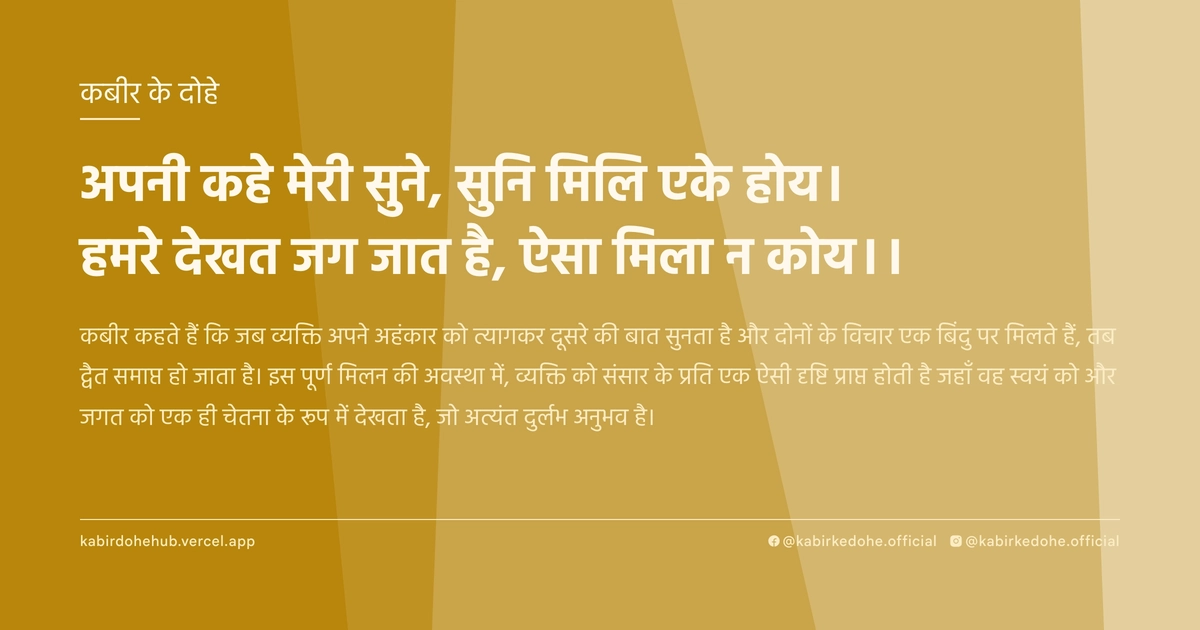
अपनी कहे मेरी सुने, सुनि मिलि एके होय।
हमरे देखत जग जात है, ऐसा मिला न कोय।।
Apni kahe meri sune, suni mili eke hoye. Hamre dekhat jag jaat hai, aisa mila na koye.
इस पृष्ठ पर इस कबीर दोहे का अर्थ (meaning), हिंदी व्याख्या और अंग्रेज़ी अनुवाद, दार्शनिक विश्लेषण और व्यावहारिक जीवन सीख दी गई है। यह दोहा अहंकार (The Ego) विषय से जुड़ा है — Kabir doha meaning and explanation in Hindi and English.
अर्थ (Meaning):
कबीर कहते हैं कि जब व्यक्ति अपने अहंकार को त्यागकर दूसरे की बात सुनता है और दोनों के विचार एक बिंदु पर मिलते हैं, तब द्वैत समाप्त हो जाता है। इस पूर्ण मिलन की अवस्था में, व्यक्ति को संसार के प्रति एक ऐसी दृष्टि प्राप्त होती है जहाँ वह स्वयं को और जगत को एक ही चेतना के रूप में देखता है, जो अत्यंत दुर्लभ अनुभव है।
Kabir suggests that when one transcends the ego to truly listen to another, and two perspectives merge into one, duality vanishes. In this state of complete union, a vision emerges where the observer and the observed world become one single consciousness—a rare spiritual realization where the separation between 'I' and 'Thou' ceases to exist.
व्याख्या (Interpretation):
यह दोहा द्वैत (Duality) से अद्वैत (Non-duality) की यात्रा का वर्णन करता है। 'अपनी कहे मेरी सुने' केवल संवाद नहीं, बल्कि अहंकार का विसर्जन है। जब 'मैं' और 'तू' का भेद मिटता है, तो वह 'एक' (The One) की स्थिति है। यह निर्गुण भक्ति का सार है, जहाँ ईश्वर किसी मूर्ति में नहीं, बल्कि चेतना के मिलन में है। माया हमें अलग-अलग दिखाती है, लेकिन सत्य यह है कि आत्मा और ब्रह्म एक ही हैं। यहाँ 'जग जात है' का अर्थ है कि संसार की मायावी परतें हट जाती हैं और केवल शुद्ध अस्तित्व शेष रहता है। यह विरोधाभास है कि जिसे हम बाहर खोजते हैं, वह वास्तव में आंतरिक मौन और समर्पण में मिलता है।
This couplet describes the journey from Duality (Dvaita) to Non-duality (Advaita). 'Apni kahe meri sune' is not mere conversation, but the dissolution of the ego. When the distinction between 'I' and 'You' vanishes, the state of 'The One' is achieved. This is the essence of Nirgun Bhakti, where the Divine is not found in idols but in the union of consciousness. Maya creates the illusion of separation, but the truth is that Atman and Brahman are identical. The phrase 'jag jaat hai' implies that the illusory veils of the world drop away, leaving only pure existence. It presents the paradox that what we seek externally is actually found in internal silence and absolute surrender.
दार्शनिक विश्लेषण (Philosophical Analysis):
कबीर का यह दृष्टिकोण उनके समय के कट्टरपंथी धार्मिक विभाजनों पर एक प्रहार था। उन्होंने देखा कि लोग धर्म, जाति और संप्रदाय के नाम पर एक-दूसरे से अलग थे। उनका दर्शन सूफीवाद के 'फना' (अहंकार का विनाश) और वेदांत के 'अहं ब्रह्मास्मि' का संगम है। वे ritualism (कर्मकांड) को नकारते हैं क्योंकि कर्मकांड अक्सर व्यक्ति को विशिष्टता का बोध कराते हैं, जो अहंकार को बढ़ाता है।
दार्शनिक स्तर पर, यह दोहा 'शून्य' की अवधारणा को स्पष्ट करता है। जब दो विपरीत विचार एक-दूसरे में विलीन होते हैं, तो जो बचता है वह शून्य है, और वही शून्य पूर्ण है। यह मनोवैज्ञानिक रूपांतरण की प्रक्रिया है जहाँ व्यक्ति अपनी पहचान (Identity) को व्यापक मानवता और फिर ब्रह्मांडीय चेतना में विस्तारित करता है।
अद्वैत वेदांत के अनुसार, अज्ञान (Avidya) ही वह पर्दा है जो हमें अलग दिखाता है। कबीर यहाँ उस पर्दे को हटाने की बात कर रहे हैं। जब हम वास्तव में 'सुनते' हैं, तो हम केवल शब्दों को नहीं, बल्कि दूसरे के भीतर की उसी चेतना को सुनते हैं जो हमारे भीतर है।
सूफी मत में इसे 'इश्क-ए-हकीकी' कहा गया है, जहाँ प्रेमी और प्रियतम एक हो जाते हैं। कबीर इस प्रेम को सामाजिक स्तर पर ले आते हैं, जहाँ संवाद ही साधना बन जाता है।
अंततः, यह दोहा हमें चेतावनी देता है कि आध्यात्मिक सत्य केवल किताबों में नहीं, बल्कि जीवित संबंधों में अहंकार को मिटाने के अभ्यास में है। जो व्यक्ति इस एकता को अनुभव करता है, उसके लिए संसार अब संघर्ष की जगह नहीं, बल्कि प्रतिबिंबों का एक खेल बन जाता है।
Kabir's perspective was a direct strike against the rigid religious divisions of his era. He observed people separated by religion, caste, and sect. His philosophy is a confluence of the Sufi concept of 'Fana' (annihilation of the ego) and the Vedantic 'Aham Brahmasmi' (I am Brahman). He rejects ritualism because rituals often instill a sense of exclusivity, which further inflates the ego.
On a philosophical level, this couplet elucidates the concept of 'Shunya' (Void). When two opposing views merge, what remains is the Void, and that Void is totality. This is a process of psychological transformation where an individual expands their identity from the personal to the collective humanity, and finally to cosmic consciousness.
According to Advaita Vedanta, ignorance (Avidya) is the veil that creates the illusion of separation. Kabir speaks of lifting this veil. When we truly 'listen,' we are not just hearing words, but recognizing the same consciousness in the other that resides within ourselves.
In Sufism, this is referred to as 'Ishq-e-Haqiqi' (Divine Love), where the lover and the Beloved become one. Kabir brings this love to a social dimension, where dialogue itself becomes a spiritual practice (Sadhana).
Ultimately, this couplet warns us that spiritual truth is not found in scriptures, but in the practice of erasing the ego within living relationships. For the one who experiences this unity, the world is no longer a place of conflict, but a play of reflections.
मूल संदेश (Core Message):
- अहंकार का विसर्जन ही वास्तविक संवाद की शुरुआत है।
- जब 'मैं' मिटता है, तब 'हम' का सत्य प्रकट होता है।
- सुनना केवल कान का कार्य नहीं, बल्कि आत्मा का समर्पण है।
- द्वैत एक भ्रम है; एकता ही एकमात्र शाश्वत सत्य है।
- सत्य किसी एक मत में नहीं, बल्कि दो मतों के मिलन में है।
- The dissolution of ego is the beginning of true dialogue.
- When the 'I' vanishes, the truth of 'We' is revealed.
- Listening is not an act of the ear, but a surrender of the soul.
- Duality is an illusion; unity is the only eternal truth.
- Truth lies not in a single opinion, but in the union of perspectives.
व्यावहारिक उदाहरण (Practical Example):
एक समय की बात है, वाराणसी के घाटों पर एक वृद्ध विधवा, जानकी रहती थी। वह अत्यंत रूढ़िवादी थी और मानती थी कि केवल उसके तरीके की पूजा ही सही है। वह हर उस व्यक्ति को तुच्छ समझती थी जो अलग परंपरा का पालन करता था।
उसी घाट पर एक युवा नाविक, माधव आता था, जो अलग प्रांत का था और जिसकी भाषा और रीति-रिवाज जानकी से बिल्कुल भिन्न थे। दोनों के बीच वर्षों तक केवल कड़वाहट और मौन रहा।
एक दिन भीषण बाढ़ आई। जानकी का छोटा सा घर पानी में डूबने लगा। माधव ने बिना सोचे अपनी नाव उसकी ओर मोड़ी और उसे बचाया। जानकी ने पहली बार माधव की आँखों में वही डर और वही करुणा देखी जो वह स्वयं महसूस करती थी।
अगले कुछ दिनों तक, जब वे एक ही शरणस्थली में रहे, जानकी ने माधव की कहानियाँ सुनीं—उसके संघर्ष, उसके परिवार का प्रेम और उसकी अपनी आस्था। उसने महसूस किया कि माधव के शब्द उसके अपने जीवन के दुखों की प्रतिध्वनि थे।
जानकी ने अपनी जिद छोड़ी और माधव की बात को केवल सुना नहीं, बल्कि उसे अपने भीतर महसूस किया। उसने पाया कि जिसे वह 'विदेशी' या 'अशुद्ध' समझती थी, वह वास्तव में उसी ईश्वर का अंश था जिसे वह मंदिर में खोजती थी।
इस मिलन ने जानकी के भीतर के अहंकार को तोड़ दिया। अब वह केवल अपनी पूजा नहीं करती थी, बल्कि माधव के साथ बैठकर जीवन के सत्य पर चर्चा करती थी।
एक दिन जब एक अन्य श्रद्धालु ने उनसे उनकी भिन्नताओं के बारे में पूछा, तो जानकी मुस्कुराई और कहा, 'अब मुझे कोई भिन्नता नहीं दिखती, केवल एक ही प्राण है जो अलग-अलग शरीरों में सांस ले रहा है।'
यह 'कबीर ट्विस्ट' था—जहाँ एक बाहरी आपदा ने आंतरिक द्वैत को समाप्त कर दिया। जानकी अब केवल एक विधवा नहीं थी, बल्कि एक मुक्त आत्मा बन गई थी जिसने मानवता के अद्वैत को पहचान लिया था।
Once, on the ghats of Varanasi, lived an elderly widow named Janaki. She was deeply orthodox and believed that only her specific way of worship was correct. She looked down upon anyone who followed a different tradition.
On the same ghat worked a young boatman, Madhav, who hailed from a different province; his language and customs were entirely foreign to Janaki.
For years, their relationship was defined by bitterness and a cold, heavy silence.
One day, a devastating flood struck. Janaki's small hut began to submerge. Without a second thought, Madhav steered his boat toward her and rescued her from the rising waters.
For the first time, Janaki saw in Madhav's eyes the same fear and the same compassion that she felt within herself.
Over the next few days, while staying in a shared shelter, Janaki listened to Madhav's stories—his struggles, the love for his family, and his own faith.
She realized that Madhav's words were echoes of her own life's sorrows. She stopped insisting on her own correctness and truly listened to him, feeling his essence within her.
She discovered that the person she had labeled as 'foreign' or 'impure' was actually a fragment of the same Divine she sought in the temple.
This union shattered Janaki's ego. She no longer practiced her worship in isolation but sat with Madhav, discussing the truths of existence.
When another devotee asked them about their differences, Janaki smiled and said, 'I no longer see any difference; there is only one breath breathing through different bodies.'
This was the 'Kabir Twist'—where an external disaster dissolved internal duality. Janaki was no longer just a widow; she became a liberated soul who recognized the non-duality of humanity.
अभ्यास मार्गदर्शन (Practice Guidance):
- सक्रिय श्रवण (Active Listening): प्रतिदिन कम से कम 15 मिनट किसी ऐसे व्यक्ति की बात सुनें जिससे आप असहमत हैं, बिना किसी निर्णय या प्रतिक्रिया के।
- अहंकार का अवलोकन: जब भी आप 'मैं सही हूँ' महसूस करें, रुकें और पूछें, 'यह 'मैं' कौन है जो सही होने का दावा कर रहा है?'
- मौन चिंतन: प्रतिदिन 10 मिनट इस भाव से बैठें कि आपके और सामने वाले के बीच की सीमा एक भ्रम है।
- डायग्नोस्टिक चेकलिस्ट: क्या मैं दूसरों की बातों को केवल जवाब देने के लिए सुनता हूँ? क्या मैं अपनी पहचान को अपनी मान्यताओं से अलग देख पा रहा हूँ? क्या मैं दूसरों में अपना ही प्रतिबिंब देख पा रहा हूँ?
- Active Listening: Spend at least 15 minutes daily listening to someone you disagree with, without judgment or the intent to react.
- Ego Observation: Whenever you feel 'I am right,' pause and ask, 'Who is this "I" that is claiming to be right?'
- Silent Contemplation: Sit for 10 minutes daily with the feeling that the boundary between you and the other is a mere illusion.
- Diagnostic Checklist: Do I listen to others only to formulate a response? Can I see my identity as separate from my beliefs? Do I recognize my own reflection in others?
चिंतन प्रश्न (Reflection Questions):
- मेरी कौन सी मान्यताएं मुझे दूसरों से अलग करती हैं और क्या वे वास्तव में मेरी अपनी हैं या समाज द्वारा दी गई हैं?
- जब मैं किसी से बहस करता हूँ, तो क्या मैं सत्य की खोज कर रहा हूँ या केवल अपनी श्रेष्ठता सिद्ध करना चाहता हूँ?
- क्या मैं अपनी डिजिटल पहचान (Social Media Ego) के पीछे छिपे उस अकेलेपन को देख पा रहा हूँ जो मुझे दूसरों से जोड़ सकता है?
- यदि मेरी सारी उपलब्धियां और पद छीन लिए जाएं, तो क्या मैं अभी भी किसी अजनबी के साथ एकरूप महसूस कर पाऊंगा?
- मेरे जीवन का वह कौन सा हिस्सा है जहाँ मैं अभी भी 'मेरी' और 'तेरी' के बीच संघर्ष कर रहा हूँ?
- Which of my beliefs separate me from others, and are they truly mine or imposed by society?
- When I argue, am I searching for truth or merely trying to prove my superiority?
- Can I see the loneliness hidden behind my digital identity (Social Media Ego) that could actually connect me to others?
- If all my achievements and titles were stripped away, would I still feel a sense of oneness with a stranger?
- In which part of my life am I still struggling with the divide between 'mine' and 'thine'?