
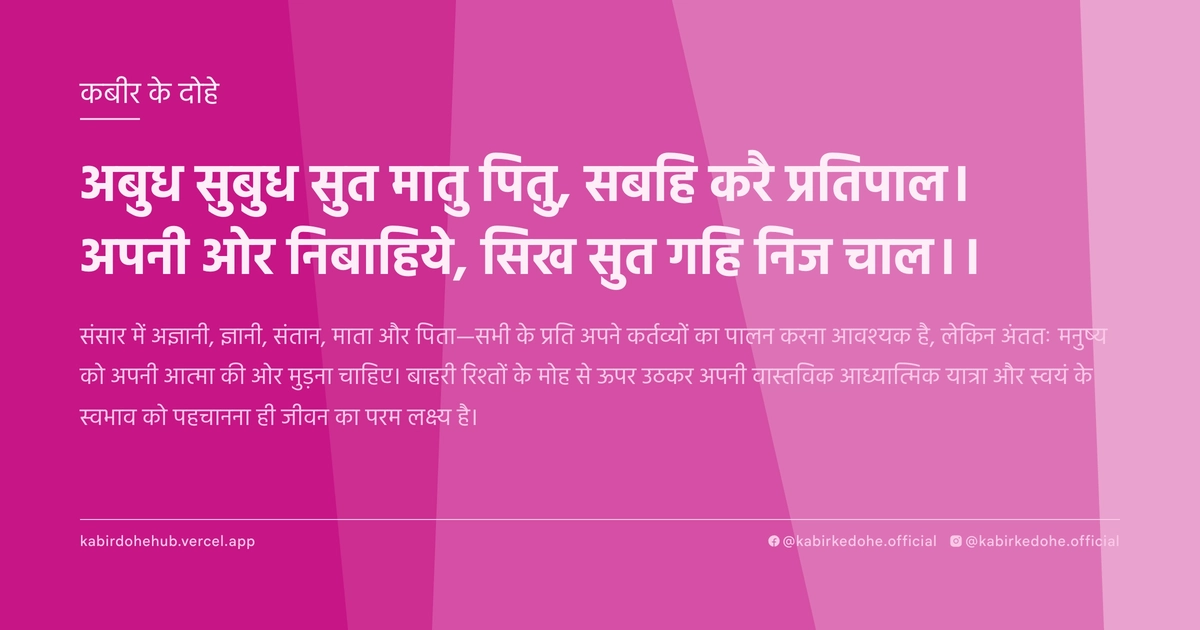
अबुध सुबुध सुत मातु पितु, सबहि करै प्रतिपाल।
अपनी ओर निबाहिये, सिख सुत गहि निज चाल।।
Abudh subudh sut maatu pitu, sabhi karai pratipal. Apni or nibahiye, sikh sut gahi nij chaal.
इस पृष्ठ पर इस कबीर दोहे का अर्थ (meaning), हिंदी व्याख्या और अंग्रेज़ी अनुवाद, दार्शनिक विश्लेषण और व्यावहारिक जीवन सीख दी गई है। यह दोहा सहज योग (Sahaja Yoga) विषय से जुड़ा है — Kabir doha meaning and explanation in Hindi and English.
अर्थ (Meaning):
संसार में अज्ञानी, ज्ञानी, संतान, माता और पिता—सभी के प्रति अपने कर्तव्यों का पालन करना आवश्यक है, लेकिन अंततः मनुष्य को अपनी आत्मा की ओर मुड़ना चाहिए। बाहरी रिश्तों के मोह से ऊपर उठकर अपनी वास्तविक आध्यात्मिक यात्रा और स्वयं के स्वभाव को पहचानना ही जीवन का परम लक्ष्य है।
In this world, one must fulfill their duties toward the ignorant, the wise, children, mothers, and fathers. However, ultimately, one must turn inward toward their own soul. The true purpose of life is to transcend the attachments of external relationships and recognize one's own authentic spiritual nature.
व्याख्या (Interpretation):
यह दोहा सामाजिक उत्तरदायित्व और व्यक्तिगत मोक्ष के बीच के सूक्ष्म संतुलन को दर्शाता है। 'अबुध' और 'सुबुध' का उल्लेख यह बताता है कि जीवन में हर प्रकार के व्यक्ति का सामना होता है। कबीर कहते हैं कि संसारिक रिश्तों का निर्वाह करना अधर्म नहीं है, परंतु इनमें पूरी तरह डूब जाना 'माया' का जाल है। जब वह कहते हैं 'अपनी ओर निबाहिये', तो वे आत्मा (Atman) के साथ एकाकार होने का संकेत देते हैं। यह निर्गुण भक्ति का सार है, जहाँ ईश्वर किसी बाहरी मूर्ति में नहीं, बल्कि स्वयं के भीतर खोजा जाता है। यहाँ 'निज चाल' का अर्थ है वह मार्ग जो अहंकार को मिटाकर ब्रह्म के साथ अद्वैत स्थिति प्राप्त कराता है। यह विरोधाभास है कि समाज में रहते हुए भी समाज से विरक्त रहना ही वास्तविक मुक्ति है।
This couplet illustrates the delicate balance between social responsibility and individual liberation. The mention of 'Abudh' (ignorant) and 'Subudh' (wise) suggests that one encounters all types of temperaments in life. Kabir asserts that fulfilling worldly obligations is not wrong, but becoming entirely consumed by them is the trap of 'Maya' (illusion). When he says 'turn toward yourself,' he signals the unification with the Atman. This is the essence of Nirgun Bhakti, where the Divine is sought not in external idols, but within. 'Nij chaal' refers to the path that annihilates the ego to achieve the non-dual state of Brahman. It is the central paradox: to live in the world while remaining detached from it is the only true liberation.
दार्शनिक विश्लेषण (Philosophical Analysis):
कबीर का यह दृष्टिकोण उनके युग के कट्टरपंथी धार्मिक और सामाजिक ढांचे के विरुद्ध एक विद्रोह था। उस समय धर्म को केवल कर्मकांडों और जातिगत शुद्धता से जोड़ा जाता था। कबीर ने इस दोहे के माध्यम से यह स्पष्ट किया कि आध्यात्मिक उन्नति किसी विशेष जाति या पारिवारिक स्थिति की मोहताज नहीं है। वे अद्वैत वेदांत के इस सिद्धांत को पुष्ट करते हैं कि आत्मा और परमात्मा एक ही हैं, और बाहरी दुनिया केवल एक प्रतिबिंब है।
सूफी मत के 'फना' (अहंकार का विनाश) और भक्ति मार्ग के 'शरणागति' का यहाँ सुंदर संगम है। कबीर तर्क देते हैं कि यदि हम केवल पारिवारिक संबंधों में उलझे रहे, तो हम कभी उस सार्वभौमिक प्रेम को नहीं पहचान पाएंगे जो सभी जीवों में समान है। यह 'सांसारिक धर्म' और 'परम धर्म' के बीच का अंतर है।
मनोवैज्ञानिक स्तर पर, यह दोहा 'पहचान के संकट' को संबोधित करता है। हम अक्सर अपनी पहचान अपनी भूमिकाओं (पिता, पुत्र, शिक्षक) से जोड़ लेते हैं। कबीर चेतावनी देते हैं कि ये भूमिकाएं अस्थायी हैं। वास्तविक पहचान वह है जो इन सभी सामाजिक मुखौटों के पीछे छिपी है।
अनुष्ठानों के प्रति उनकी अस्वीकृति यहाँ स्पष्ट है। उनके लिए सबसे बड़ा अनुष्ठान 'स्वयं को जानना' है। वे कहते हैं कि मंदिर या मस्जिद जाने से पहले व्यक्ति को अपने भीतर के मंदिर में प्रवेश करना चाहिए।
अंततः, यह शिक्षण हमें सिखाता है कि करुणा और कर्तव्य का पालन करना आवश्यक है, लेकिन इसे आसक्ति (attachment) में नहीं बदलना चाहिए। जब कर्तव्य बिना फल की इच्छा और बिना अहंकार के किया जाता है, तो वह स्वयं में एक साधना बन जाता है।
Kabir's perspective here is a rebellion against the rigid religious and social structures of his era. At that time, religion was tied strictly to rituals and caste purity. Through this doha, Kabir clarifies that spiritual evolution is not dependent on a specific caste or family status. He reinforces the Advaita Vedanta principle that the Atman and Brahman are one, and the external world is merely a reflection.
There is a beautiful convergence here of the Sufi concept of 'Fana' (annihilation of the ego) and the Bhakti path of 'Sharanagati' (surrender). Kabir argues that if we remain entangled only in familial bonds, we will never recognize the universal love that resides equally in all beings. This is the distinction between 'worldly dharma' and 'supreme dharma.'
On a psychological level, this couplet addresses the 'crisis of identity.' We often define ourselves by our roles—father, son, teacher. Kabir warns that these roles are transient. The true identity is that which remains hidden behind all these social masks.
His rejection of ritualism is evident. For him, the greatest ritual is 'knowing oneself.' He suggests that before visiting a temple or mosque, one must enter the temple within.
Ultimately, this teaching instructs us that while compassion and duty are essential, they must not transform into attachment. When duty is performed without desire for reward or ego, the act itself becomes a spiritual practice.
मूल संदेश (Core Message):
- सामाजिक कर्तव्य अनिवार्य हैं, लेकिन वे अंतिम गंतव्य नहीं हैं।
- बाहरी रिश्तों का मोह आत्मा की वास्तविक पहचान को धुंधला कर देता है।
- सच्ची भक्ति स्वयं के भीतर के ईश्वर को पहचानने में है।
- अहंकार का विसर्जन ही 'निज चाल' या सही मार्ग की शुरुआत है।
- संसार में रहें, पर संसार को अपने भीतर न बसने दें।
- Social duties are mandatory, but they are not the final destination.
- Attachment to external relationships blurs the true identity of the soul.
- True devotion lies in recognizing the Divine within oneself.
- The dissolution of ego is the beginning of the 'Nij Chaal' or the true path.
- Live in the world, but do not let the world live inside you.
व्यावहारिक उदाहरण (Practical Example):
एक समय की बात है, वाराणसी के घाटों पर रहने वाला एक वृद्ध बुनकर था, जिसका नाम माधव था। माधव अपनी पूरी जिंदगी अपने परिवार की जरूरतों को पूरा करने में लगा रहा। उसने अपने बच्चों को पढ़ाया, अपनी पत्नी की सेवा की और समाज के हर छोटे-बड़े काम में हाथ बंटाया। वह एक 'सुबुध' व्यक्ति माना जाता था क्योंकि वह सबकी मदद करता था।
लेकिन जैसे-जैसे उम्र बढ़ी, माधव को एक अजीब सी बेचैनी महसूस होने लगी। उसे लगा कि उसने सबके लिए सब कुछ किया, लेकिन वह खुद को नहीं जानता। वह अपनी पहचान केवल 'पिता' और 'बुनकर' के रूप में देखता था। जब उसके बच्चे बड़े होकर अपने कामों में व्यस्त हो गए, तो माधव को गहरा अकेलापन महसूस हुआ। उसे लगा कि उसकी दुनिया उजड़ गई है क्योंकि उसकी पहचान दूसरों पर टिकी थी।
एक दिन वह एक फकीर के पास गया और अपनी व्यथा सुनाई। फकीर ने उसे कबीर का यही दोहा सुनाया। माधव को समझ आया कि उसने 'प्रतिपाल' (पालन-पोषण) तो किया, लेकिन 'अपनी ओर निबाहिये' (स्वयं के साथ संबंध) को पूरी तरह भुला दिया था।
माधव ने अब अपनी दिनचर्या बदली। वह सुबह उठकर घाट पर बैठता, लेकिन अब वह केवल लोगों की बातें सुनने के लिए नहीं, बल्कि अपने भीतर की शांति को सुनने के लिए बैठता। उसने महसूस किया कि वह केवल एक पिता या बुनकर नहीं है, बल्कि वह उस अनंत चेतना का हिस्सा है जो सबके भीतर है।
उसने अपने परिवार से प्रेम करना नहीं छोड़ा, लेकिन अब वह प्रेम 'मोह' नहीं था। जब उसका बेटा किसी बात पर क्रोध करता, तो माधव विचलित नहीं होता था। वह जानता था कि क्रोध बेटे का है, उसका नहीं।
उसने अपने करघे पर कपड़े बुनते समय भी ध्यान लगाना शुरू किया। हर धागा उसे जीवन के अंतर्संबंधों की याद दिलाता, लेकिन वह जानता था कि वह धागा नहीं, बल्कि वह बुनकर है जो इस मायाजाल को देख रहा है।
धीरे-धीरे माधव के चेहरे पर एक ऐसी चमक आ गई जो पहले कभी नहीं थी। लोग उसके पास सलाह लेने आने लगे, लेकिन अब वह उन्हें केवल सामाजिक नियम नहीं बताता था, बल्कि उन्हें स्वयं के भीतर झांकने के लिए प्रेरित करता था।
उसकी मृत्यु के समय, उसके परिवार में शोक तो था, लेकिन माधव के चेहरे पर एक गहरी मुस्कान थी। उसने अपनी 'निज चाल' पा ली थी। वह अब केवल एक व्यक्ति नहीं, बल्कि एक मुक्त आत्मा बन चुका था जिसने संसार और स्वयं के बीच का संतुलन पा लिया था।
Once, there lived an elderly weaver named Madhav on the ghats of Varanasi. Madhav spent his entire life fulfilling the needs of his family. He educated his children, served his wife, and helped everyone in the community. He was considered a 'Subudh' (wise) man because of his helpful nature.
However, as he aged, Madhav began to feel a strange restlessness. He felt that while he had done everything for everyone, he did not know himself. He viewed his identity solely as a 'father' and a 'weaver.' When his children grew up and became busy with their own lives, Madhav felt a profound loneliness. He felt his world had crumbled because his identity was anchored in others.
One day, he approached a wandering fakir and shared his grief. The fakir recited this specific doha of Kabir. Madhav realized that while he had performed 'Pratipal' (nurturing others), he had completely forgotten to 'Nibahiye' (maintain a relationship) with his own soul.
Madhav changed his routine. He began sitting on the ghats every morning, not to listen to the gossip of people, but to listen to the silence within. He realized he was not just a father or a weaver, but a part of the infinite consciousness that resides in all.
He did not stop loving his family, but that love was no longer 'Moh' (attachment). When his son would get angry, Madhav remained undisturbed. He knew the anger belonged to the son, not to him.
He began practicing mindfulness while weaving on his loom. Every thread reminded him of the interconnections of life, yet he knew he was not the thread, but the weaver observing this web of Maya.
Gradually, a glow appeared on Madhav's face that was never there before. People began coming to him for advice, but he no longer gave them mere social rules; he inspired them to look within themselves.
At the time of his passing, there was grief in his family, but a deep smile remained on Madhav's face. He had found his 'Nij Chaal' (own path). He was no longer just a man, but a liberated soul who had found the balance between the world and the self.
अभ्यास मार्गदर्शन (Practice Guidance):
- दैनिक चिंतन: प्रतिदिन 20 मिनट मौन बैठें और स्वयं से पूछें, 'इन सभी भूमिकाओं (पुत्र, पिता, कर्मचारी) के बिना मैं कौन हूँ?'
- जर्नलिंग: एक डायरी लिखें जिसमें आप उन क्षणों को दर्ज करें जब आपने कर्तव्य पालन के दौरान अहंकार या मोह महसूस किया। विश्लेषण करें कि वह भावना कहाँ से आई।
- व्यवहार परिवर्तन: जब आप किसी की मदद करें, तो सचेत रहें कि आप उसे 'अहसान' के रूप में नहीं, बल्कि एक सार्वभौमिक कर्तव्य के रूप में कर रहे हैं।
- निदान चेकलिस्ट: क्या आप दूसरों की प्रतिक्रियाओं से अत्यधिक प्रभावित होते हैं? क्या आपकी खुशी केवल परिवार की संतुष्टि पर निर्भर है? यदि हाँ, तो आप 'अपनी ओर' निबाहने में विफल हो रहे हैं।
- Daily Contemplation: Sit in silence for 20 minutes daily and ask yourself, 'Who am I beyond all these roles (son, father, employee)?'
- Journaling: Keep a diary recording moments where you felt ego or attachment while performing a duty. Analyze the source of that emotion.
- Behavioral Change: When helping someone, consciously ensure you are doing it as a universal duty, not as a favor that creates a psychological debt.
- Diagnostic Checklist: Are you overly affected by others' reactions? Is your happiness solely dependent on family satisfaction? If yes, you are failing to 'maintain the relationship' with your own self.
चिंतन प्रश्न (Reflection Questions):
- यदि आपसे आपकी सभी सामाजिक और पारिवारिक पहचान छीन ली जाएं, तो क्या आपके पास कोई मूल्य बचेगा?
- क्या आपका 'दूसरों की देखभाल' करने का स्वभाव वास्तव में करुणा है, या यह आपकी अपनी श्रेष्ठता सिद्ध करने का एक तरीका है?
- आप अपनी डिजिटल पहचान (सोशल मीडिया) को बनाए रखने के लिए अपनी आंतरिक शांति का कितना त्याग करते हैं?
- क्या आप वास्तव में अपने प्रियजनों से प्रेम करते हैं, या आप उस छवि से प्रेम करते हैं जो वे आपके बारे में रखते हैं?
- आपके जीवन का वह कौन सा 'कर्तव्य' है जो वास्तव में एक बोझ बन गया है क्योंकि उसमें आत्मा का अभाव है?
- If all your social and familial identities were stripped away, would anything of value remain?
- Is your nature of 'caring for others' truly compassion, or is it a way to prove your own superiority?
- How much of your inner peace do you sacrifice to maintain your digital identity (social media)?
- Do you truly love your loved ones, or do you love the image they hold of you?
- Which 'duty' in your life has actually become a burden because it lacks the presence of the soul?