
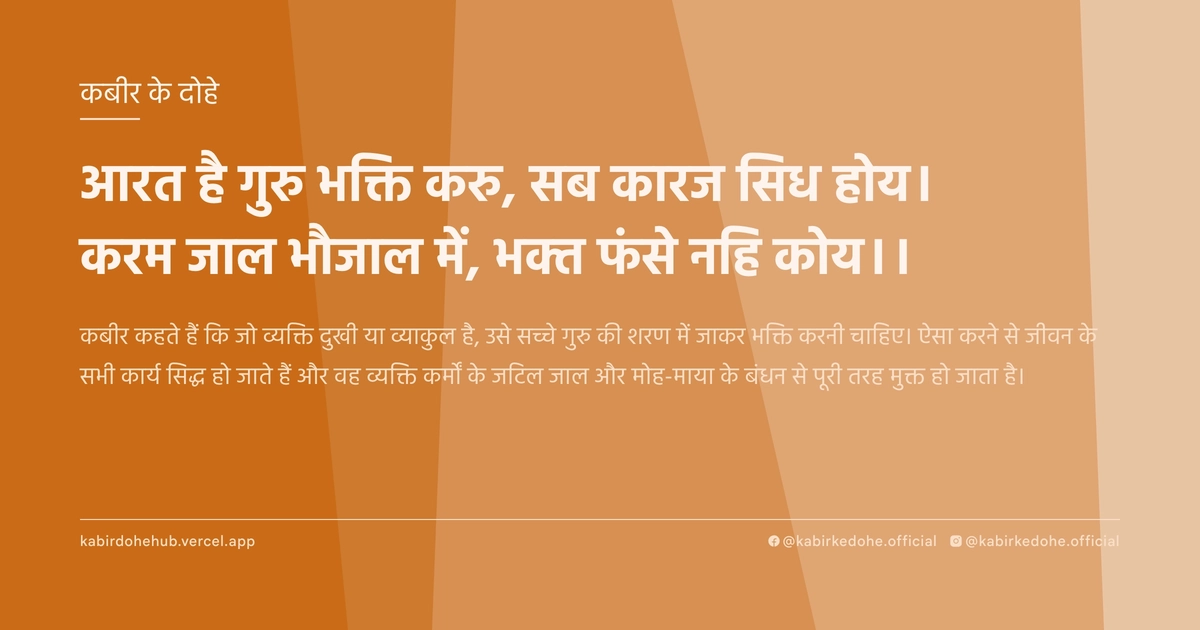
आरत है गुरु भक्ति करु, सब कारज सिध होय।
करम जाल भौजाल में, भक्त फंसे नहि कोय।।
Aarat hai guru bhakti karu, sab kaaraj sidh hoye. Karam jaal bhojaal mein, bhakt phanse nahi koy.
इस पृष्ठ पर इस कबीर दोहे का अर्थ (meaning), हिंदी व्याख्या और अंग्रेज़ी अनुवाद, दार्शनिक विश्लेषण और व्यावहारिक जीवन सीख दी गई है। यह दोहा गुरु महत्व (The Guru's Importance) विषय से जुड़ा है — Kabir doha meaning and explanation in Hindi and English.
अर्थ (Meaning):
कबीर कहते हैं कि जो व्यक्ति दुखी या व्याकुल है, उसे सच्चे गुरु की शरण में जाकर भक्ति करनी चाहिए। ऐसा करने से जीवन के सभी कार्य सिद्ध हो जाते हैं और वह व्यक्ति कर्मों के जटिल जाल और मोह-माया के बंधन से पूरी तरह मुक्त हो जाता है।
Kabir suggests that those in distress or spiritual longing should seek the guidance of a true Guru and immerse themselves in devotion. By doing so, all worldly and spiritual endeavors reach fruition, and the devotee is liberated from the intricate web of karma and the illusions of worldly attachment.
व्याख्या (Interpretation):
यहाँ 'आरत' का अर्थ केवल भौतिक दुख नहीं, बल्कि आत्मा की वह तड़प है जो परमात्मा के लिए होती है। गुरु वह माध्यम है जो अज्ञान के अंधकार को मिटाकर साधक को आत्म-साक्षात्कार कराता है। 'करम जाल' उस चक्र को दर्शाता है जहाँ मनुष्य अपने पिछले कर्मों और इच्छाओं के कारण बार-बार जन्म और मृत्यु के बंधन में बंधता है। जब साधक गुरु की कृपा से निरगुण ब्रह्म (निराकार ईश्वर) को पहचान लेता है, तो वह द्वैत से अद्वैत की ओर बढ़ता है। यह स्थिति वह है जहाँ 'मैं' और 'मेरा' समाप्त हो जाता है और केवल शुद्ध चेतना शेष रहती है। इस प्रकार, भक्ति केवल पूजा नहीं, बल्कि अहंकार का विसर्जन है। अंततः, भक्त वह है जिसने माया के खेल को समझ लिया है और अब वह उसके प्रभाव से मुक्त है।
The term 'Aarat' refers not merely to physical suffering, but to the profound existential longing of the soul for the Divine. The Guru serves as the catalyst who dissolves the veil of ignorance, leading the seeker toward self-realization. The 'Karam Jaal' (web of karma) symbolizes the cyclical trap of birth and death, fueled by unfulfilled desires and egoic attachments. Through the Guru's grace, the seeker transitions from duality to the non-dual state of Advaita, recognizing the formless Nirgun Brahman. This process is not about ritualistic worship but the systematic annihilation of the 'I' (ego). The paradox lies in the fact that only by surrendering the individual will can one attain the universal will. Ultimately, the devotee is one who has seen through the illusion of Maya and emerged untouched by its entanglements.
दार्शनिक विश्लेषण (Philosophical Analysis):
कबीर का यह दोहा मध्यकालीन भारत के उस सामाजिक परिवेश में लिखा गया जहाँ धर्म केवल कर्मकांडों और बाहरी दिखावे तक सीमित था। कबीर ने पुरोहितवाद और जाति व्यवस्था का कड़ा विरोध किया, क्योंकि उनका मानना था कि ईश्वर किसी विशेष वर्ग या मंदिर की संपत्ति नहीं है। उन्होंने 'गुरु' को किसी व्यक्ति के रूप में नहीं, बल्कि उस ज्ञान के रूप में परिभाषित किया जो आत्मा को परमात्मा से जोड़ता है। यह विचार सूफी मत के 'पीर' और वेदांत के 'गुरु' के समान है, जहाँ आंतरिक मार्गदर्शन बाहरी अनुष्ठानों से अधिक महत्वपूर्ण है।
दार्शनिक स्तर पर, यह दोहा 'कर्म' के सिद्धांत की व्याख्या करता है। हिंदू दर्शन के अनुसार, मनुष्य अपने कर्मों के फल भोगने के लिए विवश है, लेकिन कबीर यहाँ 'भक्ति' को एक ऐसे मार्ग के रूप में प्रस्तुत करते हैं जो इस नियति को बदल सकता है। यह 'प्रारब्ध' से ऊपर उठकर 'पुरुषार्थ' और 'कृपा' के मिलन की बात है। जब साधक अपनी पहचान को शरीर से हटाकर शुद्ध आत्मा (Atman) में स्थापित करता है, तो कर्मों का बंधन स्वतः समाप्त हो जाता है।
यहाँ सूफीवाद का प्रभाव स्पष्ट है, जहाँ 'फना' (अहंकार का विनाश) के माध्यम से ही 'बका' (ईश्वर में शाश्वत अस्तित्व) प्राप्त होता है। कबीर कहते हैं कि जब तक मनुष्य स्वयं को कर्ता मानता है, वह कर्म जाल में फंसा रहेगा। जैसे ही वह यह अनुभव करता है कि सब कुछ उस एक निराकार सत्ता द्वारा संचालित है, वह मुक्त हो जाता है।
यह दोहा इस गलतफहमी को दूर करता है कि भक्ति केवल पलायन है। वास्तव में, यह एक मनोवैज्ञानिक रूपांतरण है। यह व्यक्ति को बाहरी दुनिया की अराजकता से हटाकर आंतरिक शांति की ओर ले जाता है। यह 'माया' के प्रभाव को कम करने की एक विधि है, जहाँ संसार को नकारा नहीं जाता, बल्कि उसकी वास्तविकता को समझा जाता है।
अंततः, कबीर का संदेश यह है कि मुक्ति किसी बाहरी तीर्थ या कठिन तपस्या से नहीं, बल्कि सही मार्गदर्शन (गुरु) और पूर्ण समर्पण (भक्ति) से संभव है। यह मार्ग सरल है लेकिन कठिन, क्योंकि इसमें सबसे बड़ी बाधा मनुष्य का अपना अहंकार है।
This couplet was composed during a period of intense religious rigidity in medieval India, where spirituality had been reduced to hollow rituals and caste-based exclusions. Kabir vehemently rejected the priestly hegemony, asserting that the Divine is not the property of a specific caste or temple. He defines the 'Guru' not merely as a human instructor, but as the embodiment of the primordial knowledge that bridges the gap between the individual soul and the Universal Consciousness. This aligns with the Sufi concept of the 'Pir' and the Vedantic tradition of the spiritual guide, prioritizing internal awakening over external piety.
Philosophically, the verse addresses the law of Karma. While classical Indian philosophy suggests that one must exhaust their karmic debts, Kabir proposes 'Bhakti' (devotion) as a transformative alchemy that can dissolve these bonds. It is a shift from 'Prarabdha' (destiny) to a state of grace and conscious effort. When the seeker shifts their identity from the transient body to the eternal Atman, the causal chain of karma is broken, as there is no longer an 'ego' to claim the fruits of action.
There is a strong resonance with the Sufi doctrine of 'Fana' (annihilation of the self). Kabir suggests that as long as a person perceives themselves as the 'doer' (Karta), they remain entangled in the web. Liberation occurs only when the individual realizes that the entire cosmic play is orchestrated by the one Formless Reality (Nirgun Brahman). The 'web' is not the world itself, but the attachment to the world.
This teaching corrects the common misconception that devotion is a form of escapism. On the contrary, it is a rigorous psychological restructuring. It moves the practitioner from a state of fragmentation to wholeness. By understanding the nature of 'Maya' (illusion), the seeker learns to live in the world without being of the world, transforming their relationship with existence from one of struggle to one of flow.
Ultimately, Kabir posits that liberation is not achieved through pilgrimage or ascetic torture, but through the synergy of right guidance and total surrender. The path is deceptively simple yet profoundly difficult, for the primary obstacle is the very ego that seeks liberation. The 'Guru' is the mirror that reflects this ego back to the seeker, allowing it to be dissolved in the fire of devotion.
मूल संदेश (Core Message):
- दुख केवल एक संकेत है कि आप अपनी वास्तविक पहचान भूल चुके हैं।
- सच्चा गुरु वह है जो आपको आपके अपने भीतर के ईश्वर से मिला दे।
- कर्मों का बंधन केवल तब तक है जब तक 'मैं' का भाव जीवित है।
- समर्पण ही वह एकमात्र कुंजी है जो माया के ताले खोल सकती है।
- मुक्ति बाहरी दुनिया में नहीं, बल्कि आंतरिक बोध में निहित है।
- Suffering is merely a signal that you have forgotten your true identity.
- A true Guru is one who mirrors the Divine already residing within you.
- The bonds of karma exist only as long as the illusion of the 'I' persists.
- Total surrender is the only key capable of unlocking the gates of Maya.
- Liberation is not a destination in the world, but a realization of the Self.
व्यावहारिक उदाहरण (Practical Example):
एक समय की बात है, बनारस के घाटों पर रहने वाली एक वृद्ध विधवा, जानकी, का जीवन केवल शोक और अकेलेपन से भरा था। वह प्रतिदिन घंटों मंदिर में समय बिताती, लेकिन उसके मन में अपने बेटे के प्रति गहरा क्रोध और समाज के प्रति कड़वाहट थी। वह मानती थी कि उसका दुख उसके पिछले जन्मों के पापों का फल है और वह इस 'कर्म जाल' में फंसी हुई है।
एक दिन उसकी मुलाकात एक साधारण से दिखने वाले साधु से हुई, जो घाट की सीढ़ियों पर चुपचाप बैठे थे। जानकी ने उनसे अपनी पीड़ा साझा की और पूछा कि वह इस दुख से कैसे मुक्त हो सकती है। साधु ने उसे कोई मंत्र नहीं दिया, बल्कि केवल इतना कहा, 'तुम जिसे अपना दुख कह रही हो, वह तुम्हारी अपनी पहचान का मोह है। जिस दिन तुम यह जान लोगी कि तुम केवल एक शरीर नहीं, बल्कि उस अनंत चेतना का हिस्सा हो, तुम्हारा बोझ उतर जाएगा।'
जानकी को पहले तो यह बात समझ नहीं आई, लेकिन उसने साधु के शब्दों पर विचार करना शुरू किया। उसने महसूस किया कि वह अपने 'दुखी होने' की पहचान से इतनी प्यार करने लगी थी कि उसने उसे अपनी आत्मा मान लिया था। वह अपनी पीड़ा को ढो रही थी क्योंकि वह उसे अपनी एकमात्र सच्चाई मानती थी।
धीरे-धीरे, उसने बाहरी अनुष्ठानों के बजाय अपने भीतर के मौन को खोजना शुरू किया। उसने यह अभ्यास किया कि जब भी क्रोध या दुख आए, वह खुद से पूछे, 'यह दुख किसे हो रहा है? क्या मैं यह शरीर हूँ या वह जो इस दुख को देख रहा है?'
इस आत्म-पूछताछ ने उसके भीतर एक बदलाव लाया। उसने पाया कि जब वह खुद को केवल एक 'विधवा' या 'दुखी माँ' के रूप में देखना बंद करती है, तो वह सबके प्रति करुणा महसूस करने लगती है। उसने अपने मोह का त्याग किया और मोह की जगह प्रेम ने ले ली।
एक दिन, उसने अपने उस बेटे को क्षमा कर दिया जिसने उसे वर्षों पहले छोड़ दिया था। यह क्षमा किसी बाहरी दबाव में नहीं, बल्कि इस बोध से आई कि न तो वह अलग थी और न ही उसका बेटा। वे दोनों एक ही चेतना के दो रूप थे।
उसका जीवन अब मंदिर की भीड़ में नहीं, बल्कि अपने भीतर के एकांत में बीतने लगा। वह अब भी घाटों पर जाती थी, लेकिन अब वह प्रार्थना करने नहीं, बल्कि दूसरों के दुख को समझने और उन्हें सांत्वना देने जाती थी।
जानकी का रूपांतरण इस बात का प्रमाण था कि जब गुरु का ज्ञान (बोध) जीवन में उतरता है, तो कर्मों का वह जाल, जो उसे जकड़े हुए था, तिनके की तरह टूट गया। वह अब 'आरत' नहीं थी, बल्कि आनंदमय थी।
In the ancient lanes of Varanasi, there lived an elderly widow named Janaki. Her life was a tapestry of grief and isolation. She spent hours every day at the temples, yet her heart was heavy with a simmering rage toward her estranged son and a deep bitterness toward a society that had marginalized her. She believed her suffering was an inescapable karmic debt, a 'web' she was destined to endure.
One afternoon, she encountered a humble seeker sitting silently on the stone steps of the ghats. Overwhelmed by her sorrow, Janaki asked him how she could find liberation from her misery. The seeker did not offer her a ritual or a mantra; instead, he said, 'The grief you cling to is actually your attachment to a specific identity. The moment you realize you are not this suffering body, but a spark of the Infinite Consciousness, your burden will vanish.'
Initially, Janaki found these words abstract. However, she began to contemplate them deeply. She realized that she had become so identified with her role as a 'suffering mother' that she was unconsciously nurturing her pain to maintain her sense of self. Her identity was built upon her wounds.
Guided by this insight, she shifted her practice from external rituals to internal observation. Whenever a wave of anger or sorrow surfaced, she would ask herself, 'Who is experiencing this pain? Am I the one who suffers, or am I the witness of this suffering?'
This practice of self-inquiry triggered a profound psychological shift. As she detached her identity from her social role and her trauma, a natural compassion for others began to bloom. She stopped seeing herself as a victim of fate and started seeing herself as a vessel of the Divine.
One evening, she felt a sudden, overwhelming sense of forgiveness for the son who had abandoned her. This wasn't a forced act of will, but a spontaneous realization that the separation between them was an illusion. In the eyes of the Absolute, there was no 'me' and 'him'—only one singular existence.
Janaki's life changed. She continued to visit the ghats, but no longer to beg for mercy from a distant god. Instead, she became a source of quiet strength for other grieving women, helping them see beyond their immediate pain.
Her transformation illustrated the 'Kabir Twist': by surrendering the ego-driven identity of the 'sufferer' through the guidance of a true teacher, the karmic web that had strangled her for decades simply dissolved, leaving behind a state of luminous peace.
अभ्यास मार्गदर्शन (Practice Guidance):
- प्रतिदिन 20 मिनट मौन रहकर यह विचार करें कि 'मैं' कौन हूँ—क्या मैं मेरा नाम, मेरा पेशा, या मेरी समस्याएँ हूँ, या मैं वह साक्षी हूँ जो इन सबको देख रहा है?
- एक 'अहंकार डायरी' बनाएँ। जब भी आपको क्रोध, ईर्ष्या या अपमान महसूस हो, तो लिखें कि किस 'पहचान' (Identity) को चोट पहुँची है और फिर उसे मानसिक रूप से समर्पित कर दें।
- व्यवहार परिवर्तन: दिन में कम से कम एक बार किसी ऐसे व्यक्ति की निस्वार्थ मदद करें जिससे आपका कोई संबंध न हो, ताकि 'स्व' और 'पर' का भेद मिट सके।
- डायग्नोस्टिक चेकलिस्ट: क्या मैं अभी भी अपनी समस्याओं को 'भाग्य' या 'पिछले जन्म' का दोष दे रहा हूँ? क्या मैं शांति के लिए बाहरी वस्तुओं पर निर्भर हूँ? यदि हाँ, तो आप अभी भी कर्म जाल में हैं।
- Spend 20 minutes daily in silence, contemplating the question: 'Who am I?'—Am I my name, my profession, my traumas, or the silent witness observing all these?
- Maintain an 'Ego Journal.' Whenever you feel anger, jealousy, or offended, record which specific 'identity' felt threatened, and then consciously surrender that identity to the Divine.
- Behavioral Shift: Perform one act of selfless service daily for a complete stranger to dissolve the perceived boundary between 'self' and 'other.'
- Diagnostic Checklist: Do I still blame 'fate' or 'past lives' for my current struggles? Am I seeking peace through external acquisitions? If yes, you are still entangled in the karmic web.
चिंतन प्रश्न (Reflection Questions):
- वह कौन सी 'पहचान' है जिसे आप इतनी मजबूती से पकड़े हुए हैं कि उसे खोने का विचार ही आपको डरा देता है?
- क्या आपकी भक्ति वास्तव में समर्पण है, या यह ईश्वर के साथ एक सौदा है जिसमें आप अपनी इच्छाओं की पूर्ति चाहते हैं?
- आपके जीवन का वह कौन सा 'कर्म जाल' है जिसे आप बार-बार दोहरा रहे हैं, और वह किस गहरे डर से जुड़ा है?
- यदि आज आपकी सारी सामाजिक प्रतिष्ठा और उपलब्धियाँ छीन ली जाएँ, तो आपके पास क्या बचेगा?
- क्या आप अपने भीतर के उस मौन को सुनने का साहस रखते हैं जो आपकी सारी मान्यताओं को चुनौती देता है?
- What is the specific 'identity' you cling to so fiercely that the mere thought of losing it terrifies you?
- Is your devotion a genuine surrender, or is it a subconscious bargain with the Divine for personal gain?
- Which 'karmic loop' in your life do you find yourself repeating, and what hidden fear sustains it?
- If all your social status and achievements were stripped away today, what would remain of you?
- Do you possess the courage to listen to the inner silence that challenges every belief you hold dear?