
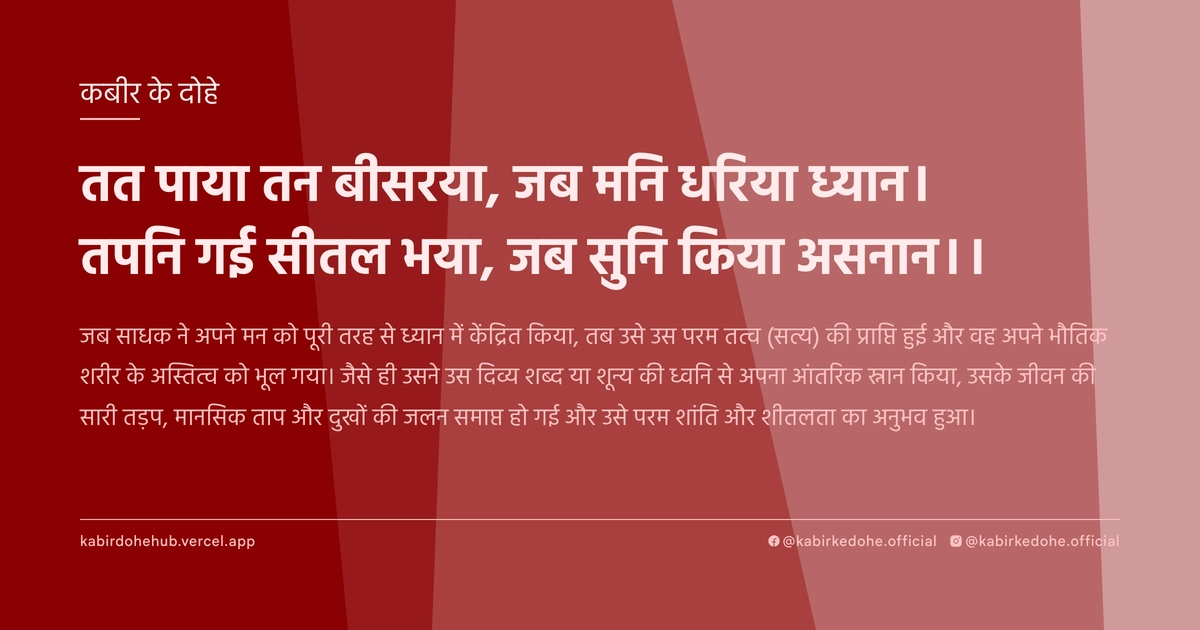
तत पाया तन बीसरया, जब मनि धरिया ध्यान।
तपनि गई सीतल भया, जब सुनि किया असनान।।
Tat paaya tan bisraya, jab mani dhariya dhyaan. Tapni gai sital bhaya, jab suni kiya asnaan.
इस पृष्ठ पर इस कबीर दोहे का अर्थ (meaning), हिंदी व्याख्या और अंग्रेज़ी अनुवाद, दार्शनिक विश्लेषण और व्यावहारिक जीवन सीख दी गई है। यह दोहा ध्यान (Meditation) विषय से जुड़ा है — Kabir doha meaning and explanation in Hindi and English.
अर्थ (Meaning):
जब साधक ने अपने मन को पूरी तरह से ध्यान में केंद्रित किया, तब उसे उस परम तत्व (सत्य) की प्राप्ति हुई और वह अपने भौतिक शरीर के अस्तित्व को भूल गया। जैसे ही उसने उस दिव्य शब्द या शून्य की ध्वनि से अपना आंतरिक स्नान किया, उसके जीवन की सारी तड़प, मानसिक ताप और दुखों की जलन समाप्त हो गई और उसे परम शांति और शीतलता का अनुभव हुआ।
When the seeker anchored the mind in unwavering meditation, the ultimate Essence was realized, and the consciousness of the physical body dissolved. Upon performing a spiritual bath in the resonance of the Divine Sound or the Void, the scorching heat of worldly desires and mental anguish vanished, replaced by an eternal, cooling serenity.
व्याख्या (Interpretation):
यह दोहा शरीर और आत्मा के द्वैत से मुक्ति की यात्रा का वर्णन करता है। 'तत' का अर्थ है वह मूल तत्व या ब्रह्म, जिसकी खोज हर आत्मा करती है। जब मन बाहरी भटकाव को छोड़कर अंतर्मुखी होता है, तो 'तन बीसरया' की अवस्था आती है, जहाँ अहंकार और शारीरिक पहचान समाप्त हो जाती है। यहाँ 'तपनि' केवल शारीरिक गर्मी नहीं, बल्कि काम, क्रोध और मोह की अग्नि है। 'सुनि किया असनान' एक गहरा रूपक है; यह जल से स्नान नहीं, बल्कि 'अनहद नाद' या आंतरिक ध्वनि के श्रवण से होने वाला शुद्धिकरण है। यह निर्गुण भक्ति का सार है, जहाँ ईश्वर किसी मूर्ति में नहीं, बल्कि स्वयं के भीतर की शून्यता और ध्वनि में पाया जाता है, जिससे साधक अद्वैत की स्थिति में पहुँच जाता है।
This couplet delineates the journey from the duality of body and soul toward absolute liberation. 'Tat' refers to the primordial Essence or Brahman, the ultimate reality. When the mind ceases its outward wanderings and turns inward, the state of 'tan bisaraya' occurs—the dissolution of the ego and the forgetting of the physical vessel. The 'tapani' mentioned is not mere physical heat, but the scorching fire of desire, anger, and attachment. 'Suni kiya asnaan' is a profound metaphor; it is not a ritual bath in water, but a purification through the listening of the 'Anhad Naad' or the unstruck sound of the Void. This embodies the core of Nirgun Bhakti, where the Divine is found not in idols, but in the silence and resonance within, leading the seeker to the non-dual state of Advaita.
दार्शनिक विश्लेषण (Philosophical Analysis):
कबीर का यह दर्शन मध्यकालीन भारत के उस दौर का है जब धर्म कर्मकांडों और बाहरी आडंबरों में फँसा हुआ था। वे स्पष्ट रूप से कहते हैं कि मोक्ष किसी तीर्थ यात्रा या शारीरिक स्नान से नहीं, बल्कि मानसिक रूपांतरण से मिलता है। यह विचार अद्वैत वेदांत के 'अहं ब्रह्मास्मि' के करीब है, जहाँ व्यक्ति यह अनुभव करता है कि वह और परमात्मा अलग नहीं हैं।
सूफी मत के 'फना' (अहंकार का विनाश) की अवधारणा यहाँ स्पष्ट दिखती है। जब कबीर 'तन बीसरया' कहते हैं, तो वे उसी अवस्था की बात कर रहे होते हैं जहाँ 'मैं' मिट जाता है और केवल 'वह' शेष रहता है। यह मनोवैज्ञानिक स्तर पर एक गहरा विस्थापन है, जहाँ व्यक्ति अपनी सीमित पहचान को त्यागकर सार्वभौमिक चेतना में विलीन हो जाता है।
कबीर ने जाति और वर्ण व्यवस्था को नकारते हुए यह संदेश दिया कि आध्यात्मिक अनुभव किसी विशेष वर्ग का विशेषाधिकार नहीं है। उनके लिए 'ध्यान' एक लोकतांत्रिक उपकरण है। वे तर्क देते हैं कि यदि मन स्थिर है, तो एक साधारण बुनकर भी उस सत्य को पा सकता है जिसे बड़े-बड़े पंडित शास्त्रों में खोजते हैं।
यहाँ 'शून्य' या 'सुनि' का महत्व है। यह बौद्ध धर्म के शून्यत और नाथ पंथ की लयाकत से प्रभावित है। यह वह बिंदु है जहाँ विचार समाप्त होते हैं और केवल शुद्ध अस्तित्व बचता है। यह मानसिक शोर का अंत है, जो मनुष्य को उसके वास्तविक स्वरूप से मिलाता है।
अंततः, यह दोहा यह स्पष्ट करता है कि वास्तविक शांति बाहरी परिस्थितियों के बदलने से नहीं, बल्कि आंतरिक ताप (अज्ञान) के शांत होने से आती है। यह एक ऐसी मनोवैज्ञानिक क्रांति है जो मनुष्य को भय और इच्छाओं के बंधन से मुक्त कर उसे एक 'स्थितप्रज्ञ' या संतुलित व्यक्तित्व में बदल देती है।
Kabir's philosophy emerged during a medieval Indian era where religion was stifled by rigid rituals and external ostentations. He asserts that liberation is not achieved through pilgrimages or physical ablutions, but through a profound psychological and spiritual transmutation. This aligns closely with the Advaita Vedanta principle of 'Aham Brahmasmi'—the realization that the individual self and the ultimate reality are one.
The Sufi concept of 'Fana' (the annihilation of the ego) is vividly present here. When Kabir speaks of 'tan bisaraya,' he refers to the state where the 'I' dissolves, leaving only the 'Thou.' Psychologically, this is a radical shift where the individual transcends their limited identity to merge into universal consciousness.
By rejecting caste and social hierarchies, Kabir emphasizes that spiritual realization is not the prerogative of a privileged few. For him, 'Dhyana' (meditation) is a democratic tool. He argues that if the mind is steadied, a simple weaver can attain the truth that scholars spend lifetimes seeking in scriptures.
The significance of 'Shunya' or 'Suni' (the Void/Silence) reflects influences from Buddhist emptiness and the Nath tradition. It is the point where conceptual thought ceases and pure existence remains. It is the cessation of mental noise, allowing the human to encounter their authentic essence.
Ultimately, this couplet clarifies that true peace does not arise from changing external circumstances, but from quenching the internal fire of ignorance. It is a psychological revolution that frees the human from the shackles of fear and desire, transforming them into a 'Sthitaprajna'—one who is equanimously poised in truth.
मूल संदेश (Core Message):
- बाहरी कर्मकांड केवल शरीर को धोते हैं, ध्यान आत्मा को शुद्ध करता है।
- अहंकार का विसर्जन ही वास्तविक ज्ञान की पहली सीढ़ी है।
- मानसिक अशांति का समाधान बाहरी दुनिया में नहीं, आंतरिक मौन में है।
- जब 'मैं' मिटता है, तब ब्रह्मांडीय चेतना का अनुभव होता है।
- सत्य शब्दों में नहीं, बल्कि शब्दों के बीच के सन्नाटे में बसता है।
- External rituals wash the body; meditation purifies the soul.
- The dissolution of the ego is the first step toward true gnosis.
- The cure for mental unrest lies in internal silence, not external change.
- When the 'I' vanishes, the experience of universal consciousness begins.
- Truth resides not in words, but in the stillness between them.
व्यावहारिक उदाहरण (Practical Example):
एक समय की बात है, वाराणसी के घाटों पर रहने वाला एक वृद्ध विधवा महिला थी, जिसका नाम जानकी था। जानकी का जीवन दुखों की एक लंबी श्रृंखला था; उसने अपना पति, अपना इकलौता बेटा और अपनी सारी जमापूंजी खो दी थी। वह हर दिन गंगा में स्नान करती, हजारों मंत्र पढ़ती और घंटों मंदिर में बिताती, लेकिन उसके मन की 'तपनि' यानी उसकी आंतरिक बेचैनी और शोक की अग्नि कभी शांत नहीं हुई। उसे लगता था कि शायद उसकी भक्ति में कोई कमी है या उसके पाप बहुत बड़े हैं।
एक दिन उसकी मुलाकात एक घुमंतू फकीर से हुई, जो घाट की सीढ़ियों पर चुपचाप बैठा था। जानकी ने अपनी व्यथा सुनाई और पूछा कि वह शांति कैसे पाए। फकीर ने मुस्कुराकर कहा, "माई, तू शरीर को धो रही है, लेकिन मन की गंदगी को नहीं। तू शब्दों को दोहरा रही है, लेकिन उस मौन को नहीं सुन रही जहाँ ईश्वर बैठा है।"
जानकी ने पूछा, "वह मौन कहाँ है?" फकीर ने उसे निर्देश दिया कि वह अपनी आँखें बंद करे और बाहरी दुनिया के शोर को छोड़कर केवल अपनी आती-जाती सांसों के बीच के उस छोटे से अंतराल (gap) को सुनने की कोशिश करे।
शुरुआत में जानकी को बहुत कठिनाई हुई। उसके मन में पुराने दुखों की यादें, पछतावे और भविष्य की चिंताएं शोर मचाती रहीं। उसे लगा कि यह असंभव है। लेकिन उसने हार नहीं मानी और हर दिन केवल दस मिनट के लिए उस 'शून्य' को सुनने का प्रयास किया।
धीरे-धीरे, एक दोपहर जब वह ध्यान में थी, उसे महसूस हुआ कि उसका शरीर जैसे गायब हो गया है। उसे अब यह याद नहीं था कि वह एक विधवा है, वह गरीब है या वह दुखी है। वह केवल एक शुद्ध चेतना बन गई थी। उसे ऐसा लगा जैसे उसके भीतर एक शीतल जल की धारा बह रही है, जिसने उसके वर्षों पुराने मानसिक घावों को धो दिया।
यह वह 'सुनि किया असनान' था जिसकी बात कबीर ने की थी। जानकी को समझ आया कि वह अब तक केवल पानी से शरीर धो रही थी, जबकि असली शुद्धि तो उस आंतरिक मौन में थी।
उस दिन के बाद जानकी का व्यवहार पूरी तरह बदल गया। वह अब भी मंदिर जाती थी, लेकिन अब वह वहां मांगने नहीं, बल्कि उस शांति को साझा करने जाती थी।
उसने अपने जीवन के शेष वर्ष अन्य दुखी महिलाओं की मदद करने में बिताए। उसकी आंखों में अब शोक नहीं, बल्कि एक ऐसी गहराई थी जो दूसरों को भी सुकून देती थी। उसने जान लिया था कि जब 'मैं' मिटता है, तभी 'परम' मिलता है।
Once, on the ghats of Varanasi, lived an elderly widow named Janaki. Her life had been a relentless chain of sorrows; she had lost her husband, her only son, and all her meager savings. Every day, she bathed in the Ganges, recited thousands of mantras, and spent hours in temples, yet the 'tapani'—the internal fire of restlessness and grief—never subsided. She believed her devotion was flawed or her sins were too great.
One day, she encountered a wandering fakir sitting silently on the stone steps. Janaki poured out her grief and asked how she could find peace. The fakir smiled and said, "Mother, you are washing the body, but not the grime of the mind. You repeat words, but you do not listen to the silence where the Divine resides."
Janaki asked, "Where is this silence?" The fakir instructed her to close her eyes and, ignoring the external noise, try to listen to the tiny gap between her incoming and outgoing breaths.
Initially, Janaki struggled. Memories of old sorrows, regrets, and anxieties about the future screamed in her mind. She felt it was impossible. However, she persisted, spending just ten minutes each day attempting to hear that 'Shunya' or Void.
Gradually, one afternoon while in meditation, she felt her body simply vanish. She no longer remembered that she was a widow, that she was poor, or that she was grieving. She became pure consciousness. It felt as if a stream of cool, celestial water was flowing through her, washing away wounds that had festered for decades.
This was the 'Suni kiya asnaan' (spiritual bath in silence) that Kabir spoke of. Janaki realized she had been washing her skin with river water, while true purification lay in that internal stillness.
After that day, Janaki's demeanor transformed completely. She still visited the temple, but no longer to beg for relief, but to share the peace she had found.
She spent the remaining years of her life helping other grieving women. Her eyes no longer held sorrow, but a depth that provided solace to others. She had learned that only when the 'I' dissolves does the 'Absolute' appear.
अभ्यास मार्गदर्शन (Practice Guidance):
- प्रतिदिन 20 मिनट 'शून्य ध्यान' का अभ्यास करें: अपनी सांसों के बीच के अंतराल पर ध्यान केंद्रित करें और बाहरी शोर को केवल एक गूंज की तरह सुनें।
- स्व-अन्वेषण जर्नल: प्रतिदिन लिखें कि आज किन क्षणों में आपका 'अहंकार' (Ego) हावी रहा और कैसे वह आपको मानसिक तनाव (तपनि) दे रहा था।
- मौन व्रत: सप्ताह में एक दिन या दिन में कुछ घंटे पूर्ण मौन रहें, ताकि आप बाहरी शब्दों के बजाय आंतरिक ध्वनि को सुन सकें।
- डायग्नोस्टिक चेकलिस्ट: क्या आप अभी भी अपनी पहचान अपने दुखों या उपलब्धियों से जोड़ रहे हैं? क्या आप शांति के लिए बाहरी साधनों पर निर्भर हैं? यदि हाँ, तो आप अभी भी 'तन' (शरीर/अहंकार) में फंसे हैं।
- Practice 20 minutes of 'Shunya Dhyana' (Void Meditation) daily: Focus on the gap between breaths and observe external noises as mere echoes without attachment.
- Self-Inquiry Journaling: Record moments where your 'Ego' dominated your day and how that attachment created mental friction or 'heat' (tapani).
- Vow of Silence: Observe complete silence for a few hours a day or one day a week to shift your attention from external words to the internal resonance.
- Diagnostic Checklist: Are you still defining yourself by your griefs or achievements? Are you relying on external sources for peace? If yes, you are still anchored in the 'Tan' (physical/egoic identity).
चिंतन प्रश्न (Reflection Questions):
- यदि आपकी सामाजिक पहचान, नाम और पद छीन लिए जाएं, तो आपके भीतर क्या शेष बचेगा?
- आपकी 'तपनि' (मानसिक जलन) का असली कारण क्या है—परिस्थितियाँ या आपका उन परिस्थितियों के प्रति लगाव?
- क्या आप वास्तव में मौन में रहने से डरते हैं क्योंकि वहाँ आपको अपने वास्तविक स्वरूप का सामना करना पड़ता है?
- आपकी डिजिटल पहचान (सोशल मीडिया ईगो) आपके वास्तविक आत्म को कितना ढक चुकी है?
- क्या आप ईश्वर को खोजने के लिए बाहर भटक रहे हैं, जबकि वह आपके भीतर के सन्नाटे में प्रतीक्षा कर रहा है?
- If your social identity, name, and status were stripped away, what would remain within you?
- What is the true source of your 'tapani' (mental heat)—the circumstances themselves or your attachment to them?
- Do you fear silence because it forces you to confront your authentic, unmasked self?
- To what extent has your digital persona (social media ego) obscured your actual soul?
- Are you wandering externally for the Divine, while the Divine waits in the silence of your own being?