
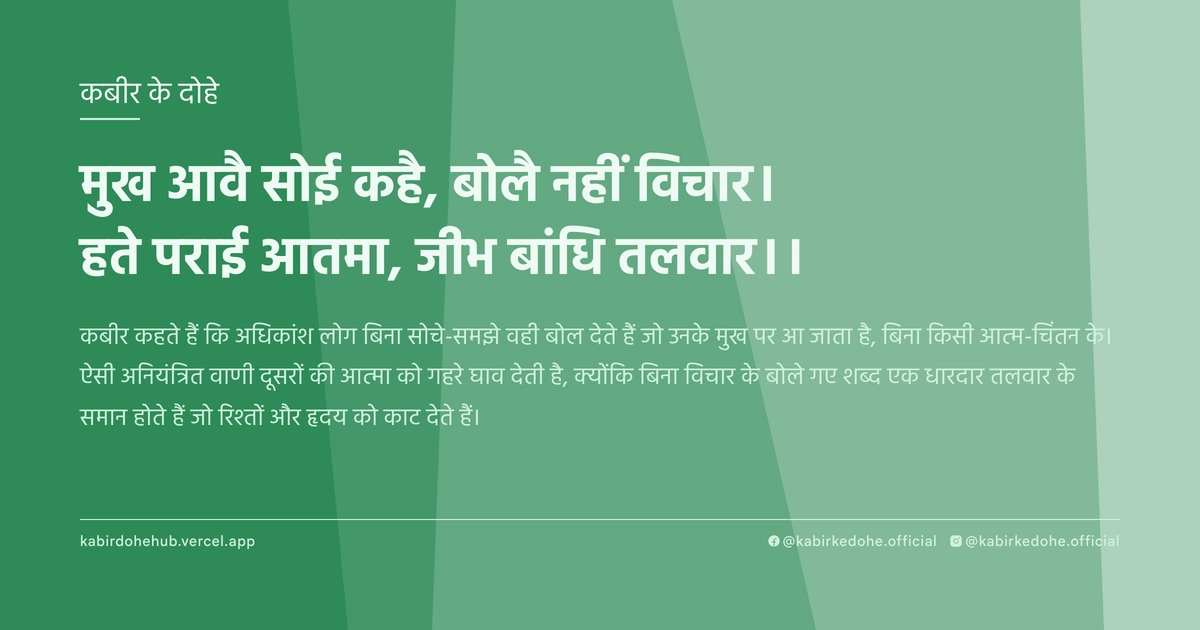
मुख आवै सोई कहै, बोलै नहीं विचार।
हते पराई आतमा, जीभ बांधि तलवार।।
Mukh aavai soi kahai, bolai nahi vichaar. Hate parai aatma, jeebh baandhi talvaar.
इस पृष्ठ पर इस कबीर दोहे का अर्थ (meaning), हिंदी व्याख्या और अंग्रेज़ी अनुवाद, दार्शनिक विश्लेषण और व्यावहारिक जीवन सीख दी गई है। यह दोहा संयम (Self-discipline) विषय से जुड़ा है — Kabir doha meaning and explanation in Hindi and English.
अर्थ (Meaning):
कबीर कहते हैं कि अधिकांश लोग बिना सोचे-समझे वही बोल देते हैं जो उनके मुख पर आ जाता है, बिना किसी आत्म-चिंतन के। ऐसी अनियंत्रित वाणी दूसरों की आत्मा को गहरे घाव देती है, क्योंकि बिना विचार के बोले गए शब्द एक धारदार तलवार के समान होते हैं जो रिश्तों और हृदय को काट देते हैं।
Kabir observes that most people speak impulsively, uttering whatever comes to mind without any conscious reflection or deliberation. Such uncontrolled speech inflicts deep wounds upon the souls of others, as words spoken without thought act like a sharpened sword, severing emotional bonds and piercing the heart.
व्याख्या (Interpretation):
यह दोहा वाणी के संयम और उसके विनाशकारी प्रभाव का विश्लेषण करता है। शाब्दिक अर्थ यह है कि विचारहीन बोलना हानिकारक है। आध्यात्मिक स्तर पर, यह 'अहंकार' और 'माया' के प्रभाव को दर्शाता है जहाँ व्यक्ति अपनी इंद्रियों का दास बन जाता है। निर्गुण भक्ति में, मौन और आंतरिक जागरूकता को प्राथमिकता दी गई है। जब हम बिना सोचे बोलते हैं, तो हम अपनी चेतना (Atman) को खो देते हैं और केवल शारीरिक प्रतिक्रिया बन जाते हैं। यह विरोधाभास है कि जिस जीभ से हम ईश्वर का नाम लेते हैं, वही जीभ बिना विवेक के दूसरों के विनाश का शस्त्र बन जाती है। यह अद्वैत वेदांत के उस सिद्धांत से जुड़ता है जहाँ दूसरे में स्वयं को देखना ही वास्तविक ज्ञान है; यदि मैं दूसरे को शब्द से चोट पहुँचाता हूँ, तो मैं वास्तव में अपनी ही आत्मा को खंडित कर रहा हूँ।
This couplet analyzes the lack of restraint in speech and its destructive consequences. Literally, it warns against impulsive talking. On a spiritual level, it illustrates the grip of 'Ahankara' (ego) and 'Maya' (illusion), where the individual becomes a slave to their sensory impulses. In Nirgun Bhakti, silence and internal awareness are prioritized over external noise. When we speak without reflection, we lose touch with our consciousness (Atman) and become mere biological reactions. The central paradox lies in the fact that the same tongue used for divine chanting can become a weapon of destruction when devoid of discernment. This aligns with Advaita Vedanta's principle of non-duality: seeing oneself in others. If I wound another with words, I am fundamentally fracturing my own soul, as there is no true separation between the self and the other.
दार्शनिक विश्लेषण (Philosophical Analysis):
कबीर का यह दोहा उनके युग के सामाजिक और धार्मिक पाखंड के विरुद्ध एक प्रहार है। उस समय, धार्मिक बहसें और शास्त्रार्थ अक्सर अहंकार की संतुष्टि के लिए किए जाते थे, जहाँ शब्दों का प्रयोग सत्य की खोज के बजाय दूसरों को नीचा दिखाने के लिए होता था। कबीर ने ritualism (कर्मकांड) की तरह ही 'वाचिक अहंकार' का विरोध किया। वे मानते थे कि बाहरी पूजा व्यर्थ है यदि वाणी में करुणा नहीं है।
दार्शनिक रूप से, यह सूफीवाद के 'नफ्स' (नफ़्स-ए-अम्मारा या निम्न इच्छाएं) के नियंत्रण से मेल खाता है। सूफी मत में जीभ का नियंत्रण आध्यात्मिक यात्रा की पहली सीढ़ी है। जब तक व्यक्ति अपनी वाणी को वश में नहीं करता, वह ईश्वर के नूर (प्रकाश) का अनुभव नहीं कर सकता। कबीर यहाँ यह समझा रहे हैं कि शब्द केवल ध्वनि नहीं हैं, बल्कि वे ऊर्जा के वाहक हैं जो भौतिक जगत में प्रभाव डालते हैं।
अद्वैत वेदांत के परिप्रेक्ष्य में, यह दोहा 'विवेक' (discernment) की आवश्यकता पर बल देता है। विवेक वह छननी है जो विचार को शब्द बनने से पहले शुद्ध करती है। बिना विवेक के बोलना अज्ञानता (Avidya) का लक्षण है। कबीर का तर्क है कि जो व्यक्ति अपनी जीभ को नियंत्रित नहीं कर सकता, वह आत्म-साक्षात्कार (Self-realization) की उम्मीद नहीं कर सकता क्योंकि उसका मन निरंतर बाहरी उत्तेजनाओं में भटक रहा है।
मनोवैज्ञानिक स्तर पर, यह 'प्रतिक्रियात्मक व्यवहार' (reactive behavior) और 'सचेत प्रतिक्रिया' (conscious response) के बीच का अंतर है। अहंकार व्यक्ति को त्वरित प्रतिक्रिया देने के लिए उकसाता है ताकि वह अपनी श्रेष्ठता सिद्ध कर सके। कबीर इस अहंकार के विलीनीकरण (annihilation of ego) की बात करते हैं। जब 'मैं' मिट जाता है, तब शब्द केवल प्रेम और सत्य का माध्यम रह जाते हैं, हथियार नहीं।
अंततः, कबीर यह संदेश देते हैं कि वास्तविक भक्ति मंदिर या मस्जिद में नहीं, बल्कि हमारी बातचीत के लहजे में होनी चाहिए। यदि हमारी वाणी दूसरों के लिए पीड़ा का कारण है, तो हमारी सारी आध्यात्मिक साधनाएं शून्य हैं। यह एक क्रांतिकारी विचार था जिसने धर्म को कर्मकांडों से हटाकर मानवीय आचरण और नैतिकता की ओर मोड़ा।
Kabir's couplet is a sharp critique of the social and religious hypocrisy of his era. During his time, theological debates and scriptural arguments were often conducted to satisfy the ego, where words were used to belittle others rather than to seek truth. Kabir opposed 'verbal arrogance' just as he opposed empty ritualism. He believed that external worship is futile if the speech lacks compassion.
Philosophically, this resonates with the Sufi concept of controlling the 'Nafs' (specifically Nafs-al-Ammara, the commanding self). In Sufism, mastering the tongue is the first step of the spiritual journey. Until a seeker controls their speech, they cannot experience the Noor (divine light) of God. Kabir explains that words are not merely sounds but carriers of energy that manifest physical and emotional effects in the material world.
From the perspective of Advaita Vedanta, this verse emphasizes the necessity of 'Viveka' (discernment). Viveka is the filter that purifies a thought before it crystallizes into a word. Speaking without this discernment is a symptom of Avidya (ignorance). Kabir argues that one who cannot govern their tongue cannot hope for Self-realization, as their mind remains scattered in external stimulations.
Psychologically, this highlights the gap between 'reactive behavior' and 'conscious response.' The ego goads the individual toward an immediate reaction to establish superiority. Kabir advocates for the annihilation of this ego. When the 'I' vanishes, words cease to be weapons and become mere conduits for love and truth.
Ultimately, Kabir conveys that true devotion is found not in temples or mosques, but in the tone of our interactions. If our speech causes pain to others, all our spiritual practices are rendered void. This was a revolutionary shift, moving religion away from rituals and toward human conduct and ethics.
मूल संदेश (Core Message):
- असंयमित वाणी अहंकार का सबसे बड़ा हथियार है।
- विचारहीन शब्द आत्मा को खंडित करते हैं।
- मौन केवल शब्दों का अभाव नहीं, बल्कि जागरूकता की उपस्थिति है।
- सत्य जब करुणा के बिना बोला जाता है, तो वह हिंसा बन जाता है।
- वाणी का संयम ही वास्तविक आत्म-विजय है।
- Unrestrained speech is the ego's most potent weapon.
- Thoughtless words fracture the soul of the listener.
- Silence is not just the absence of words, but the presence of awareness.
- Truth spoken without compassion transforms into violence.
- Mastery over speech is the ultimate victory over the self.
व्यावहारिक उदाहरण (Practical Example):
वाराणसी के एक पुराने मोहल्ले में रामदीन नाम का एक बुनकर रहता था। वह अपनी कला में निपुण था, लेकिन उसकी जीभ बहुत कड़वी थी। वह अक्सर अपने परिवार, पड़ोसियों और यहाँ तक कि अपने ग्राहकों को भी बिना सोचे-समझे कठोर शब्द कह देता था। वह इसे अपनी 'स्पष्टवादिता' कहता था, जबकि वास्तव में वह उसका अनियंत्रित क्रोध था।
एक दिन रामदीन ने अपने सबसे पुराने मित्र और साथी बुनकर, माधव को उसके काम में एक छोटी सी गलती के लिए सबके सामने बहुत बुरा-भला कहा। उसने माधव की योग्यता पर सवाल उठाए और उसे 'नालायक' कहा। माधव ने कोई जवाब नहीं दिया, बस उसकी आँखों में एक गहरी उदासी छा गई और वह चुपचाप वहाँ से चला गया।
अगले कुछ दिनों तक माधव ने रामदीन से बात नहीं की। रामदीन को शुरू में लगा कि माधव कमजोर है, लेकिन धीरे-धीरे उसे महसूस हुआ कि उसके शब्दों ने एक पुराने और गहरे भरोसे को तोड़ दिया है। वह घर में अकेला महसूस करने लगा, क्योंकि लोग अब उससे बात करने से कतराने लगे थे।
एक शाम, रामदीन ने कबीर के इस दोहे को सुना: 'जीभ बांधि तलवार'। उसे अचानक अहसास हुआ कि उसने शब्दों की तलवार से केवल माधव को ही नहीं, बल्कि अपने स्वयं के सामाजिक और मानसिक सुकून को भी काट दिया है। उसे समझ आया कि 'सच बोलना' और 'कड़वा बोलना' दो अलग बातें हैं।
रामदीन ने तय किया कि वह अब बोलने से पहले तीन सेकंड रुकेगा। वह खुद से पूछेगा: क्या यह सच है? क्या यह जरूरी है? और क्या यह दयालु है?
शुरुआत में यह बहुत कठिन था। कई बार उसका गुस्सा उसे उकसाता, लेकिन वह अपनी जीभ पर नियंत्रण रखने का अभ्यास करता रहा। उसने माधव के पास जाकर बिना किसी बहाने के अपनी गलती मानी और उससे क्षमा मांगी।
धीरे-धीरे रामदीन के व्यवहार में बदलाव आया। उसकी वाणी में अब मिठास और विचार था। लोग अब उससे सलाह लेने आने लगे और उसके साथ समय बिताना पसंद करने लगे।
रामदीन ने पाया कि जब उसने अपनी जीभ की 'तलवार' को म्यान में रखा, तो उसके जीवन में शांति और प्रेम का संचार हुआ। उसकी कला और निखर गई क्योंकि अब वह शांत मन से काम करता था।
In an old neighborhood of Varanasi lived a weaver named Ramdeen. He was masterful in his craft, but his tongue was incredibly bitter. He often hurled harsh words at his family, neighbors, and even his customers without a second thought. He labeled this 'frankness,' though it was actually uncontrolled anger.
One day, Ramdeen publicly berated his oldest friend and fellow weaver, Madhav, over a minor mistake in a fabric. He questioned Madhav's competence and called him 'worthless' in front of everyone. Madhav did not respond; a deep sadness clouded his eyes, and he silently walked away.
For the next few days, Madhav refused to speak to Ramdeen. Initially, Ramdeen felt Madhav was weak, but gradually he realized that his words had severed a long-standing bond of trust. He began to feel isolated as others also started avoiding him to escape his caustic tongue.
One evening, Ramdeen heard Kabir's couplet: 'The tongue is like a bound sword.' He suddenly realized that with the sword of his words, he had not only wounded Madhav but had also sliced through his own social and mental peace. He understood that 'speaking the truth' and 'speaking harshly' are two very different things.
Ramdeen decided that from then on, he would pause for three seconds before speaking. He would ask himself: Is it true? Is it necessary? And is it kind?
Initially, this was grueling. His anger often goaded him, but he persisted in practicing restraint. He eventually approached Madhav, admitted his mistake without making excuses, and sought forgiveness.
Slowly, a transformation occurred in Ramdeen's behavior. His speech now held sweetness and reflection. People began seeking his advice and enjoyed his company once again.
Ramdeen discovered that when he sheathed the 'sword' of his tongue, peace and love flowed back into his life. His art flourished further because he now worked with a tranquil mind.
अभ्यास मार्गदर्शन (Practice Guidance):
- प्रतिदिन 10 मिनट 'मौन साधना' करें, जहाँ आप न केवल बोलें नहीं, बल्कि मन में चलने वाले शब्दों के शोर को भी देखें।
- एक 'वाणी-डायरी' रखें। दिन के अंत में उन क्षणों को लिखें जब आपने बिना सोचे कुछ कहा और उसका परिणाम क्या हुआ।
- बोलने से पहले 'तीन-छलनी नियम' (सत्य, आवश्यकता, दया) का पालन करें।
- निदान चेकलिस्ट: क्या आप दूसरों की बातों पर तुरंत प्रतिक्रिया देते हैं? क्या आपके शब्दों के कारण अक्सर विवाद होते हैं? क्या आप अपनी 'स्पष्टवादिता' का उपयोग दूसरों को चोट पहुँचाने के लिए करते हैं? यदि हाँ, तो आप इस ज्ञान को जीने में विफल हो रहे हैं।
- Practice 10 minutes of 'Silent Meditation' daily, observing not just the absence of speech but the noise of words swirling in the mind.
- Maintain a 'Speech Journal.' At the end of the day, record moments where you spoke impulsively and analyze the resulting outcome.
- Implement the 'Three-Filter Rule' before speaking: Is it true? Is it necessary? Is it kind?
- Diagnostic Checklist: Do you react instantly to others? Do your words frequently spark conflict? Do you use 'frankness' as a shield to hurt others? If yes, you are failing to embody this wisdom.
चिंतन प्रश्न (Reflection Questions):
- क्या मेरी 'ईमानदारी' वास्तव में सत्य की खोज है, या यह दूसरों को नीचा दिखाने का एक तरीका है?
- जब मैं क्रोध में बोलता हूँ, तो वह 'मैं' कौन होता है जो नियंत्रण खो देता है?
- मेरे शब्द दूसरों के लिए पुल बनाते हैं या दीवारें?
- क्या मैं अपनी डिजिटल पहचान (सोशल मीडिया) पर शब्दों का उपयोग अपनी श्रेष्ठता सिद्ध करने के लिए कर रहा हूँ?
- यदि मेरे शब्द भौतिक घाव छोड़ते, तो क्या मैं अभी भी वही बोलता जो मैं बोलता हूँ?
- Is my 'honesty' truly a quest for truth, or is it a tool to assert superiority over others?
- When I speak in anger, who is the 'I' that loses control?
- Do my words build bridges or erect walls between me and others?
- Am I using words in my digital identity (social media) to feed a curated ego?
- If my words left physical scars, would I still say what I currently say?