
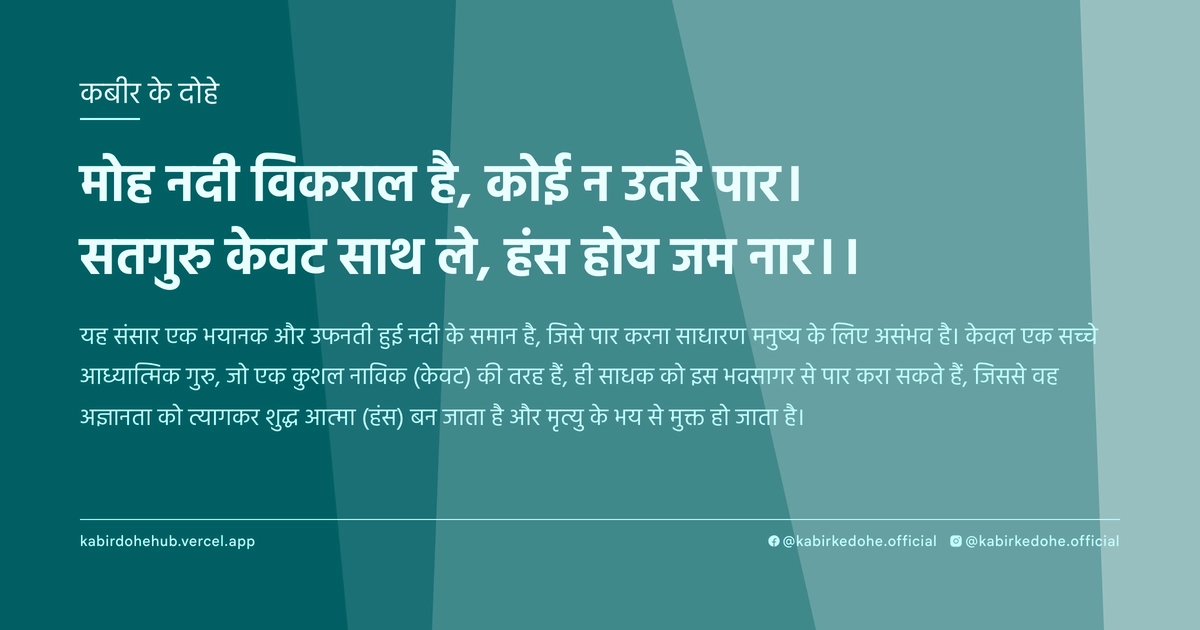
मोह नदी विकराल है, कोई न उतरै पार।
सतगुरु केवट साथ ले, हंस होय जम नार।।
Moh nadi vikral hai, koi na utrai paar. Satguru kevat sath le, hans hoye jam nar.
इस पृष्ठ पर इस कबीर दोहे का अर्थ (meaning), हिंदी व्याख्या और अंग्रेज़ी अनुवाद, दार्शनिक विश्लेषण और व्यावहारिक जीवन सीख दी गई है। यह दोहा गुरु महत्व (The Guru's Importance) विषय से जुड़ा है — Kabir doha meaning and explanation in Hindi and English.
अर्थ (Meaning):
यह संसार एक भयानक और उफनती हुई नदी के समान है, जिसे पार करना साधारण मनुष्य के लिए असंभव है। केवल एक सच्चे आध्यात्मिक गुरु, जो एक कुशल नाविक (केवट) की तरह हैं, ही साधक को इस भवसागर से पार करा सकते हैं, जिससे वह अज्ञानता को त्यागकर शुद्ध आत्मा (हंस) बन जाता है और मृत्यु के भय से मुक्त हो जाता है।
This worldly existence is like a formidable and turbulent river that no ordinary person can cross alone. Only a true spiritual master, acting as a skilled boatman (Kevat), can guide the seeker across this ocean of existence, transforming them into a liberated soul (Hans) and liberating them from the terror of death and rebirth.
व्याख्या (Interpretation):
यहाँ 'नदी' माया और सांसारिक मोह के जटिल जाल का प्रतीक है, जो मनुष्य को निरंतर भ्रमित रखती है। 'विकराल' शब्द उस मानसिक और आध्यात्मिक संघर्ष को दर्शाता है जहाँ अहंकार और वासनाएँ लहरों की तरह प्रहार करती हैं। सतगुरु का 'केवट' होना यह दर्शाता है कि ज्ञान केवल किताबी नहीं, बल्कि व्यावहारिक अनुभव है जो हमें किनारों से जोड़ता है। जब साधक गुरु के मार्गदर्शन में अहंकार का विसर्जन करता है, तो वह 'हंस' बन जाता है—एक ऐसा प्रतीक जो नीर और क्षीर (दूध और पानी) को अलग करने की क्षमता रखता है, अर्थात सत्य और असत्य का विवेक। अंततः, 'जम नार' का अर्थ है कि वह व्यक्ति यमराज (मृत्यु और समय) के नियंत्रण से ऊपर उठकर अद्वैत की स्थिति प्राप्त कर लेता है, जहाँ जन्म और मृत्यु का द्वंद्व समाप्त हो जाता है।
The 'river' symbolizes the intricate web of Maya and worldly attachments that keep the human consciousness in a state of perpetual confusion. The term 'vikral' (formidable) represents the psychological and spiritual struggle where ego and desires strike like turbulent waves. The Satguru as the 'Kevat' (boatman) signifies that true knowledge is not academic but an experiential guidance that bridges the gap between ignorance and enlightenment. As the seeker surrenders the ego under the master's guidance, they become a 'Hans' (swan)—a symbol of discernment capable of separating the eternal truth from the transient illusion. Ultimately, 'Jam naar' implies that the individual transcends the dominion of Yama (death and time), achieving a state of non-duality where the cycle of birth and death ceases to hold power.
दार्शनिक विश्लेषण (Philosophical Analysis):
कबीर का यह दोहा निर्गुण भक्ति की उस धारा को प्रस्तुत करता है जहाँ ईश्वर किसी मूर्ति या मंदिर में नहीं, बल्कि अंतरात्मा के बोध में है। यह अद्वैत वेदांत के उस सिद्धांत से मेल खाता है जहाँ जीव और ब्रह्म की एकता को पहचाना जाता है, लेकिन इस पहचान के बीच 'माया' की नदी एक बड़ी बाधा है। कबीर यहाँ कर्मकांडों और बाहरी आडंबरों का खंडन करते हैं; वे कहते हैं कि केवल तीर्थयात्रा या मंत्रोच्चार से यह नदी पार नहीं होगी, बल्कि इसके लिए एक जीवित अनुभव (गुरु) की आवश्यकता है।
सूफी मत के 'पीर' और भारतीय परंपरा के 'गुरु' का संगम यहाँ स्पष्ट है। जिस प्रकार सूफीवाद में 'फना' (अहंकार का विनाश) अनिवार्य है, वैसे ही यहाँ 'हंस' बनने के लिए पुराने व्यक्तित्व की मृत्यु आवश्यक है। यह मनोवैज्ञानिक रूपांतरण की प्रक्रिया है जहाँ साधक अपनी सीमित पहचान (मैं, मेरा, मेरा परिवार) को त्यागकर सार्वभौमिक चेतना में विलीन होता है।
ऐतिहासिक संदर्भ में, कबीर ने जाति और धर्म के कृत्रिम विभाजनों को चुनौती दी। उनके लिए 'केवट' कोई उच्च जाति का पंडित नहीं, बल्कि वह है जिसके पास सत्य का अनुभव है। यह सामाजिक क्रांति का आह्वान था, जहाँ योग्यता का पैमाना जन्म नहीं, बल्कि आध्यात्मिक जागृति थी।
यहाँ 'नदी' केवल मृत्यु के बाद की यात्रा नहीं है, बल्कि जीवित रहते हुए अज्ञानता से ज्ञान की ओर संक्रमण है। यह द्वैत (Dualism) से अद्वैत (Non-dualism) की यात्रा है। जब तक हम स्वयं को शरीर मानते हैं, हम नदी में डूबते रहते हैं; जब हम स्वयं को शुद्ध चेतना मानते हैं, हम नदी के पार पहुँच जाते हैं।
अंततः, यह दोहा इस सत्य को स्थापित करता है कि मोक्ष कोई बाहरी गंतव्य नहीं है, बल्कि आंतरिक दृष्टि का परिवर्तन है। गुरु वह दर्पण है जिसमें साधक अपनी वास्तविक स्वरूप को देखता है और पाता है कि जिसे वह पार करना चाहता था, वह वास्तव में वह स्वयं ही था, जो अब जागृत हो चुका है।
Kabir’s couplet embodies the essence of Nirgun Bhakti, where the Divine is not found in idols or temples but in the realization of the inner self. This aligns with Advaita Vedanta, which posits the fundamental unity of Atman and Brahman, yet acknowledges 'Maya' (the river) as the primary obstacle to this realization. Kabir rejects ritualism and external piety, asserting that pilgrimages or rote chanting cannot cross this river; only a living experience—the Satguru—can facilitate the crossing.
The convergence of the Sufi 'Pir' and the Indian 'Guru' is evident here. Just as Sufism emphasizes 'Fana' (annihilation of the ego), becoming a 'Hans' requires the death of the conditioned personality. This is a process of psychological transformation where the seeker sheds the limited identity of 'I' and 'mine' to merge into universal consciousness.
In his historical context, Kabir challenged the artificial divisions of caste and creed. To him, the 'Kevat' is not a high-caste priest but anyone possessing the direct experience of Truth. This was a call for social revolution, where the metric of worth was spiritual awakening rather than birthright.
The 'river' is not merely a metaphor for the afterlife but represents the transition from ignorance to enlightenment while still alive. It is the journey from Dualism to Non-dualism. As long as we identify with the physical body, we drown in the currents of desire; once we identify as pure consciousness, the river ceases to be an obstacle.
Ultimately, the doha establishes that liberation (Moksha) is not an external destination but a shift in internal perception. The Guru is the mirror in which the seeker recognizes their true nature, realizing that the river they sought to cross was an illusion created by the very ego they have now transcended.
मूल संदेश (Core Message):
- संसार की माया एक उफनती नदी है जो निरंतर भ्रम पैदा करती है।
- बिना मार्गदर्शन के अहंकार का पार पाना असंभव है।
- सच्चा गुरु वह है जो हमें स्वयं के वास्तविक स्वरूप से मिलाए।
- विवेक (हंस भाव) ही अज्ञानता के अंधकार को मिटाने का एकमात्र शस्त्र है।
- मृत्यु का भय केवल तब समाप्त होता है जब 'मैं' का विसर्जन होता है।
- The Maya of the world is a turbulent river creating constant illusion.
- Crossing the currents of ego is impossible without spiritual guidance.
- A true Guru is one who introduces the seeker to their own authentic self.
- Discernment (the Swan-state) is the only weapon to erase the darkness of ignorance.
- The fear of death vanishes only when the 'I' is completely dissolved.
व्यावहारिक उदाहरण (Practical Example):
वाराणसी के एक पुराने घाट पर माधव नाम का एक वृद्ध नाविक रहता था। माधव जीवन भर लोगों को नदी पार कराता रहा, लेकिन उसका मन हमेशा अशांत रहता था। वह खुद को केवल एक 'नाव चलाने वाला' मानता था और समाज में अपनी निम्न स्थिति को लेकर भीतर ही भीतर दुखी था। वह सोचता था कि उसकी नियति केवल इस गंदे पानी में समय बिताना है।
एक दिन उसकी नाव पर एक फकीर सवार हुआ, जिसकी आँखों में एक अजीब सी शांति थी। फकीर ने माधव से पूछा, 'तुम नाव तो पार करा रहे हो, पर क्या तुमने कभी अपनी आत्मा की नाव को किनारे लगाया है?' माधव हँसा और बोला, 'बाबा, मैं तो अनपढ़ हूँ, आत्मा-परमात्मा की बातें मेरे बस की नहीं।'
फकीर ने मुस्कुराते हुए कहा, 'जिस तरह तुम लहरों को देखकर नाव मोड़ते हो, वैसे ही अपने क्रोध और अहंकार की लहरों को पहचानो। तुम नाविक केवल इस नदी के नहीं, अपनी इंद्रियों के भी बनो।'
माधव को पहली बार महसूस हुआ कि उसकी असली लड़ाई नदी की लहरों से नहीं, बल्कि उसके भीतर के हीन-भावना और क्रोध से थी। उसने फकीर को अपना गुरु मान लिया। फकीर ने उसे कोई मंत्र नहीं दिया, बस यह सिखाया कि हर सवारी को सेवा भाव से देखना और हर लहर में ईश्वर की उपस्थिति महसूस करना ही असली साधना है।
धीरे-धीरे माधव का व्यवहार बदलने लगा। वह अब केवल पैसे के लिए नाव नहीं चलाता था, बल्कि हर यात्री में वह उस 'हंस' को देखने लगा जिसकी बात फकीर ने की थी। उसका अहंकार कि वह 'छोटा' है, समाप्त हो गया और वह स्वयं को ब्रह्मांड का एक हिस्सा मानने लगा।
एक समय ऐसा आया जब घाट के लोग, जो पहले उसे तुच्छ समझते थे, उसके पास मानसिक शांति के लिए आने लगे। माधव अब केवल एक नाविक नहीं था; वह एक जीवित उदाहरण बन गया था कि कैसे एक साधारण व्यक्ति अपनी चेतना को बदल सकता है।
उसकी आंतरिक उथल-पुथल शांत हो गई। वह अब नदी की विकरालता से नहीं डरता था, क्योंकि उसने जान लिया था कि जब भीतर शांति होती है, तो बाहर का तूफान केवल एक दृश्य बन जाता है, बाधा नहीं।
माधव की कहानी यह सिखाती है कि गुरु वह नहीं जो हमें कहीं ले जाए, बल्कि वह है जो हमें यह दिखाए कि हम पहले से ही वहाँ हैं, बस हमारी दृष्टि धुंधली थी।
On an ancient ghat in Varanasi lived an elderly boatman named Madhav. For decades, Madhav ferried people across the river, but his mind remained turbulent. He viewed himself merely as a 'lowly oarsman' and harbored a deep, silent resentment toward his social standing, believing his destiny was to toil in the murky waters.
One day, a wandering dervish with an extraordinary stillness in his eyes boarded his boat. The dervish asked, 'You ferry others across the river, but have you ever steered the boat of your own soul to the shore?' Madhav laughed bitterly, replying, 'Baba, I am unlettered; the talk of souls and divinity is beyond my reach.'
The dervish smiled and said, 'Just as you steer your boat by reading the waves, learn to recognize the waves of your own anger and ego. Do not just be a boatman of this river, but become the boatman of your own senses.'
For the first time, Madhav realized that his true struggle was not with the river's currents, but with the currents of inferiority and rage within him. He accepted the dervish as his Satguru. The master gave him no mantras, only the practice of seeing every passenger as a divine guest and feeling the presence of the Eternal in every ripple of the water.
Gradually, Madhav's demeanor shifted. He no longer rowed for mere coins; he began to see the 'Hans' (the divine spark) in every traveler. His ego, rooted in the belief that he was 'small,' dissolved, and he began to perceive himself as an integral part of the cosmic whole.
Eventually, the townspeople, who once looked down upon him, began visiting him for spiritual solace. Madhav was no longer just a boatman; he had become a living testament to the possibility of conscious transformation.
His internal turmoil vanished. He no longer feared the 'vikral' (formidable) nature of the river, for he understood that when there is peace within, the external storm becomes a mere spectacle rather than an obstacle.
Madhav's story illustrates that a Guru does not take us to a new place, but removes the veil from our eyes so we can see that we have always been at the destination.
अभ्यास मार्गदर्शन (Practice Guidance):
- दैनिक चिंतन: प्रतिदिन 15 मिनट मौन बैठें और कल्पना करें कि आपके विचार नदी की लहरों की तरह हैं। उन्हें रोकने की कोशिश न करें, बस एक तटस्थ साक्षी (Witness) बनकर उन्हें देखें।
- आत्म-पूछताछ जर्नल: लिखें कि आपके जीवन में 'विकराल नदी' (सबसे बड़ा डर या मानसिक बाधा) क्या है? यह पहचानें कि यह डर आपके अहंकार से कैसे जुड़ा है।
- व्यवहारिक परिवर्तन: जब भी क्रोध या ईर्ष्या महसूस हो, स्वयं से कहें—'यह मैं नहीं, यह केवल एक लहर है।' इस तरह अपनी पहचान को भावनाओं से अलग करें।
- निदान चेकलिस्ट: क्या आप अभी भी बाहरी परिस्थितियों को अपनी शांति का कारण मानते हैं? क्या आप दूसरों में अपनी ही कमियों का प्रतिबिंब देख रहे हैं? यदि हाँ, तो आप अभी भी नदी के बीच में हैं।
- Daily Contemplation: Spend 15 minutes in silence, imagining your thoughts as waves in a river. Do not attempt to stop them; simply observe them as a neutral witness.
- Self-Inquiry Journaling: Document what constitutes the 'formidable river' (the greatest fear or mental block) in your life. Analyze how this fear is anchored in your ego.
- Behavioral Shift: Whenever anger or jealousy arises, tell yourself—'This is not I; this is merely a wave.' Practice decoupling your identity from your transient emotions.
- Diagnostic Checklist: Do you still attribute your peace to external circumstances? Do you see your own flaws reflected in others? If yes, you are still adrift in the river of Maya.
चिंतन प्रश्न (Reflection Questions):
- वह कौन सा 'मुखौटा' है जिसे आप दुनिया के सामने पहनते हैं, लेकिन वह आपको आंतरिक रूप से थका देता है?
- यदि आपकी सामाजिक पहचान (पद, पैसा, जाति) छीन ली जाए, तो आपके पास क्या बचेगा?
- क्या आप वास्तव में सत्य की खोज कर रहे हैं, या केवल अपनी मान्यताओं की पुष्टि करने वाला गुरु ढूंढ रहे हैं?
- आपके जीवन की वह कौन सी 'लहर' है जिसे आप पार करने से सबसे ज्यादा डरते हैं?
- क्या आपकी भक्ति आपको विनम्र बना रही है, या यह आपके अहंकार को एक 'धार्मिक' रूप दे रही है?
- What is the 'mask' you wear for the world that leaves you internally exhausted?
- If your social identity (status, wealth, caste) were stripped away, what would remain of you?
- Are you truly seeking Truth, or are you merely looking for a Guru who validates your existing beliefs?
- Which 'wave' in your life are you most terrified of crossing?
- Is your devotion making you humble, or is it simply giving your ego a 'religious' justification?