
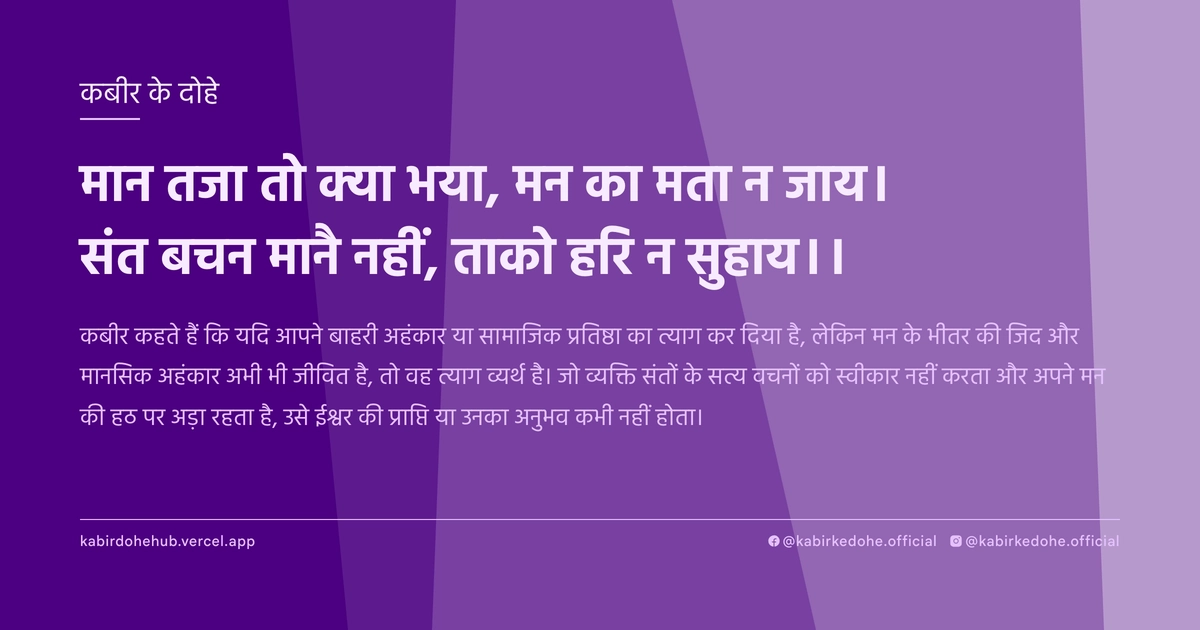
मान तजा तो क्या भया, मन का मता न जाय।
संत बचन मानै नहीं, ताको हरि न सुहाय।।
Maan taja to kya bhaya, man ka mata na jaaye. Sant bachan maanai nahi, taako hari na suhay.
इस पृष्ठ पर इस कबीर दोहे का अर्थ (meaning), हिंदी व्याख्या और अंग्रेज़ी अनुवाद, दार्शनिक विश्लेषण और व्यावहारिक जीवन सीख दी गई है। यह दोहा अहंकार (The Ego) विषय से जुड़ा है — Kabir doha meaning and explanation in Hindi and English.
अर्थ (Meaning):
कबीर कहते हैं कि यदि आपने बाहरी अहंकार या सामाजिक प्रतिष्ठा का त्याग कर दिया है, लेकिन मन के भीतर की जिद और मानसिक अहंकार अभी भी जीवित है, तो वह त्याग व्यर्थ है। जो व्यक्ति संतों के सत्य वचनों को स्वीकार नहीं करता और अपने मन की हठ पर अड़ा रहता है, उसे ईश्वर की प्राप्ति या उनका अनुभव कभी नहीं होता।
Kabir asserts that merely abandoning outward pride or social status is meaningless if the internal stubbornness and mental arrogance of the mind remain intact. One who refuses to heed the truthful guidance of the enlightened and remains enslaved to their own mental delusions will never experience the grace or presence of the Divine.
व्याख्या (Interpretation):
इस दोहे का शाब्दिक अर्थ है कि बाहरी विनम्रता पर्याप्त नहीं है। यहाँ 'मान' बाहरी प्रतिष्ठा है और 'मता' आंतरिक वैचारिक हठ। कबीर एक गहरे विरोधाभास को उजागर करते हैं: व्यक्ति दुनिया के सामने झुक सकता है, लेकिन अपने विचारों के सामने नहीं। यह 'अहंकार' का सूक्ष्म रूप है। निर्गुण भक्ति के संदर्भ में, यह मन की वह परत है जो आत्मा को ब्रह्म से अलग करती है। जब तक मन अपनी 'मता' या अपनी धारणाओं से चिपका रहता है, वह माया के जाल में फंसा रहता है। संतों के वचन यहाँ केवल शब्द नहीं, बल्कि वह दर्पण हैं जो व्यक्ति को उसके वास्तविक स्वरूप का बोध कराते हैं। जब तक यह आंतरिक प्रतिरोध समाप्त नहीं होता, हरि (परमात्मा) का अनुभव असंभव है क्योंकि ईश्वर अहंकार के शून्य में ही निवास करते हैं।
The literal meaning suggests that outward humility is insufficient. Here, 'Maan' refers to social prestige, while 'Mata' signifies internal intellectual stubbornness. Kabir highlights a profound paradox: a person may bow before the world but refuses to bow before the truth of their own mind. This is the subtle form of ego. In the context of Nirgun Bhakti, this mental rigidity is the veil of Maya that separates the Atman from Brahman. As long as the mind clings to its 'Mata' or preconceived notions, it remains trapped in illusion. The 'words of saints' are not mere instructions but mirrors reflecting one's true nature. Until this internal resistance is dissolved, the experience of Hari (the Divine) remains elusive, for the Divine resides only in the vacuum created by the annihilation of the ego.
दार्शनिक विश्लेषण (Philosophical Analysis):
कबीर का यह दोहा मध्यकालीन भारत के उस समय का है जब धर्म केवल कर्मकांडों और सामाजिक श्रेणियों में सिमट गया था। कबीर ने इस बात पर प्रहार किया कि लोग बाहरी रूप से धार्मिक दिखते हैं—जैसे माला जपना या तीर्थ यात्रा करना—लेकिन उनके भीतर का अहंकार यथावत रहता है। यह 'छद्म विनम्रता' का खंडन है।
अद्वैत वेदांत के दृष्टिकोण से, यह दोहा 'अविद्या' (अज्ञान) की चर्चा करता है। जब व्यक्ति कहता है कि 'मैं जानता हूँ', तो वह वास्तव में अपनी अज्ञानता को पुष्ट कर रहा होता है। यह मानसिक हठ ही वह अविद्या है जो हमें यह विश्वास दिलाती है कि हम परमात्मा से अलग हैं। कबीर यहाँ मन को एक रोगग्रस्त इकाई के रूप में देखते हैं जिसे केवल सत्य के कड़वे वचनों से ही ठीक किया जा सकता है।
सूफी मत के 'फना' (अहंकार का विनाश) के सिद्धांत से इसकी गहरी समानता है। सूफीवाद में भी यह माना जाता है कि जब तक 'मैं' जीवित है, 'वह' (ईश्वर) प्रकट नहीं हो सकता। कबीर का 'मन का मता' वही 'नफ्स' (lower self) है जो साधक को सत्य के मार्ग से भटकाता है।
कबीर का यह संदेश सामाजिक जाति व्यवस्था के विरुद्ध भी है। वे कहते हैं कि संत कोई भी हो सकता है, चाहे वह किसी भी जाति का हो, यदि उसके वचन सत्य हैं। जो व्यक्ति केवल उच्च कुल के लोगों की सुनता है और एक साधारण संत की उपेक्षा करता है, वह वास्तव में अपने मन के अहंकार का दास है।
मनोवैज्ञानिक स्तर पर, यह दोहा 'संज्ञानात्मक विसंगति' (cognitive dissonance) को दर्शाता है। हम अक्सर अपनी गलतियों को सही ठहराने के लिए तर्क गढ़ते हैं। कबीर इस मानसिक ढिठाई को आध्यात्मिक प्रगति में सबसे बड़ी बाधा मानते हैं। वास्तविक रूपांतरण तब होता है जब हम अपनी धारणाओं को पूरी तरह त्याग कर शून्य हो जाते हैं।
This couplet emerges from a medieval Indian era where religion had shrunk into mere rituals and social hierarchies. Kabir attacks the notion of 'performative piety'—where individuals appear religious through beads or pilgrimages while their internal arrogance remains untouched. He is condemning 'pseudo-humility.'
From the perspective of Advaita Vedanta, this verse discusses 'Avidya' (ignorance). When a person claims 'I know,' they are often reinforcing their own ignorance. This mental stubbornness is the very veil that convinces us we are separate from the Absolute. Kabir views the mind as a diseased entity that can only be cured by the astringent truth of an enlightened master.
There is a profound parallel here with the Sufi concept of 'Fana' (annihilation of the self). In Sufism, it is believed that as long as the 'I' exists, the 'He' (Divine) cannot manifest. Kabir's 'man ka mata' is equivalent to the 'Nafs' (the lower self) that diverts the seeker from the path of Truth.
Kabir's message is also a critique of the caste system. He posits that a saint can be anyone, regardless of birth; if their words are truth, they must be heard. One who listens only to high-born scholars while ignoring a humble saint is merely a slave to their own mental prejudice.
Psychologically, this verse addresses 'cognitive dissonance.' We often construct elaborate rationales to justify our errors. Kabir identifies this mental rigidity as the primary obstacle to spiritual evolution. True transformation occurs only when we surrender our preconceived notions and become a void, allowing the universal truth to flow through us.
मूल संदेश (Core Message):
- बाहरी विनम्रता अक्सर आंतरिक अहंकार का मुखौटा होती है।
- मानसिक हठ सत्य के मार्ग में सबसे बड़ी बाधा है।
- सत्य को स्वीकार करने के लिए 'मैं' का विसर्जन आवश्यक है।
- ईश्वर शब्दों में नहीं, अहंकार के शून्य में मिलते हैं।
- गुरु या संत के वचन दर्पण हैं, उन्हें स्वीकार करना ही मुक्ति है।
- Outward humility is often a mask for internal arrogance.
- Mental stubbornness is the greatest obstacle on the path to Truth.
- The dissolution of the 'I' is essential to accept the Absolute.
- The Divine is found not in words, but in the void of the ego.
- The words of a master are mirrors; accepting them is the key to liberation.
व्यावहारिक उदाहरण (Practical Example):
वाराणसी के एक पुराने घाट पर रामदीन नाम का एक वृद्ध बुनकर रहता था। रामदीन अपने काम में निपुण था और शहर भर में अपनी सादगी के लिए जाना जाता था। वह हर सुबह मंदिर जाता, दान देता और सबके सामने बहुत विनम्र रहता। लोग उसे 'परम भक्त' मानते थे।
एक दिन, एक घुमक्कड़ फकीर घाट पर आया। फकीर ने रामदीन की बुनाई की प्रशंसा की, लेकिन फिर धीरे से कहा, 'रामदीन, तुम्हारी साड़ियाँ सुंदर हैं, पर तुम्हारा मन अभी भी अपनी श्रेष्ठता के धागों में उलझा है। तुम विनम्रता का चोला पहनते हो, पर भीतर तुम सबको अपने से कमतर समझते हो।'
रामदीन को यह बात चुभी। उसने बाहरी तौर पर तो मुस्कुराहट बनाए रखी, लेकिन भीतर से वह क्रोधित हो गया। उसने सोचा, 'यह फकीर मुझे क्या सिखाएगा? मैं जीवन भर धर्म का पालन कर रहा हूँ।' उसने फकीर की बातों को अनसुना कर दिया और अपनी पुरानी मान्यताओं पर अड़ा रहा।
कई महीने बीत गए। रामदीन अब भी वही 'विनम्र' व्यक्ति था, लेकिन उसके मन में एक अजीब सी बेचैनी थी। वह महसूस कर रहा था कि उसकी प्रार्थनाएँ अब उसे शांति नहीं दे रही थीं। वह केवल शब्दों को दोहरा रहा था, अनुभव नहीं कर रहा था।
एक शाम, उसने देखा कि वही फकीर एक छोटे बच्चे को प्रेम से कुछ समझा रहा था। उस बच्चे की आँखों में जो मासूमियत और समर्पण था, उसने रामदीन को झकझोर दिया। उसे याद आया कि वह बच्चा बिना किसी 'मान' या 'मता' के सत्य को स्वीकार कर रहा था।
रामदीन को अचानक अहसास हुआ कि वह अब तक केवल 'भक्त' होने का अभिनय कर रहा था। उसने महसूस किया कि उसकी विनम्रता एक मुखौटा थी, जबकि उसका मन अभी भी इस अहंकार में था कि वह दूसरों से अधिक पवित्र है।
वह दौड़कर फकीर के पास गया और उसके पैरों में गिर पड़ा। उसने कहा, 'महाराज, मैंने बाहरी मान तो त्याग दिया था, पर मन की हठ नहीं गई। मुझे क्षमा करें।'
फकीर ने मुस्कुराकर कहा, 'अब तुमने वास्तव में द्वार खोला है।' रामदीन ने अपनी मानसिक श्रेष्ठता की भावना को त्याग दिया।
अगले कुछ वर्षों में, रामदीन का व्यवहार बदल गया। अब वह केवल मंदिर नहीं जाता था, बल्कि हर इंसान में उस परमात्मा को देखने लगा। उसकी बुनाई में अब एक अलग ही शांति थी।
उसने सीखा कि जब तक मन की जिद नहीं मरती, तब तक ईश्वर का अनुभव केवल एक कहानी रहता है। वह अब वास्तव में मुक्त था क्योंकि उसने अपने 'अहंकार के मता' को विसर्जित कर दिया था।
On an ancient ghat in Varanasi lived an elderly weaver named Ramdeen. Ramdeen was master of his craft and renowned throughout the city for his simplicity. He visited the temple every morning, gave alms, and remained outwardly humble. People regarded him as a 'supreme devotee.'
One day, a wandering fakir arrived at the ghat. The fakir praised Ramdeen's weaving but then softly remarked, 'Ramdeen, your sarees are beautiful, but your mind is still entangled in the threads of its own superiority. You wear the cloak of humility, but inside, you consider everyone inferior to you.'
This stung Ramdeen. Outwardly he maintained a smile, but internally he was enraged. He thought, 'Who is this fakir to teach me? I have followed dharma my entire life.' He ignored the fakir's words and clung to his old beliefs.
Months passed. Ramdeen was still the same 'humble' man, but a strange restlessness grew within him. He felt that his prayers no longer brought peace; he was merely repeating words without experiencing the essence.
One evening, he saw the same fakir teaching a small child with immense love. The innocence and surrender in the child's eyes shook Ramdeen. He realized the child was accepting the truth without any 'Maan' (prestige) or 'Mata' (stubbornness).
Ramdeen suddenly realized he had only been acting the part of a devotee. He saw that his humility was a mask, while his mind remained convinced of its own spiritual purity over others.
He rushed to the fakir and fell at his feet, saying, 'Maharaj, I had discarded outward pride, but the stubbornness of my mind remained. Please forgive me.'
The fakir smiled and said, 'Now you have truly opened the door.' Ramdeen surrendered his sense of mental superiority.
Over the next few years, Ramdeen's behavior transformed. He no longer just visited the temple; he began to see the Divine in every human being. A new kind of peace infused his weaving.
He learned that until the stubbornness of the mind dies, the experience of God remains a mere story. He was now truly free because he had dissolved the 'Mata' of his ego.
अभ्यास मार्गदर्शन (Practice Guidance):
- दैनिक आत्म-निरीक्षण: प्रतिदिन 15 मिनट मौन बैठें और उन क्षणों को याद करें जब आपने किसी की सही बात को केवल इसलिए ठुकराया क्योंकि वह आपकी धारणा के विपरीत थी।
- सत्य-स्वीकृति अभ्यास: जब भी कोई आपकी आलोचना करे, तुरंत बचाव करने के बजाय 10 सेकंड रुकें और पूछें, 'क्या इस आलोचना में कोई ऐसा सत्य है जिसे मेरा अहंकार स्वीकार नहीं करना चाहता?'
- जर्नलिंग प्रॉम्प्ट: 'मेरे जीवन का वह कौन सा विश्वास है जिसे मैं सत्य होने के बावजूद केवल अपनी जिद के कारण नहीं छोड़ पा रहा हूँ?'
- निदान चेकलिस्ट: क्या मैं दूसरों की सलाह को 'अहंकार' के चश्मे से देखता हूँ? क्या मैं विनम्रता का प्रदर्शन करता हूँ जबकि भीतर से दूसरों को छोटा समझता हूँ? क्या मैं केवल अपनी पसंद के लोगों की बात सुनता हूँ?
- Daily Self-Observation: Sit in silence for 15 minutes daily and recall moments where you rejected a truth simply because it contradicted your preconceived notions.
- Truth-Acceptance Practice: Whenever you are criticized, instead of immediately defending yourself, pause for 10 seconds and ask, 'Is there a truth in this critique that my ego is refusing to accept?'
- Journaling Prompt: 'What is the one belief in my life that I am clinging to out of sheer stubbornness, even though I suspect it may be false?'
- Diagnostic Checklist: Do I view others' advice through the lens of superiority? Do I perform humility while internally belittling others? Do I only listen to people who validate my existing views?
चिंतन प्रश्न (Reflection Questions):
- क्या मेरी विनम्रता वास्तव में समर्पण है, या यह केवल मेरी सामाजिक छवि को बनाए रखने का एक तरीका है?
- मैं किन लोगों की बातों को 'अयोग्य' मानकर अनसुना कर देता हूँ, और यह निर्णय मेरा अहंकार ले रहा है या मेरी विवेकबुद्धि?
- यदि आज मुझे पता चले कि मेरा सबसे गहरा विश्वास गलत है, तो क्या मैं उसे छोड़ने का साहस रखूँगा या अपनी पहचान बचाने के लिए उससे चिपका रहूँगा?
- मेरे भीतर का वह कौन सा 'मता' (हठ) है जो मुझे वास्तव में प्रेम करने और प्रेम पाने से रोक रहा है?
- क्या मैं सत्य की खोज कर रहा हूँ, या केवल उन सत्यों की खोज कर रहा हूँ जो मेरी वर्तमान धारणाओं की पुष्टि करें?
- Is my humility true surrender, or is it merely a strategy to maintain my social image?
- Which voices do I dismiss as 'unworthy,' and is this decision driven by my ego or by genuine discernment?
- If I discovered today that my deepest conviction is wrong, would I have the courage to let it go, or would I cling to it to protect my identity?
- What is the specific 'Mata' (stubbornness) within me that prevents me from truly loving and being loved?
- Am I seeking the Truth, or am I merely seeking truths that confirm my existing biases?