
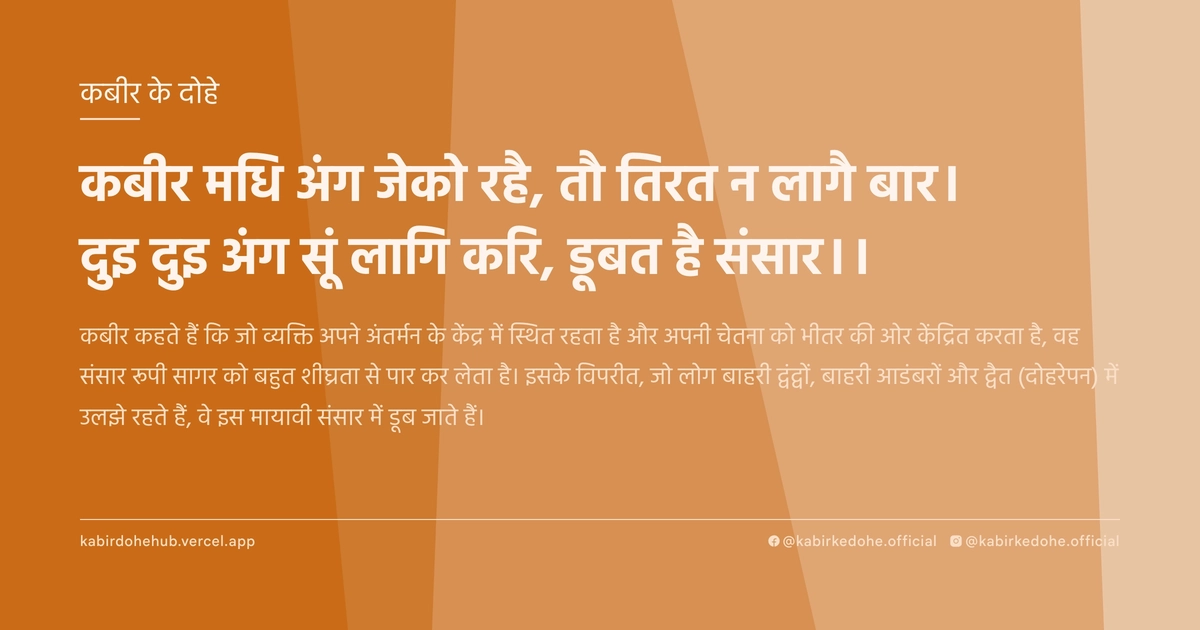
कबीर मधि अंग जेको रहै, तौ तिरत न लागै बार।
दुइ दुइ अंग सूं लागि करि, डूबत है संसार।।
Kabir madhi ang jeko rahai, tau tirat na laagai baar. Dui dui ang soon laagi kari, doobat hai sansaar.
इस पृष्ठ पर इस कबीर दोहे का अर्थ (meaning), हिंदी व्याख्या और अंग्रेज़ी अनुवाद, दार्शनिक विश्लेषण और व्यावहारिक जीवन सीख दी गई है। यह दोहा सहज योग (Sahaja Yoga) विषय से जुड़ा है — Kabir doha meaning and explanation in Hindi and English.
अर्थ (Meaning):
कबीर कहते हैं कि जो व्यक्ति अपने अंतर्मन के केंद्र में स्थित रहता है और अपनी चेतना को भीतर की ओर केंद्रित करता है, वह संसार रूपी सागर को बहुत शीघ्रता से पार कर लेता है। इसके विपरीत, जो लोग बाहरी द्वंद्वों, बाहरी आडंबरों और द्वैत (दोहरेपन) में उलझे रहते हैं, वे इस मायावी संसार में डूब जाते हैं।
Kabir asserts that the individual who remains anchored in the center of their own being—the core of the soul—crosses the turbulent ocean of worldly existence without delay. Conversely, those who are entangled in dualities, external rituals, and the fragmentation of the self, inevitably sink into the depths of this illusory world.
व्याख्या (Interpretation):
इस दोहे का शाब्दिक अर्थ है कि आंतरिक केंद्र में टिके रहने वाला व्यक्ति मोक्ष प्राप्त करता है। यहाँ "मधि अंग" का तात्पर्य उस शून्य या बिंदु से है जहाँ आत्मा और परमात्मा का मिलन होता है। कबीर यहाँ 'द्वैत' (Duality) की चेतावनी दे रहे हैं, जहाँ मनुष्य स्वयं को शरीर, मन और बाहरी दुनिया से अलग मानकर संघर्ष करता है। यह निरगुण भक्ति का सार है, जहाँ ईश्वर बाहर नहीं बल्कि भीतर के मौन में खोजा जाता है। जब हम 'दो' (मैं और तू) के भ्रम में जीते हैं, तो हम माया के जाल में फंस जाते हैं। अद्वैत वेदांत के अनुसार, जब तक ज्ञाता और ज्ञेय का भेद रहता है, तब तक बंधन बना रहता है। केवल केंद्र (Sushumna or the Core) में स्थित होकर ही इस द्वंद्व से मुक्ति संभव है।
Literally, the verse suggests that staying centered leads to liberation. The term "madhi ang" refers to the spiritual center or the 'still point' where the individual soul merges with the Universal Consciousness. Kabir warns against 'Duality' (Dvaita), where the human perceives a separation between the self, the body, and the external world. This is the essence of Nirgun Bhakti, where the Divine is not a distant entity but a presence found within the silence of the heart. When we live in the illusion of 'two'—the ego and the other—we become entangled in Maya. According to Advaita Vedanta, as long as the distinction between the knower and the known persists, bondage remains. Only by anchoring oneself in the singular center can one transcend the fragmentation of existence.
दार्शनिक विश्लेषण (Philosophical Analysis):
कबीर का यह दर्शन उनके युग के कट्टरपंथी धार्मिक अनुष्ठानों और बाहरी दिखावे के विरुद्ध एक सशक्त प्रहार है। उस समय समाज कर्मकांडों, तीर्थयात्राओं और बाहरी प्रतीकों में उलझा था, जिसे कबीर ने 'दो अंग' या द्वैत कहा है। उनका तर्क है कि सत्य किसी मंदिर, मस्जिद या बाहरी क्रिया में नहीं, बल्कि चेतना के केंद्र में है। यह दृष्टिकोण सूफी मत के 'फना' (अहंकार का विलीनीकरण) और अद्वैत वेदांत के 'अहं ब्रह्मास्मि' से गहराई से मेल खाता है।
यहाँ 'डूबने' का अर्थ भौतिक मृत्यु नहीं, बल्कि आध्यात्मिक पतन और अज्ञानता का गहरा होना है। जब मनुष्य अपनी ऊर्जा को बाहरी दुनिया की प्रशंसा, क्रोध, लोभ और सामाजिक प्रतिष्ठा में विभाजित करता है, तो उसकी आंतरिक शक्ति क्षीण हो जाती है। कबीर मनोवैज्ञानिक रूपांतरण की बात करते हैं, जहाँ व्यक्ति को अपनी पहचान को बाहरी उपाधियों से हटाकर आंतरिक शून्यता में स्थापित करना होता है।
यह दोहा यह स्पष्ट करता है कि मोक्ष कोई बाहरी गंतव्य नहीं है, बल्कि एक आंतरिक स्थिति है। जो व्यक्ति अपनी इंद्रियों के बिखराव को रोककर केंद्र में स्थित होता है, वह माया के प्रभाव से मुक्त हो जाता है। यह 'एकता' का मार्ग है, जो जाति, धर्म और संप्रदाय की सीमाओं को तोड़ देता है।
कबीर के अनुसार, संसार का 'डूबना' वास्तव में अहंकार का डूबना है। जब तक 'मैं' और 'मेरा' का भाव रहता है, तब तक व्यक्ति द्वैत के बोझ तले दबा रहता है। जैसे ही यह बोध होता है कि सब कुछ एक ही चेतना का विस्तार है, वह व्यक्ति 'तैर' जाता है।
अंततः, यह विश्लेषण हमें सिखाता है कि आध्यात्मिक प्रगति का पैमाना यह नहीं है कि हमने कितने ग्रंथ पढ़े या कितने व्रत रखे, बल्कि यह है कि हम अपने आंतरिक केंद्र के कितने करीब हैं। बाहरी शोर के बीच आंतरिक मौन को बनाए रखना ही वास्तविक साधना है।
Kabir's philosophy here is a potent critique of the rigid religious rituals and external displays prevalent during his era. Society was obsessed with ceremonialism, pilgrimages, and outward symbols, which Kabir characterizes as the 'two parts' or duality. He argues that Truth resides not in temples, mosques, or external acts, but at the very center of consciousness.
This perspective aligns profoundly with the Sufi concept of 'Fana' (the annihilation of the ego) and the Advaita Vedanta realization of 'Aham Brahmasmi' (I am Brahman). The 'sinking' mentioned is not physical death, but spiritual decay and the deepening of ignorance. When a human divides their energy among external praise, anger, greed, and social status, their inner strength is depleted.
Kabir advocates for a psychological transformation where the individual shifts their identity from external labels to the internal void. He clarifies that liberation is not a distant destination but an internal state of being. One who halts the scattering of their senses and anchors themselves in the center becomes immune to the delusions of Maya.
This is the path of 'Oneness,' which transcends the boundaries of caste, religion, and sect. According to Kabir, the 'sinking' of the world is actually the sinking of the ego. As long as the sense of 'I' and 'Mine' persists, the individual remains burdened by duality. The moment the realization dawns that everything is an extension of a single consciousness, the soul 'swims' across.
Ultimately, this analysis teaches us that the measure of spiritual progress is not the number of scriptures read or fasts observed, but how close one is to their own internal center. Maintaining inner silence amidst external noise is the true spiritual practice.
मूल संदेश (Core Message):
- बाहरी शोर में खोना आध्यात्मिक पतन है।
- आंतरिक केंद्र ही एकमात्र सुरक्षित आश्रय है।
- द्वैत का त्याग ही वास्तविक मुक्ति का मार्ग है।
- अहंकार का विलीनीकरण ही संसार से पार उतरना है।
- स्थिरता बाहरी परिस्थितियों में नहीं, भीतर के मौन में है।
- स्वयं को जानना ही परमात्मा को पाना है।
- Losing oneself in external noise is spiritual decay.
- The internal center is the only secure sanctuary.
- Renouncing duality is the true path to liberation.
- The dissolution of ego is the act of crossing the world.
- Stability lies not in circumstances, but in inner silence.
- Knowing the self is the ultimate realization of the Divine.
व्यावहारिक उदाहरण (Practical Example):
वाराणसी के एक पुराने घाट पर माधव नाम का एक वृद्ध बुनकर रहता था। माधव अपनी पूरी जिंदगी रेशमी धागों को बुनने में बिता चुका था, लेकिन उसका मन हमेशा अशांत रहता था। वह समाज में अपनी प्रतिष्ठा, अपने बेटों की सफलता और पड़ोसियों की ईर्ष्या के बीच झूलता रहता था। वह अक्सर सोचता था कि यदि वह और अधिक धन कमा ले या बड़े विद्वानों की संगत में रहे, तो उसे शांति मिलेगी। वह बाहरी दुनिया के 'दो अंगों'—लाभ और हानि, मान और अपमान—के बीच बुरी तरह फंसा हुआ था।
एक दिन माधव की मुलाकात एक घुमक्कड़ फकीर से हुई, जिसने उसे कबीर का यह दोहा सुनाया। फकीर ने कहा, "माधव, तुम धागों को तो सीधा कर रहे हो, लेकिन अपनी चेतना को बिखेर रहे हो। तुम बाहर खोज रहे हो, जबकि खजाना तुम्हारे भीतर के केंद्र में है।"
माधव ने इस बात पर विचार किया। उसने महसूस किया कि उसकी सारी चिंताएं इस बात पर टिकी थीं कि 'लोग क्या कहेंगे' या 'मेरा भविष्य क्या होगा'। वह अपनी खुशी को बाहरी परिस्थितियों से जोड़ रहा था। उसने तय किया कि वह अब अपनी पहचान को अपनी उपलब्धियों या दूसरों की राय से नहीं जोड़ेगा।
उसने प्रतिदिन सुबह एक घंटा मौन रहकर केवल अपनी सांसों के केंद्र पर ध्यान लगाना शुरू किया। जब भी उसके मन में किसी के प्रति क्रोध या ईर्ष्या आती, वह खुद से पूछता, "क्या यह मेरे केंद्र का हिस्सा है या बाहरी शोर का?"
धीरे-धीरे माधव के व्यवहार में बदलाव आया। अब वह अपने काम को केवल पैसे के लिए नहीं, बल्कि एक ध्यान (Meditation) की तरह करने लगा। उसने देखा कि जब वह केंद्र में रहता है, तो बाहरी विवाद उसे विचलित नहीं करते।
एक बार उसके बेटे ने पारिवारिक संपत्ति को लेकर एक बड़ा विवाद खड़ा किया। पहले का माधव इस तनाव में डूब जाता और रातों की नींद खो देता। लेकिन अब, वह शांत रहा। उसने महसूस किया कि विवाद बाहरी है, लेकिन उसकी शांति आंतरिक है।
उसने अपने बेटे से शांति से बात की और समस्या का समाधान निकाला, बिना अपनी मानसिक शांति खोए। उसके परिवार वाले हैरान थे कि माधव अब पहले से कहीं अधिक स्थिर और प्रसन्न रहने लगा था।
माधव ने जान लिया था कि संसार की लहरें तो उठती रहेंगी, लेकिन जो अपनी जड़ को केंद्र में जमा लेता है, वह कभी नहीं डूबता। उसने बाहरी द्वंद्वों को त्यागकर आंतरिक एकता को अपना लिया था।
उसकी यह शांति अब उसके काम में भी झलकने लगी। उसके द्वारा बुने गए कपड़ों में एक अजीब सी सौम्यता और पूर्णता आ गई थी।
अंत में, माधव ने पाया कि जिस मोक्ष की तलाश में लोग तीर्थों पर जाते हैं, वह वास्तव में स्वयं के भीतर ठहरने की कला है।
In the ancient ghats of Varanasi lived an elderly weaver named Madhav. Madhav had spent his entire life weaving silk threads, yet his mind was perpetually restless. He swung between the desire for social prestige, his sons' success, and the jealousy of his neighbors. He believed that earning more wealth or associating with great scholars would bring him peace. He was deeply trapped between the 'two parts' of the external world—profit and loss, honor and insult.
One day, Madhav met a wandering fakir who recited this specific Doha of Kabir. The fakir said, "Madhav, you are straightening the threads of your cloth, but you are scattering your consciousness. You search outside, while the treasure lies at the center of your being."
Madhav pondered this. He realized that all his anxieties were rooted in 'what people would say' or 'what his future would hold.' He had tied his happiness to external circumstances. He decided that he would no longer link his identity to his achievements or the opinions of others.
He began spending an hour every morning in silence, focusing solely on the center of his breath. Whenever anger or jealousy arose, he would ask himself, "Is this part of my center, or is it external noise?"
Gradually, a shift occurred in Madhav's behavior. He stopped weaving just for money and began treating his craft as a form of meditation. He noticed that when he remained centered, external conflicts could not disturb him.
Once, his son created a major dispute over family property. The old Madhav would have drowned in stress and lost sleep. But now, he remained calm. He realized the conflict was external, but his peace was internal.
He spoke to his son with composure and resolved the issue without sacrificing his mental equilibrium. His family was astonished that Madhav had become more stable and joyful than ever before.
Madhav had learned that the waves of the world will always rise, but he who anchors his root in the center never sinks. He had abandoned external dualities in favor of internal unity.
This peace began to reflect in his work. The fabrics he wove acquired a strange softness and perfection, as if they were infused with silence.
Ultimately, Madhav discovered that the liberation people seek in pilgrimages is, in reality, the art of remaining still within oneself.
अभ्यास मार्गदर्शन (Practice Guidance):
- दैनिक ध्यान: प्रतिदिन 20 मिनट 'शून्य' या हृदय केंद्र पर ध्यान केंद्रित करें। विचार आएं तो उन्हें केवल देखें, उनमें शामिल न हों।
- आत्म-पूछताछ जर्नल: दिन के अंत में लिखें कि आज आप कितनी बार 'बाहरी द्वंद्वों' (जैसे प्रशंसा या आलोचना) के कारण विचलित हुए और उस समय आपका केंद्र कहाँ था।
- व्यवहार परिवर्तन: जब भी कोई विवाद हो, तुरंत प्रतिक्रिया देने के बजाय 3 गहरी सांसें लें और अपनी चेतना को शरीर के केंद्र में वापस लाएं।
- निदान चेकलिस्ट: क्या मैं दूसरों की राय से अपनी खुशी तय कर रहा हूँ? क्या मैं 'मैं' और 'वे' के भेद में उलझा हूँ? यदि हाँ, तो मैं 'डूब' रहा हूँ; यदि मैं तटस्थ हूँ, तो मैं 'तैर' रहा हूँ।
- Daily Meditation: Spend 20 minutes daily focusing on the 'Void' or the center of the heart. Observe thoughts as they arise without becoming entangled in them.
- Self-Inquiry Journal: At the end of the day, record how many times you were disturbed by 'external dualities' (such as praise or criticism) and where your center was at that moment.
- Behavioral Shift: During a conflict, instead of reacting instantly, take three deep breaths and consciously pull your awareness back to the center of your being.
- Diagnostic Checklist: Am I letting others' opinions determine my happiness? Am I trapped in the distinction of 'I' vs 'Them'? If yes, I am 'sinking'; if I remain neutral, I am 'swimming'.
चिंतन प्रश्न (Reflection Questions):
- मेरी पहचान का कितना हिस्सा मेरी वास्तविक चेतना है और कितना केवल सामाजिक मुखौटा है?
- मैं किन 'दो अंगों' या द्वंद्वों (जैसे सफलता बनाम विफलता) के बीच सबसे अधिक संघर्ष करता हूँ?
- यदि मेरी सारी बाहरी उपलब्धियाँ छीन ली जाएं, तो मेरे भीतर क्या बचेगा?
- क्या मेरा 'डिजिटल अहंकार' मुझे मेरे आंतरिक केंद्र से दूर ले जा रहा है?
- मैं दूसरों में जो कमियां देखता हूँ, क्या वे वास्तव में मेरे अपने आंतरिक बिखराव का प्रतिबिंब हैं?
- क्या मैं शांति की तलाश बाहर कर रहा हूँ, जबकि मैं स्वयं ही शांति का स्रोत हूँ?
- How much of my identity is my true consciousness, and how much is merely a social mask?
- Between which 'two parts' or dualities (e.g., success vs. failure) do I struggle the most?
- If all my external achievements were stripped away, what would remain within me?
- Is my 'digital ego' pulling me away from my internal center?
- Are the flaws I see in others actually reflections of my own internal fragmentation?
- Am I searching for peace externally, while I myself am the source of peace?