
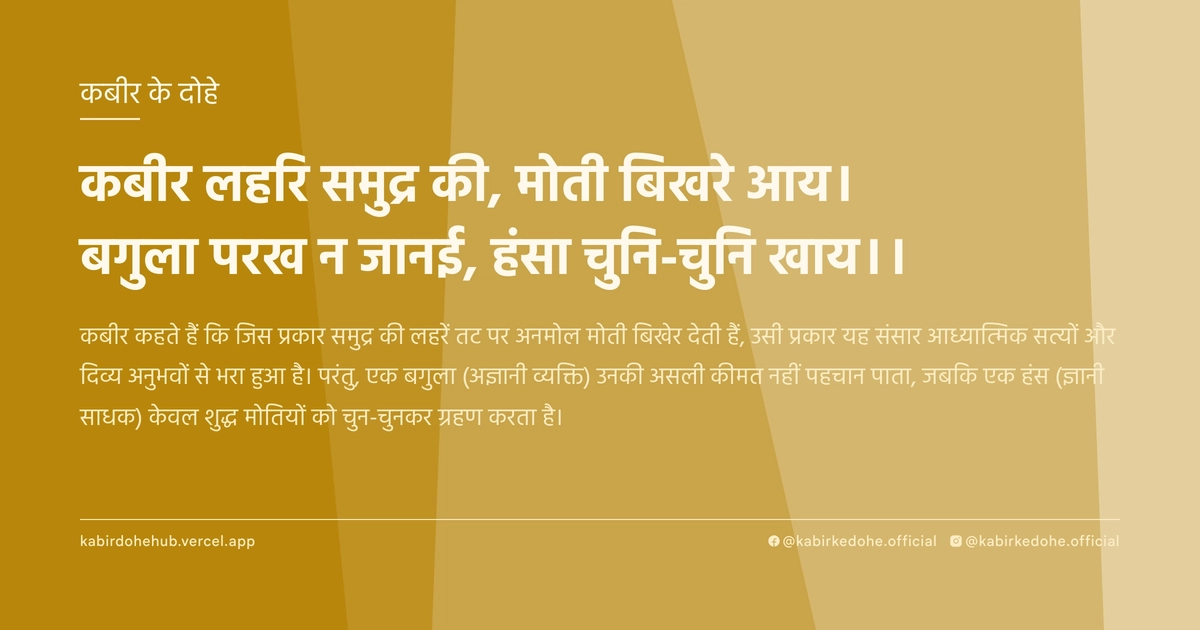
कबीर लहरि समुद्र की, मोती बिखरे आय।
बगुला परख न जानई, हंसा चुनि-चुनि खाय।।
Kabir lahari samudra ki, moti bikhre aay. Bagula parakh na jaanai, hansa chuni-chuni khaay.
इस पृष्ठ पर इस कबीर दोहे का अर्थ (meaning), हिंदी व्याख्या और अंग्रेज़ी अनुवाद, दार्शनिक विश्लेषण और व्यावहारिक जीवन सीख दी गई है। यह दोहा सहज योग (Sahaja Yoga) विषय से जुड़ा है — Kabir doha meaning and explanation in Hindi and English.
अर्थ (Meaning):
कबीर कहते हैं कि जिस प्रकार समुद्र की लहरें तट पर अनमोल मोती बिखेर देती हैं, उसी प्रकार यह संसार आध्यात्मिक सत्यों और दिव्य अनुभवों से भरा हुआ है। परंतु, एक बगुला (अज्ञानी व्यक्ति) उनकी असली कीमत नहीं पहचान पाता, जबकि एक हंस (ज्ञानी साधक) केवल शुद्ध मोतियों को चुन-चुनकर ग्रहण करता है।
Kabir explains that just as the waves of the ocean cast precious pearls upon the shore, the world is overflowing with spiritual truths and divine revelations. However, the heron (the ignorant or superficial seeker) fails to recognize their true value, whereas the swan (the enlightened soul) discerns and gathers only the pure, essential pearls of wisdom.
व्याख्या (Interpretation):
इस दोहे में 'समुद्र' इस भौतिक जगत और 'लहरें' समय के प्रवाह का प्रतीक हैं। 'मोती' वह गुप्त ज्ञान या आत्म-साक्षात्कार है जो हर व्यक्ति के भीतर और बाहर उपलब्ध है। बगुला उस व्यक्ति का प्रतिनिधित्व करता है जो केवल बाहरी दिखावे, कर्मकांडों और सांसारिक लाभों में उलझा रहता है, जिससे वह सत्य को देखने में असमर्थ होता है। इसके विपरीत, 'हंस' उस जागृत चेतना का प्रतीक है जो विवेक (Discrimination) का उपयोग कर माया के शोर में छिपे सत्य को पहचान लेता है। यह निरगुण भक्ति का सार है, जहाँ ईश्वर किसी मंदिर या मस्जिद में नहीं, बल्कि अस्तित्व के कण-कण में व्याप्त है। यहाँ हंस का 'चुन-चुनकर खाना' विवेक-शक्ति (Viveka) को दर्शाता है, जो अद्वैत वेदांत के अनुसार मिथ्या और नित्य के बीच भेद करने की क्षमता है। अंततः, यह दोहा हमें बताता है कि सत्य सबके लिए उपलब्ध है, लेकिन केवल वही उसे पा सकता है जिसकी दृष्टि शुद्ध है और जो अहंकार से मुक्त है।
In this couplet, the 'ocean' symbolizes the material universe and the 'waves' represent the flow of time and existence. The 'pearls' are the hidden spiritual truths or the spark of self-realization available both within and without. The 'heron' represents the ignorant person preoccupied with external appearances, rituals, and worldly gains, rendering them blind to the essence of truth. Conversely, the 'swan' symbolizes the awakened consciousness that employs Viveka (spiritual discrimination) to identify the truth hidden amidst the noise of Maya (illusion). This is the core of Nirgun Bhakti, where the Divine is not confined to temples or mosques but permeates every atom of existence. The act of the swan 'picking and choosing' signifies the capacity to distinguish between the transient (Mithya) and the eternal (Nitya), a central tenet of Advaita Vedanta. Ultimately, the doha asserts that while truth is universally accessible, only those with a purified vision and an ego-less heart can truly perceive and integrate it.
दार्शनिक विश्लेषण (Philosophical Analysis):
कबीर का यह दर्शन उनके समय के कट्टरपंथ और बाहरी आडंबरों के विरुद्ध एक सशक्त प्रहार है। उन्होंने देखा कि लोग तीर्थयात्राओं और कठिन अनुष्ठानों में समय व्यतीत करते हैं, जबकि वास्तविक सत्य उनके अपने भीतर और सरल जीवन के अनुभवों में बिखरा पड़ा है। यह दृष्टिकोण सूफीवाद के 'इंसान-ए-कामिल' (पूर्ण मनुष्य) और अद्वैत वेदांत के 'ब्रह्म' की अवधारणा से मेल खाता है, जहाँ आत्मा और परमात्मा के बीच का अंतर केवल अज्ञानता के कारण है।
बगुला यहाँ उस मनोवैज्ञानिक स्थिति का प्रतीक है जिसे 'सांसारिक आसक्ति' कहा जाता है। बगुला मछली पकड़ता है, जो कि एक सीमित और भौतिक इच्छा है। वह मोतियों को नहीं देखता क्योंकि उसकी दृष्टि केवल भूख और जीवित रहने के संघर्ष तक सीमित है। यह मानव अहंकार (Ahamkara) की त्रासदी है; हम सत्य के सागर में तैर रहे होते हैं, फिर भी अपनी छोटी इच्छाओं के कारण उस अनंत आनंद को अनदेखा कर देते हैं।
कबीर 'हंस' के माध्यम से उस मानसिक रूपांतरण की बात करते हैं जहाँ साधक 'साक्षी भाव' (Witness Consciousness) में स्थित होता है। हंस का स्वभाव दूध और पानी को अलग करने का माना जाता है, जो कि विवेक का उच्चतम स्तर है। यह प्रक्रिया केवल शास्त्रों को पढ़ने से नहीं, बल्कि आंतरिक मौन और निरंतर आत्म-निरीक्षण से आती है।
यहाँ निरगुण भक्ति का प्रभाव स्पष्ट है। कबीर किसी साकार देवता की पूजा के बजाय उस निराकार तत्व की खोज पर जोर देते हैं जो सर्वव्यापी है। उनके लिए, प्रकृति और जीवन की हर घटना एक संदेश है, बशर्ते देखने वाला 'हंस' बन चुका हो। यह दर्शन व्यक्ति को बाहरी गुरुओं की निर्भरता से हटाकर स्वयं के भीतर के अंतर्ज्ञान (Intuition) की ओर ले जाता है।
अंततः, यह दोहा यह स्पष्ट करता है कि आध्यात्मिक प्रगति का अर्थ नई चीजों को प्राप्त करना नहीं, बल्कि जो पहले से मौजूद है उसे पहचानने की क्षमता विकसित करना है। यह 'अविद्या' (अज्ञान) के विनाश और 'विद्या' (ज्ञान) के उदय की यात्रा है, जहाँ व्यक्ति यह समझता है कि वह स्वयं वह मोती है जिसे वह बाहर खोज रहा था।
Kabir's philosophy here serves as a potent critique of the dogmatism and external ostentation prevalent during his era. He observed people spending lifetimes in pilgrimages and rigorous rituals, while the actual truth lay scattered within themselves and in the simple experiences of daily life. This perspective aligns with the Sufi concept of 'Al-Insan al-Kamil' (the Perfect Human) and the Advaita Vedanta notion of 'Brahman,' where the perceived separation between the soul and the Divine is merely a product of ignorance.
The 'heron' symbolizes the psychological state of 'Samsaric attachment.' The heron hunts fish, representing limited, material desires. It overlooks the pearls because its vision is constrained by hunger and the struggle for survival. This is the tragedy of the human ego (Ahamkara); we swim in an ocean of truth yet ignore the infinite bliss due to our petty cravings.
Through the 'swan,' Kabir speaks of a mental transformation where the seeker attains 'Sakshi Bhava' (Witness Consciousness). The swan is traditionally believed to have the ability to separate milk from water, signifying the highest level of spiritual discrimination. This process is not achieved through the mere study of scriptures, but through inner silence and constant self-inquiry.
The influence of Nirgun Bhakti is evident. Rather than worshipping a form-bound deity, Kabir emphasizes the search for the formless element that permeates everything. For him, every natural event and life experience is a message, provided the observer has evolved into a 'swan.' This philosophy shifts the seeker's dependence from external gurus to their own inner intuition.
Ultimately, the doha clarifies that spiritual progress is not about acquiring new things, but about developing the capacity to recognize what is already present. It is a journey from 'Avidya' (ignorance) to 'Vidya' (knowledge), where the individual realizes that they themselves are the pearl they were searching for externally.
मूल संदेश (Core Message):
- बाहरी आडंबर सत्य की दृष्टि को धुंधला कर देते हैं।
- विवेक ही वह शक्ति है जो साधारण को असाधारण बनाती है।
- सत्य सर्वव्यापी है, केवल हमारी पात्रता की कमी है।
- अहंकार का त्याग ही 'बगुले' से 'हंस' बनने का मार्ग है।
- ईश्वर को खोजने के लिए कहीं जाने की नहीं, केवल देखने के ढंग को बदलने की आवश्यकता है।
- External ostentation blurs the vision of truth.
- Discrimination (Viveka) is the power that turns the ordinary into the extraordinary.
- Truth is omnipresent; only our capacity to perceive it is lacking.
- Renouncing the ego is the only path from being a heron to becoming a swan.
- Finding the Divine requires no travel, only a change in the way we perceive.
व्यावहारिक उदाहरण (Practical Example):
वाराणसी के घाटों पर रहने वाले एक वृद्ध विधवा, जानकी, का जीवन अत्यंत अभावपूर्ण था। वह दिन भर अन्य लोगों के घरों में सफाई करती और शाम को गंगा किनारे बैठकर मौन रहती। शहर के कई बड़े पंडित और विद्वान उनके पास से गुजरते, उन्हें केवल एक 'गरीब विधवा' के रूप में देखते और उपदेश देते कि उन्हें मोक्ष के लिए कठिन व्रत करने चाहिए। ये विद्वान उस 'बगुले' की तरह थे जो केवल बाहरी पहचान और कर्मकांडों को देख रहे थे।
एक दिन, एक युवा जिज्ञासु ने देखा कि जानकी जब किसी से बात करती, तो उसकी बातों में एक ऐसी शांति और गहराई होती थी जो बड़े-बड़े ग्रंथों में नहीं मिलती। वह जिज्ञासु उनके पास गया और पूछा, "माँ, आप इतनी गरीबी में भी इतनी शांत कैसे हैं?"
जानकी ने मुस्कुराकर पास पड़े एक गंदे पत्थर को उठाया और कहा, "बेटा, लोग इस पत्थर को गंदगी समझकर छोड़ देते हैं, लेकिन अगर इसे रगड़ा जाए, तो इसके भीतर का असली रंग बाहर आता है। मेरा दुख भी मेरे लिए वही रगड़ है, जिसने मुझे मेरे भीतर के ईश्वर से मिला दिया।"
उस युवा जिज्ञासु को अचानक कबीर का वह दोहा याद आया। उसने महसूस किया कि वह अब तक केवल 'बगुला' बनकर ज्ञान की खोज कर रहा था—किताबों में, प्रवचनों में और बाहरी आडंबरों में। लेकिन जानकी, जो समाज की नजर में कुछ नहीं थी, वास्तव में वह 'हंस' थी जिसने जीवन के दुखों के समुद्र से शांति का मोती चुन लिया था।
उस क्षण उस युवक के भीतर एक गहरा रूपांतरण हुआ। उसने अपनी बौद्धिक श्रेष्ठता का अहंकार त्याग दिया। उसने समझा कि ज्ञान शब्दों में नहीं, बल्कि अनुभव और सरलता में होता है।
उसने जानकी के चरणों में बैठकर मौन रहना सीखा। उसने पाया कि जब हम दूसरों को उनकी सामाजिक स्थिति से नहीं, बल्कि उनकी आत्मा से देखते हैं, तब हमें हर व्यक्ति में एक गुरु नजर आता है।
उसने अपने जीवन से दिखावे की सारी परतें हटा दीं। वह अब मंदिर जाने के बजाय, उन लोगों की सेवा करने लगा जो उपेक्षित थे, क्योंकि उसने जान लिया था कि मोती वहीं बिखरे हैं जहाँ दुनिया की नजर नहीं जाती।
इस प्रकार, एक साधारण विधवा के सरल शब्दों ने उस युवक को 'बगुले' से 'हंस' बना दिया, और उसने जीवन को केवल जीने के बजाय उसे अनुभव करना शुरू किया।
In the ghats of Varanasi lived an elderly widow named Janaki, whose life was marked by extreme scarcity. She spent her days cleaning other people's homes and her evenings sitting in silence by the Ganges. Many prominent pundits and scholars passed by her, seeing her only as a 'poor widow' and advising her to perform rigorous fasts to attain salvation. These scholars were like the 'herons,' seeing only external identities and rituals.
One day, a young seeker noticed that whenever Janaki spoke, there was a peace and depth in her words that was absent in the greatest texts. The seeker approached her and asked, "Mother, how are you so peaceful despite such poverty?"
Janaki smiled, picked up a dirty stone from the ground, and said, "Son, people discard this stone as filth, but if it is rubbed and polished, its true color emerges. My sorrow has been that very friction for me, which connected me to the Divine within."
The young seeker suddenly remembered Kabir's doha. He realized that he had been acting as the 'heron,' searching for knowledge in books, lectures, and external displays.
But Janaki, who was nothing in the eyes of society, was actually the 'swan' who had gathered the pearl of peace from the ocean of life's sorrows.
In that moment, a profound transformation occurred within the youth. He discarded the ego of his intellectual superiority.
He understood that true knowledge resides not in words, but in experience and simplicity.
He began to sit in silence at Janaki's feet. He discovered that when we view others not through their social status but through their soul, we find a guru in every person.
He stripped away all the layers of pretense from his life. Instead of merely visiting temples, he began serving the marginalized, for he realized that the pearls are scattered where the world refuses to look.
Thus, the simple words of an ordinary widow transformed the youth from a 'heron' into a 'swan,' and he began to truly experience life rather than just existing through it.
अभ्यास मार्गदर्शन (Practice Guidance):
- दैनिक अभ्यास: प्रतिदिन 20 मिनट 'साक्षी भाव' का अभ्यास करें। अपने विचारों को बिना किसी निर्णय के देखें, जैसे आप किसी अन्य व्यक्ति के विचारों को देख रहे हों।
- आत्म-पूछताछ जर्नल: हर शाम लिखें—'आज मैंने कितनी बार अपनी धारणाओं (Judgments) के आधार पर किसी को परखा? क्या मैं बगुले की तरह केवल बाहरी सतह को देख रहा था?'
- व्यवहारिक परिवर्तन: दिन में कम से कम एक बार किसी ऐसे व्यक्ति से बात करें जिसे समाज 'महत्वहीन' मानता है, और उनके भीतर छिपे किसी एक गुण या सत्य को खोजने का प्रयास करें।
- निदान चेकलिस्ट: यदि आप अभी भी दूसरों की आलोचना कर रहे हैं या केवल भौतिक उपलब्धियों से संतुष्ट हैं, तो आप 'बगुला' अवस्था में हैं। यदि आप विपरीत परिस्थितियों में भी आंतरिक शांति खोज पा रहे हैं, तो आप 'हंस' की ओर बढ़ रहे हैं।
- Daily Practice: Practice 'Sakshi Bhava' (Witness Consciousness) for 20 minutes daily. Observe your thoughts without judgment, as if you are observing someone else's mind.
- Self-Inquiry Journal: Every evening, write—'How many times today did I judge someone based on my preconceived notions? Was I acting like the heron, seeing only the surface?'
- Behavioral Change: At least once a day, engage with someone whom society deems 'insignificant' and consciously try to find a virtue or a truth hidden within them.
- Diagnostic Checklist: If you are still criticizing others or finding satisfaction only in material achievements, you are in the 'heron' state. If you can find inner peace even in adverse circumstances, you are evolving into the 'swan'.
चिंतन प्रश्न (Reflection Questions):
- मेरी वह कौन सी 'मानसिक भूख' है जो मुझे सत्य के मोतियों को देखने से रोकती है?
- मैं अपनी सार्वजनिक छवि (Digital/Social Ego) को बनाए रखने के लिए कितनी सच्चाई की बलि देता हूँ?
- क्या मैं वास्तव में सत्य की खोज कर रहा हूँ, या केवल अपनी मान्यताओं की पुष्टि (Confirmation Bias) चाहता हूँ?
- मेरे जीवन के वे कौन से 'कठिन अनुभव' हैं जिन्हें मैं अब तक बोझ समझ रहा था, लेकिन वे वास्तव में मुझे तराशने वाले मोती थे?
- यदि मैं अपनी सभी उपाधियों और उपलब्धियों को हटा दूँ, तो क्या मेरे भीतर वह 'हंस' जीवित है जो मौन में आनंद पा सके?
- What is the 'mental hunger' within me that prevents me from seeing the pearls of truth?
- How much of my authentic truth do I sacrifice to maintain my public image (Digital/Social Ego)?
- Am I truly seeking the truth, or am I merely seeking confirmation of my existing biases?
- Which 'difficult experiences' in my life have I viewed as burdens, when they were actually the friction polishing my soul?
- If I strip away all my titles and achievements, does the 'swan' within me still exist, capable of finding bliss in silence?