
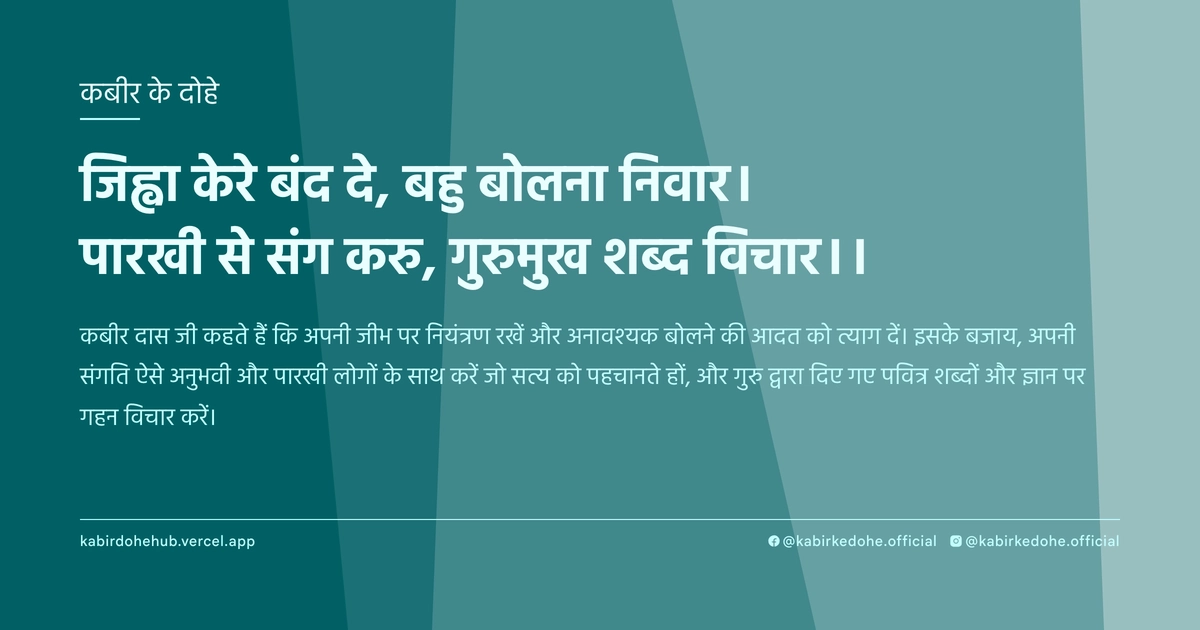
जिह्वा केरे बंद दे, बहु बोलना निवार।
पारखी से संग करु, गुरुमुख शब्द विचार।।
Jihva kere band de, bahu bolna nivaar. Parkhi se sang karu, gurumukh shabd vichaar.
इस पृष्ठ पर इस कबीर दोहे का अर्थ (meaning), हिंदी व्याख्या और अंग्रेज़ी अनुवाद, दार्शनिक विश्लेषण और व्यावहारिक जीवन सीख दी गई है। यह दोहा संयम (Self-discipline) विषय से जुड़ा है — Kabir doha meaning and explanation in Hindi and English.
अर्थ (Meaning):
कबीर दास जी कहते हैं कि अपनी जीभ पर नियंत्रण रखें और अनावश्यक बोलने की आदत को त्याग दें। इसके बजाय, अपनी संगति ऐसे अनुभवी और पारखी लोगों के साथ करें जो सत्य को पहचानते हों, और गुरु द्वारा दिए गए पवित्र शब्दों और ज्ञान पर गहन विचार करें।
Kabir advises the seeker to restrain the tongue and eliminate the habit of excessive speaking. Instead of wasting energy in idle chatter, one should seek the company of the 'Parkhi'—the discerning experts of truth—and deeply contemplate the sacred words and wisdom transmitted by the enlightened Guru.
व्याख्या (Interpretation):
इस दोहे का शाब्दिक अर्थ मौन का अभ्यास है, लेकिन इसका आध्यात्मिक अर्थ ऊर्जा का संरक्षण है। 'जिह्वा केरे बंद' का तात्पर्य केवल चुप रहने से नहीं, बल्कि मन के शोर को शांत करने से है। जब हम अत्यधिक बोलते हैं, तो हम अपनी आंतरिक शक्ति को व्यर्थ करते हैं और अहंकार को पोषित करते हैं। यह Nirgun Bhakti का मार्ग है जहाँ बाहरी आडंबरों और शब्दों के बजाय आंतरिक अनुभव को प्राथमिकता दी जाती है। माया हमें शब्दों के जाल में उलझाती है, जबकि 'गुरुमुख शब्द' हमें उस अद्वैत सत्य की ओर ले जाते हैं जहाँ आत्मा और परमात्मा एक हो जाते हैं। यहाँ विरोधाभास यह है कि सत्य को पाने के लिए पहले शब्दों का त्याग करना पड़ता है।
Literally, this couplet advocates for silence, but spiritually, it addresses the conservation of vital energy. 'Restraining the tongue' is not merely about physical silence but about silencing the mental noise that fuels the ego. Excessive speech often serves as a veil for Maya, keeping the seeker trapped in the illusion of social identity and intellectual pride. In the tradition of Nirgun Bhakti, the formless Divine is not reached through linguistic gymnastics but through the stillness of the heart. The 'Gurumukh' represents the bridge between the conditioned mind and the unconditioned Atman. The central paradox is that to articulate the ultimate truth of Advaita Vedanta, one must first embrace the profound silence that precedes all words.
दार्शनिक विश्लेषण (Philosophical Analysis):
कबीर का यह संदेश उस समय के सामाजिक और धार्मिक परिवेश में एक क्रांतिकारी प्रहार था, जहाँ पंडित और मुल्ला केवल शब्दों के जाल और शास्त्रार्थ के माध्यम से अपनी श्रेष्ठता सिद्ध करते थे। कबीर ने कर्मकांडीय ज्ञान के बजाय 'अनुभवजन्य ज्ञान' (Experiential Knowledge) पर जोर दिया। वे मानते थे कि जब तक व्यक्ति अपनी इंद्रियों, विशेषकर वाणी पर नियंत्रण नहीं पाता, वह आंतरिक शून्य का अनुभव नहीं कर सकता।
यह दर्शन अद्वैत वेदांत के उस सिद्धांत से मेल खाता है जहाँ 'नेति-नेति' (यह नहीं, वह नहीं) के माध्यम से सत्य तक पहुँचा जाता है। शब्दों का त्याग ही वह द्वार है जिससे हम द्वैत (Duality) से ऊपर उठकर अभेद स्थिति में पहुँचते हैं। सूफीवाद में भी 'खामोशी' या 'समत' को ईश्वर से मिलन की एक अनिवार्य शर्त माना गया है, क्योंकि शब्द सीमित हैं और ईश्वर असीम है।
मनोवैज्ञानिक स्तर पर, अत्यधिक बोलना अक्सर असुरक्षा और बाहरी मान्यता की भूख का परिणाम होता है। कबीर यहाँ अहंकार के विलीनीकरण (Annihilation of Ego) की बात कर रहे हैं। जब हम चुप होते हैं, तो हम सुनने की क्षमता विकसित करते हैं, और सुनना ही सीखने की पहली सीढ़ी है।
कबीर का 'पारखी' वह व्यक्ति है जिसने सत्य को केवल पढ़ा नहीं है, बल्कि जिया है। यह बौद्धिक ज्ञान बनाम आध्यात्मिक बोध का संघर्ष है। वे चेतावनी देते हैं कि गलत संगति शब्दों के माध्यम से भ्रम को और गहरा करती है।
अंततः, यह दोहा हमें सिखाता है कि आध्यात्मिक प्रगति का पैमाना इस बात से नहीं मापा जाता कि हमने कितना ज्ञान अर्जित किया है, बल्कि इस बात से कि हमने अपने भीतर कितनी शांति स्थापित की है। मौन केवल शब्दों का अभाव नहीं, बल्कि चेतना की पूर्ण उपस्थिति है।
Kabir's directive was a radical critique of the 15th-century socio-religious landscape, dominated by scholars who used linguistic dexterity and scriptural debates to assert spiritual superiority. He shifted the focus from 'scholastic knowledge' to 'experiential realization.' For Kabir, the tongue is the primary instrument of the ego; by restraining it, the seeker prevents the leakage of spiritual energy (Prana) and halts the cycle of mental agitation.
This aligns profoundly with Advaita Vedanta's process of 'Neti-Neti' (not this, not that), where the stripping away of false identifications leads to the realization of the Brahman. Words are inherently dualistic—they categorize, divide, and limit. To experience the non-dual reality, one must transcend the medium of language. Similarly, in Sufism, the concept of 'Samat' (sacred silence) is viewed as the only language capable of communicating with the Divine, as the Infinite cannot be captured in the finite net of words.
Psychologically, the compulsion to speak excessively often stems from a deep-seated need for external validation and a fear of internal void. Kabir addresses the annihilation of the ego (Fana), suggesting that silence is the crucible in which the false self is burned away. By silencing the external voice, the 'Anahad Naad' (the unstruck sound of the universe) becomes audible.
The 'Parkhi' (the discerner) mentioned by Kabir is not a teacher of books, but a witness of truth. This distinguishes between intellectual accumulation and spiritual awakening. Kabir warns that associating with those who merely 'talk' about spirituality without embodying it only thickens the veil of Maya.
Ultimately, this teaching posits that spiritual evolution is measured not by the volume of one's discourse, but by the depth of one's silence. Silence is not a void, but a plenum—a state of full presence where the individual soul (Atman) recognizes its identity with the universal consciousness.
मूल संदेश (Core Message):
- शब्द अक्सर सत्य को ढकने वाले पर्दे होते हैं।
- मौन केवल चुप्पी नहीं, बल्कि आंतरिक जागरूकता है।
- अहंकार शब्दों के माध्यम से जीवित रहता है; मौन उसे मिटाता है।
- सच्चा ज्ञान शास्त्रों में नहीं, बल्कि गुरु के अनुभव में है।
- संगति का चुनाव विवेकपूर्ण होना चाहिए, न कि केवल सुखद।
- आंतरिक शांति ही सर्वोच्च आध्यात्मिक उपलब्धि है।
- Words are often veils that obscure the ultimate truth.
- Silence is not a void, but a state of heightened awareness.
- The ego survives on speech; silence is its annihilation.
- True wisdom resides in the Guru's experience, not in texts.
- Choose company based on discernment, not on mere comfort.
- Inner stillness is the highest spiritual attainment.
व्यावहारिक उदाहरण (Practical Example):
एक समय की बात है, वाराणसी के घाटों पर माधव नाम का एक वृद्ध बुनकर रहता था। माधव अपनी कला में निपुण था, लेकिन वह अपनी वाकपटुता के लिए जाना जाता था। वह हर समय दूसरों की गलतियाँ निकालता और अपनी श्रेष्ठता सिद्ध करने के लिए लंबी-लंबी बहसें करता था। शहर के लोग उसकी बुद्धिमत्ता की प्रशंसा तो करते, लेकिन उसके कड़वे शब्दों के कारण उससे दूर रहते थे।
एक दिन माधव की मुलाकात एक मौन साधु से हुई जो गंगा किनारे केवल अपनी माला जप रहे थे। माधव ने अपनी ज्ञान की पोटली खोलकर साधु को प्रभावित करने की कोशिश की। उसने घंटों तक वेदांत और धर्म पर व्याख्यान दिया। साधु ने एक शब्द भी नहीं बोला, बस एक मंद मुस्कान के साथ माधव की आँखों में देखा।
माधव को लगा कि साधु उसे अनदेखा कर रहे हैं। वह और अधिक उत्तेजित होकर बोलने लगा, यहाँ तक कि उसने साधु की चुप्पी का मजाक उड़ाना शुरू कर दिया। अचानक, साधु ने अपना हाथ उठाया और माधव के होंठों पर एक उंगली रख दी। उस एक इशारे में ऐसी शांति थी कि माधव के भीतर का सारा शोर अचानक थम गया।
उस क्षण माधव को महसूस हुआ कि वह अब तक केवल शब्दों का व्यापार कर रहा था, सत्य का नहीं। उसे अपनी पूरी जिंदगी एक शोर की तरह लगी, जिसमें उसने बहुत कुछ कहा लेकिन कुछ महसूस नहीं किया। वह साधु के चरणों में गिर पड़ा और उनसे मौन रहने की विधि पूछी।
साधु ने उसे एक सरल अभ्यास दिया: 'अगले एक महीने तक, केवल उतना ही बोलो जितना अनिवार्य हो, और बाकी समय अपने भीतर उठने वाले विचारों को देखो।' माधव ने इस कठिन मार्ग को चुना। उसने देखा कि जब वह चुप रहता था, तो उसे अपने भीतर एक गहरा क्रोध और अहंकार महसूस होता था जो शब्दों के माध्यम से बाहर निकलता था।
धीरे-धीरे, माधव की वाणी में मिठास आई। उसने बहस करना छोड़ दिया और लोगों को सुनना शुरू किया। उसने पाया कि जब वह चुप रहा, तो वह अपने आस-पास के लोगों के दुखों को बेहतर ढंग से समझने लगा। उसकी बुनाई में भी एक नई सूक्ष्मता आई क्योंकि उसका मन अब शांत था।
एक दिन, वही पुराना विवाद फिर से शुरू हुआ जब एक पड़ोसी ने उसकी कला की आलोचना की। माधव ने पहले की तरह पलटकर जवाब नहीं दिया, बल्कि बस मुस्कुरा दिया। पड़ोसी हैरान रह गया और उसने पूछा, 'तुम अब लड़ते क्यों नहीं?'
माधव ने शांति से कहा, 'मैं अब शब्दों के बोझ से मुक्त हूँ।' यह उसका 'कबीर ट्विस्ट' था। उसने महसूस किया कि असली शक्ति बोलने में नहीं, बल्कि उस मौन में है जो शब्दों की आवश्यकता को समाप्त कर देता है।
In the ancient lanes of Varanasi lived an elderly weaver named Madhav. Madhav was a master of his craft, but he was equally known for his sharp tongue. He spent his days engaging in endless debates, pointing out the flaws in others' logic to establish his own intellectual superiority. While people admired his wit, they avoided his company due to his caustic nature.
One afternoon, Madhav encountered a silent monk meditating by the Ganges. Driven by a need for validation, Madhav began to lecture the monk on the intricacies of Vedanta and the nature of the soul. He spoke for hours, weaving complex arguments to impress the silent observer. The monk did not utter a single word; he merely looked at Madhav with a serene, knowing smile.
Feeling ignored, Madhav became agitated. He raised his voice and began to mock the monk's silence, calling it a sign of ignorance. Suddenly, the monk raised his hand and placed a single finger upon Madhav's lips. In that simple gesture, there was a resonance of peace so profound that the storm inside Madhav abruptly ceased.
In that moment of stillness, Madhav realized he had been trading in words, not truth. His entire life felt like a cacophony where he had spoken much but experienced nothing. Overwhelmed, he fell at the monk's feet and begged to be taught the art of silence.
The monk gave him a simple practice: 'For the next month, speak only what is absolutely necessary, and spend the rest of your time observing the thoughts that arise within you.' Madhav embraced this discipline. He discovered that in the silence, a reservoir of anger and ego surfaced—emotions he had previously masked with clever speech.
Gradually, Madhav's voice changed. He stopped arguing and started listening. He found that by silencing his own narrative, he could actually hear the unspoken pain of those around him. Even his weaving became more refined, as his mind was no longer fragmented by mental noise.
One day, a neighbor attempted to provoke him by criticizing his work. Instead of launching into a defensive tirade, Madhav simply smiled. The neighbor, bewildered, asked, 'Why don't you fight back anymore?'
Madhav replied softly, 'I have finally set down the burden of words.' This was his 'Kabir Twist.' He realized that true power does not lie in the ability to dominate a conversation, but in the silence that renders the need for domination obsolete.
अभ्यास मार्गदर्शन (Practice Guidance):
- दैनिक मौन व्रत: प्रतिदिन कम से कम एक घंटा 'पूर्ण मौन' का अभ्यास करें, जिसमें न केवल बोलना बल्कि लिखना और डिजिटल संचार भी वर्जित हो।
- सजग श्रवण (Mindful Listening): जब कोई दूसरा बोल रहा हो, तो उत्तर सोचने के बजाय केवल उनकी आवाज़ और भावनाओं को सुनें।
- आत्म-निरीक्षण जर्नल: प्रतिदिन रात को लिखें कि आज आपने कितनी बार अनावश्यक रूप से बोला और उस समय आपके भीतर कौन सा अहंकार (जैसे- श्रेष्ठ दिखने की इच्छा) सक्रिय था।
- निदान चेकलिस्ट: क्या आप बातचीत में दूसरों को काटने की कोशिश करते हैं? क्या आप चुप रहने पर बेचैनी महसूस करते हैं? क्या आपकी बातें दूसरों को छोटा महसूस कराती हैं? यदि हाँ, तो आप अभी भी 'जिह्वा के बंद' से दूर हैं।
- Daily Silence Vow: Practice at least one hour of 'Absolute Silence' daily, abstaining not only from speaking but also from writing and digital communication.
- Mindful Listening: When someone else is speaking, consciously stop formulating a response and instead focus entirely on their tone, emotion, and presence.
- Self-Inquiry Journaling: Each night, record instances where you spoke unnecessarily. Identify the underlying ego-driver (e.g., the need to appear knowledgeable or superior).
- Diagnostic Checklist: Do you frequently interrupt others? Do you feel anxious or restless during silence? Do your words often make others feel diminished? If yes, you are still far from the 'restraint of the tongue'.
चिंतन प्रश्न (Reflection Questions):
- जब मैं चुप होता हूँ, तो मुझे अपने भीतर कौन सा डर या खालीपन महसूस होता है जिसे मैं शब्दों से भरने की कोशिश करता हूँ?
- क्या मेरी बातचीत का उद्देश्य सत्य की खोज है या केवल अपनी छवि (Image) को बेहतर बनाना?
- मेरे जीवन में वह 'पारखी' कौन है जो मुझे मेरी गलतियों का आईना दिखा सके, बिना किसी स्वार्थ के?
- यदि मुझसे मेरी सारी बौद्धिक उपलब्धियाँ और शब्द छीन लिए जाएँ, तो मेरी वास्तविक पहचान क्या रह जाएगी?
- डिजिटल युग में, मेरी 'सोशल मीडिया उपस्थिति' मेरे वास्तविक मौन और आंतरिक शांति को कैसे बाधित कर रही है?
- When I am silent, what fear or emptiness arises within me that I instinctively try to fill with words?
- Is the primary purpose of my conversations to seek truth or to curate a superior image of myself?
- Who is the 'discerner' in my life capable of mirroring my flaws without personal agenda?
- If all my intellectual achievements and vocabulary were stripped away, what would remain of my identity?
- In the digital age, how does my 'online persona' disrupt my capacity for genuine silence and inner peace?