
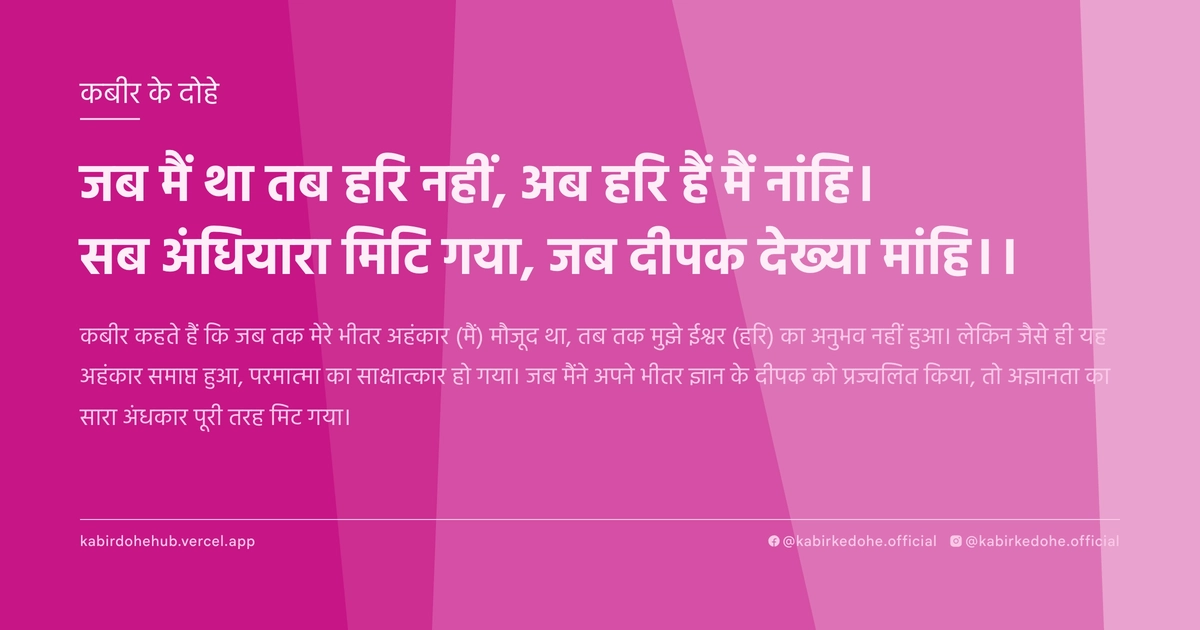
जब मैं था तब हरि नहीं, अब हरि हैं मैं नांहि।
सब अंधियारा मिटि गया, जब दीपक देख्या मांहि।।
Jab main tha tab hari nahi, ab hari hain main naahi. Sab andhiyara miti gaya, jab deepak dekhya maahi.
इस पृष्ठ पर इस कबीर दोहे का अर्थ (meaning), हिंदी व्याख्या और अंग्रेज़ी अनुवाद, दार्शनिक विश्लेषण और व्यावहारिक जीवन सीख दी गई है। यह दोहा अहंकार (The Ego) विषय से जुड़ा है — Kabir doha meaning and explanation in Hindi and English.
अर्थ (Meaning):
कबीर कहते हैं कि जब तक मेरे भीतर अहंकार (मैं) मौजूद था, तब तक मुझे ईश्वर (हरि) का अनुभव नहीं हुआ। लेकिन जैसे ही यह अहंकार समाप्त हुआ, परमात्मा का साक्षात्कार हो गया। जब मैंने अपने भीतर ज्ञान के दीपक को प्रज्वलित किया, तो अज्ञानता का सारा अंधकार पूरी तरह मिट गया।
Kabir asserts that as long as the ego (the 'I') existed within him, the Divine (Hari) remained absent. Once the ego vanished, the Divine became manifest. The moment he witnessed the lamp of spiritual knowledge within his own heart, the darkness of ignorance was completely obliterated.
व्याख्या (Interpretation):
इस दोहे का शाब्दिक अर्थ अहंकार और ईश्वर के बीच के परस्पर विरोध को दर्शाता है। यहाँ 'मैं' का अर्थ शारीरिक पहचान नहीं, बल्कि वह सूक्ष्म अहंकार है जो स्वयं को ब्रह्मांड से अलग मानता है। यह निरगुण भक्ति का सार है, जहाँ ईश्वर किसी बाहरी मूर्ति में नहीं, बल्कि आत्मा के शुद्ध स्वरूप में स्थित है। माया ने हमें यह विश्वास दिलाया है कि हम अलग हैं, जो एक आध्यात्मिक अंधकार है। जब साधक अद्वैत वेदांत के सत्य को पहचानता है कि आत्मा और ब्रह्म एक ही हैं, तो द्वैत समाप्त हो जाता है। 'दीपक' यहाँ आत्म-साक्षात्कार और विवेक का प्रतीक है। अंततः, यह दोहा इस विरोधाभास को स्पष्ट करता है कि परमात्मा को पाने के लिए पहले स्वयं को खोना पड़ता है।
The literal meaning of this couplet highlights the mutual exclusivity of the ego and the Divine. Here, 'I' does not refer to the physical identity, but to the subtle ego that perceives itself as separate from the universe. This is the essence of Nirgun Bhakti, where the Divine is not found in external idols but in the pure essence of the soul. Maya has deceived us into believing in separation, creating a spiritual darkness. When the seeker realizes the truth of Advaita Vedanta—that Atman and Brahman are non-dual—the duality vanishes. The 'lamp' symbolizes self-realization and spiritual discernment. Ultimately, the doha clarifies the central paradox: to find the Divine, one must first lose the self.
दार्शनिक विश्लेषण (Philosophical Analysis):
कबीर का यह दोहा 15वीं शताब्दी के सामाजिक-धार्मिक विद्रोह का प्रतिबिंब है, जहाँ उन्होंने कर्मकांडों और बाहरी आडंबरों का कड़ा विरोध किया। उनके समय में धर्म को बाहरी अनुष्ठानों, तीर्थयात्राओं और जातिगत श्रेष्ठता से जोड़ा जाता था। कबीर ने इस पूरी व्यवस्था को नकारते हुए 'सहज' मार्ग का प्रस्ताव दिया, जो सीधे हृदय से जुड़ा था।
दार्शनिक रूप से, यह विचार अद्वैत वेदांत के 'अहं ब्रह्मास्मि' (मैं ब्रह्म हूँ) के करीब है, लेकिन यह एक महत्वपूर्ण मोड़ लेता है। जहाँ वेदांत ज्ञान के माध्यम से एकता की बात करता है, कबीर उसे 'मैं' के पूर्ण विलोपन (annihilation) के रूप में देखते हैं। यह सूफी मत के 'फना' (Fana) की अवधारणा के समान है, जहाँ प्रेमी अपने अस्तित्व को ईश्वर की इच्छा में पूरी तरह विलीन कर देता है।
यहाँ 'हरि' शब्द का प्रयोग केवल एक हिंदू देवता के लिए नहीं, बल्कि उस निराकार सत्ता (Nirgun) के लिए किया गया है जो सर्वव्यापी है। कबीर तर्क देते हैं कि ईश्वर कहीं बाहर से नहीं आता, बल्कि वह हमेशा मौजूद था; बस अहंकार की परतों ने उसे ढक रखा था। यह मनोवैज्ञानिक रूपांतरण की प्रक्रिया है जहाँ व्यक्ति अपनी पहचान को सामाजिक पद, नाम और उपलब्धियों से हटाकर शुद्ध चेतना में स्थानांतरित करता है।
अहंकार का अर्थ केवल घमंड नहीं, बल्कि वह 'पहचान' है जिसे हमने दुनिया के सामने बनाया है। जब तक हम खुद को 'कर्ता' मानते हैं, हम सत्य से दूर रहते हैं। कबीर सिखाते हैं कि जब 'कर्ता' मर जाता है, तब केवल 'क्रीड़ा' या ईश्वरीय इच्छा शेष रहती है।
अतः, यह दोहा केवल धार्मिक उपदेश नहीं है, बल्कि चेतना के विकास का एक मानचित्र है। यह बताता है कि आध्यात्मिक प्रगति बाहरी संचय में नहीं, बल्कि आंतरिक रिक्तता (emptiness) पैदा करने में है, ताकि अनंत सत्य उसमें समा सके।
This doha is a reflection of the 15th-century socio-religious rebellion, where Kabir vehemently opposed ritualism and external ostentation. In his era, religion was tied to outward rituals, pilgrimages, and caste superiority. Kabir rejected this entire system, proposing the path of 'Sahaja' (spontaneity), which connected directly to the heart.
Philosophically, this idea aligns with the Advaita Vedanta concept of 'Aham Brahmasmi' (I am Brahman), but it takes a critical turn. While Vedanta speaks of unity through knowledge, Kabir views it as the total annihilation of the 'I'. This is strikingly similar to the Sufi concept of 'Fana', where the lover completely dissolves their existence into the will of the Divine.
The use of the word 'Hari' here does not refer to a specific Hindu deity, but to the formless entity (Nirgun) that is omnipresent. Kabir argues that God does not arrive from outside; He was always present, merely obscured by layers of ego. This is a process of psychological transformation where an individual shifts their identity from social status, name, and achievements to pure consciousness.
Ego here does not merely mean pride, but the 'identity' we have constructed for the world. As long as we perceive ourselves as the 'doer', we remain distant from the Truth. Kabir teaches that when the 'doer' dies, only the 'play' or the Divine will remains.
Thus, this doha is not just a religious sermon but a map for the evolution of consciousness. It suggests that spiritual progress lies not in external accumulation, but in creating an internal emptiness, allowing the infinite Truth to reside within.
मूल संदेश (Core Message):
- अहंकार वह पर्दा है जो सत्य को ढकता है।
- स्वयं को मिटाना ही परमात्मा को पाना है।
- ज्ञान बाहरी नहीं, आंतरिक प्रज्वलन है।
- द्वैत का अंत ही वास्तविक शांति की शुरुआत है।
- शून्य होना ही पूर्ण होना है।
- Ego is the veil that obscures the Truth.
- To erase the self is to find the Divine.
- Knowledge is not external, but an internal ignition.
- The end of duality is the beginning of true peace.
- To become nothing is to become everything.
व्यावहारिक उदाहरण (Practical Example):
वाराणसी के घाटों पर रहने वाली एक वृद्ध विधवा, जानकी, का जीवन केवल दूसरों की सेवा और कठोर तपस्या में बीता था। वह मानती थी कि उसकी पवित्रता उसके कठोर नियमों और उपवासों में है। वह अक्सर दूसरों को उनके 'अशुद्ध' व्यवहार के लिए टोकती थी, क्योंकि उसे लगता था कि वह आध्यात्मिक रूप से उनसे बहुत ऊपर है।
उसका पूरा अस्तित्व इस बात पर टिका था कि वह एक 'आदर्श भक्त' है। यह 'मैं' उसके भीतर एक अदृश्य दीवार बन गई थी। वह मंदिर जाती थी, मंत्र पढ़ती थी, लेकिन उसके मन में शांति नहीं थी, बल्कि एक निरंतर श्रेष्ठता का भाव था।
एक दिन, एक छोटा बच्चा, जो बहुत गरीब था और फटे कपड़ों में था, उसके पास आया और उससे एक रोटी मांगी। जानकी ने उसे देने से पहले उसकी गंदगी देखी और उसे दूर हटने को कहा। बच्चे ने मासूमियत से पूछा, "माँ, क्या आपकी ईश्वर की मूर्ति भी इतनी साफ है कि उसे गंदगी पसंद नहीं?"
यह सरल प्रश्न जानकी के हृदय पर बिजली की तरह गिरा। उसे अचानक महसूस हुआ कि जिस 'पवित्रता' का वह गर्व कर रही थी, वह वास्तव में उसका अहंकार था। वह जिसे भक्ति समझ रही थी, वह वास्तव में उसकी अपनी छवि की पूजा थी।
उस रात वह सो नहीं सकी। उसे कबीर के शब्दों की याद आई कि जब तक 'मैं' है, तब तक 'हरि' नहीं। उसने महसूस किया कि उसकी सारी तपस्या केवल उसके अहंकार को पालने के लिए थी। उसने अपनी पहचान एक 'पवित्र विधवा' के रूप में त्याग दी।
अगले दिन से जानकी ने नियमों की चिंता छोड़ दी। उसने उस बच्चे और अन्य उपेक्षित लोगों की सेवा करना शुरू किया, लेकिन अब वह यह सोचकर नहीं कर रही थी कि वह 'पुण्य' कमा रही है, बल्कि इसलिए कि वह उन लोगों में उसी ईश्वर को देख रही थी।
उसने पाया कि जैसे ही उसने अपनी श्रेष्ठता का मुखौटा उतारा, उसके भीतर एक असीम शांति का संचार हुआ। वह अब मंदिर की दीवारों में नहीं, बल्कि हर इंसान की आँखों में ईश्वर को देखने लगी।
उसका अहंकार मिट गया था, और अब वह स्वयं को एक शून्य की तरह महसूस करती थी, जिसमें परमात्मा का संगीत गूंज रहा था। यह उसका 'कबीर ट्विस्ट' था—पवित्रता के भ्रम का टूटना और वास्तविक प्रेम का उदय होना।
Janaki, an elderly widow living on the ghats of Varanasi, spent her life in rigorous austerity and service to others. She believed her purity lay in her strict rules and fasts. She often corrected others for their 'impure' behavior, believing she was spiritually far superior to them.
Her entire existence was anchored in the belief that she was an 'ideal devotee'. This 'I' became an invisible wall within her. She visited temples and chanted mantras, but there was no peace in her heart, only a constant sense of superiority.
One day, a small child, impoverished and dressed in rags, approached her and asked for a piece of bread. Before giving it, Janaki noticed his filth and told him to step back. The child asked innocently, "Mother, is your idol of God so clean that it dislikes filth?"
This simple question struck Janaki's heart like lightning. She suddenly realized that the 'purity' she was proud of was actually her ego. What she had mistaken for devotion was, in reality, the worship of her own image.
She could not sleep that night. She recalled Kabir's words: as long as the 'I' exists, 'Hari' does not. She realized that all her austerities were merely feeding her ego. She renounced her identity as a 'holy widow'.
From the next day, Janaki stopped worrying about the rules. She began serving the child and other neglected people, but no longer to earn 'merit', but because she saw the same Divine in those people.
She found that as soon as she dropped the mask of superiority, an infinite peace flowed through her. She no longer sought God within temple walls but began seeing Him in the eyes of every human being.
Her ego had vanished, and she now felt like a void in which the music of the Divine resonated. This was her 'Kabir Twist'—the shattering of the illusion of purity and the birth of authentic love.
अभ्यास मार्गदर्शन (Practice Guidance):
- प्रतिदिन 20 मिनट मौन ध्यान करें, जहाँ आप अपने विचारों को केवल एक साक्षी (witness) की तरह देखें, बिना किसी निर्णय के।
- एक 'अहंकार डायरी' लिखें: दिन भर में जब भी आपको महसूस हो कि आप दूसरों से श्रेष्ठ हैं या आप 'सही' हैं, उसे लिखें और विश्लेषण करें कि वह कौन सा 'मैं' है जो बोल रहा है।
- सेवा का अभ्यास करें, लेकिन इस शर्त पर कि आप अपनी पहचान गुप्त रखें। यदि कोई आपको धन्यवाद देता है, तो उस श्रेय को मानसिक रूप से परमात्मा को समर्पित कर दें।
- निदान चेकलिस्ट: क्या आप अपनी उपलब्धियों पर गर्व महसूस करते हैं? क्या आप दूसरों की आलोचना करते समय खुद को श्रेष्ठ पाते हैं? यदि हाँ, तो 'मैं' अभी भी मौजूद है और हरि ओझल हैं।
- Practice 20 minutes of silent meditation daily, observing your thoughts as a witness without any judgment.
- Maintain an 'Ego Diary': Whenever you feel superior to others or convinced of your absolute 'rightness' during the day, record it and analyze which 'I' is speaking.
- Practice selfless service, ensuring your identity remains anonymous. If someone thanks you, mentally surrender that credit to the Divine.
- Diagnostic Checklist: Do you feel a sense of pride in your achievements? Do you find yourself superior while criticizing others? If yes, the 'I' still exists, and the Divine remains hidden.
चिंतन प्रश्न (Reflection Questions):
- वह कौन सी छवि है जिसे मैं दुनिया के सामने बनाए रखने के लिए सबसे अधिक संघर्ष करता हूँ?
- यदि मेरी सारी उपाधियाँ, पद और उपलब्धियाँ छीन ली जाएँ, तो वास्तव में मेरा अस्तित्व क्या बचेगा?
- क्या मेरी आध्यात्मिक साधना मुझे विनम्र बना रही है, या यह मेरे भीतर एक 'आध्यात्मिक अहंकार' पैदा कर रही है?
- मैं किन लोगों को खुद से कमतर समझता हूँ, और यह धारणा मेरे किस डर या असुरक्षा से उपजी है?
- क्या मैं वास्तव में ईश्वर की खोज कर रहा हूँ, या मैं केवल अपनी इच्छाओं की पूर्ति के लिए एक दैवीय माध्यम ढूँढ रहा हूँ?
- What is the image of myself that I struggle most to maintain in front of the world?
- If all my titles, positions, and achievements were stripped away, what would actually remain of my existence?
- Is my spiritual practice making me humble, or is it creating a 'spiritual ego' within me?
- Who are the people I consider inferior to myself, and from which fear or insecurity does this perception arise?
- Am I truly seeking the Divine, or am I merely looking for a divine medium to fulfill my own desires?