
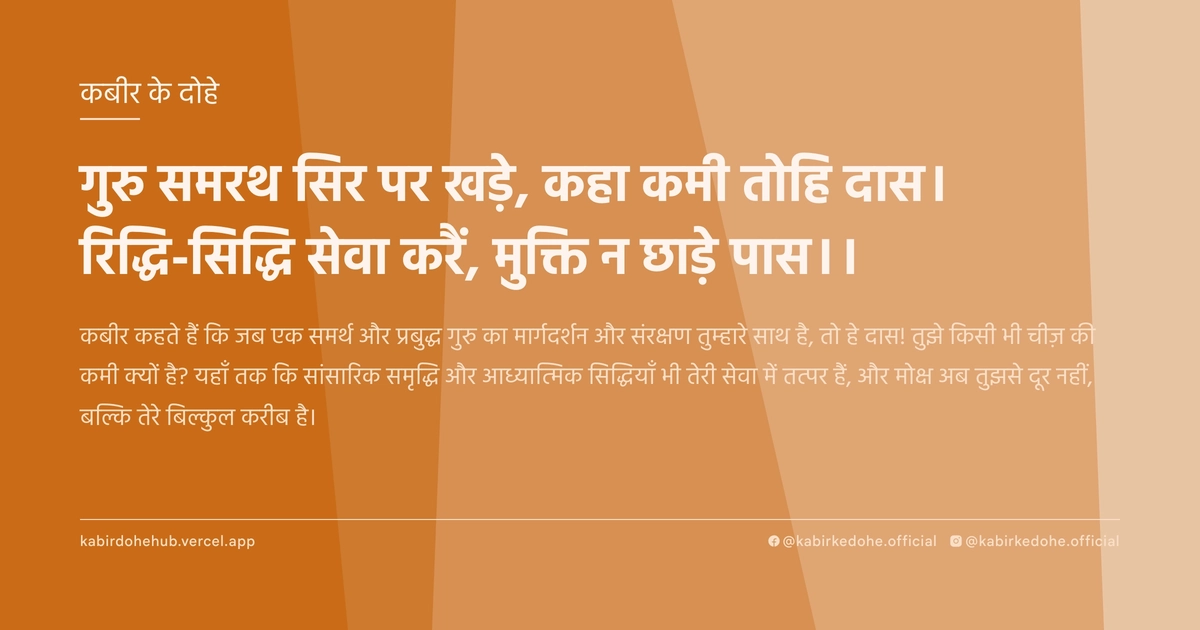
गुरु समरथ सिर पर खड़े, कहा कमी तोहि दास।
रिद्धि-सिद्धि सेवा करैं, मुक्ति न छाड़े पास।।
Guru samrath sir par khade, kaha kami tohi das. Riddhi-siddhi seva karain, mukti na chhade paas.
इस पृष्ठ पर इस कबीर दोहे का अर्थ (meaning), हिंदी व्याख्या और अंग्रेज़ी अनुवाद, दार्शनिक विश्लेषण और व्यावहारिक जीवन सीख दी गई है। यह दोहा गुरु महत्व (The Guru's Importance) विषय से जुड़ा है — Kabir doha meaning and explanation in Hindi and English.
अर्थ (Meaning):
कबीर कहते हैं कि जब एक समर्थ और प्रबुद्ध गुरु का मार्गदर्शन और संरक्षण तुम्हारे साथ है, तो हे दास! तुझे किसी भी चीज़ की कमी क्यों है? यहाँ तक कि सांसारिक समृद्धि और आध्यात्मिक सिद्धियाँ भी तेरी सेवा में तत्पर हैं, और मोक्ष अब तुझसे दूर नहीं, बल्कि तेरे बिल्कुल करीब है।
Kabir asserts that when a powerful and enlightened Guru stands over you as a protector and guide, O seeker, what lack could you possibly suffer? Even worldly prosperity and spiritual attainments stand ready to serve you, and liberation is no longer a distant dream but is intimately present within your reach.
व्याख्या (Interpretation):
इस दोहे का शाब्दिक अर्थ है कि गुरु की उपस्थिति में शिष्य पूर्ण हो जाता है। गहरे स्तर पर, 'गुरु' केवल एक व्यक्ति नहीं, बल्कि वह चेतना है जो अज्ञान के अंधकार को मिटाती है। यह निर्गुण भक्ति का सार है जहाँ गुरु वह सेतु है जो जीव को ब्रह्म से जोड़ता है। यहाँ 'रिद्धि-सिद्धि' का अर्थ केवल चमत्कार नहीं, बल्कि मानसिक स्पष्टता और आंतरिक संतुलन है। माया का पर्दा तब हटता है जब शिष्य का अहंकार गुरु की कृपा में विलीन हो जाता है। यह अद्वैत वेदांत के उस सत्य को दर्शाता है जहाँ गुरु, शिष्य और परमात्मा एक ही तत्व के तीन रूप हैं। अंततः, मुक्ति बाहरी खोज नहीं बल्कि गुरु द्वारा जाग्रत की गई आंतरिक अनुभूति है।
Literally, the verse suggests that the presence of a Guru completes the disciple. On a deeper metaphorical plane, the 'Guru' is not merely a physical teacher but the awakened consciousness that dissolves the darkness of ignorance. This aligns with Nirgun Bhakti, where the Guru serves as the bridge between the finite soul and the infinite Brahman. 'Riddhi-Siddhi' here refers not to occult powers, but to the attainment of mental clarity and spiritual equilibrium. The veil of Maya is lifted only when the disciple's ego dissolves into the grace of the teacher. This reflects the Advaita Vedanta principle of non-duality, where Guru, disciple, and the Divine are recognized as one essence. Ultimately, liberation is not an external destination but an internal awakening triggered by the Guru's presence.
दार्शनिक विश्लेषण (Philosophical Analysis):
कबीर का यह दोहा उस युग की पृष्ठभूमि में है जहाँ धर्म कर्मकांडों और बाहरी आडंबरों में जकड़ा हुआ था। कबीर ने पुरोहितवाद और जातिगत श्रेष्ठता को नकारते हुए 'समरथ गुरु' की अवधारणा पेश की, जो किसी शास्त्र या कुल से नहीं, बल्कि अनुभव और सत्य से समर्थ होता है। यह दृष्टिकोण सूफी मत के 'मुर्शिद' (मार्गदर्शक) की अवधारणा से मेल खाता है, जहाँ बिना गुरु के आध्यात्मिक यात्रा असंभव मानी जाती है।
दार्शनिक रूप से, यह दोहा 'अहंकार के विसर्जन' की बात करता है। जब कबीर 'दास' शब्द का प्रयोग करते हैं, तो वे दासता की बात नहीं, बल्कि समर्पण (Surrender) की बात कर रहे हैं। यह समर्पण ही वह चाबी है जो माया के बंधनों को खोलती है। जब तक 'मैं' जीवित है, तब तक मुक्ति असंभव है; जैसे ही 'मैं' गुरु के चरणों में समर्पित होता है, वह 'ब्रह्म' हो जाता है।
यहाँ रिद्धि-सिद्धि का उल्लेख एक चेतावनी भी है। कबीर यह स्पष्ट करते हैं कि आध्यात्मिक मार्ग पर मिलने वाली शक्तियाँ (Siddhis) लक्ष्य नहीं हैं, बल्कि वे केवल उप-उत्पाद हैं। वास्तविक लक्ष्य 'मुक्ति' है। अक्सर साधक सिद्धियों के मोह में फंसकर मार्ग भटक जाते हैं, लेकिन समर्थ गुरु का कार्य शिष्य को इन भ्रामक आकर्षणों से बचाकर शून्य की ओर ले जाना है।
यह शिक्षण अद्वैत वेदांत के 'तत्वमसि' (तुम वही हो) के करीब है। गुरु केवल वह दर्पण है जो शिष्य को दिखाता है कि वह पहले से ही मुक्त है। मुक्ति कहीं बाहर से नहीं आती, बल्कि वह हमारे भीतर ही मौजूद है, बस उसे पहचानने के लिए एक प्रबुद्ध दृष्टि की आवश्यकता होती है।
अंततः, कबीर यह स्थापित करते हैं कि गुरु की कृपा केवल व्यक्तिगत लाभ के लिए नहीं, बल्कि वैश्विक चेतना के उत्थान के लिए है। जब एक व्यक्ति गुरु के माध्यम से स्वयं को जान लेता है, तो वह संपूर्ण सृष्टि के साथ एकाकार हो जाता है, और यही वास्तविक मोक्ष है।
This Doha emerges from an era where religion was stifled by rigid ritualism and caste hierarchies. Kabir rejects the priestly class and hereditary superiority, proposing the concept of the 'Samrath Guru'—one whose authority stems from direct experience and truth rather than scriptures or lineage. This mirrors the Sufi concept of the 'Murshid,' without whom the spiritual journey is considered perilous and incomplete.
Philosophically, the verse centers on the 'annihilation of the ego.' When Kabir uses the term 'Daas' (servant), he is not advocating for servitude but for total surrender. This surrender is the catalyst that dissolves the bonds of Maya. As long as the 'I' persists, liberation remains elusive; once the 'I' is surrendered to the Guru, the individual merges with the Brahman.
The mention of 'Riddhi-Siddhi' serves as a subtle caution. Kabir clarifies that spiritual powers are not the goal but mere by-products of the path. The ultimate objective is 'Mukti' (liberation). Many seekers fall into the trap of these illusory powers, but the role of the Samrath Guru is to steer the disciple away from these distractions and toward the Void (Shunya).
This teaching resonates with the Advaita Vedanta mahavakya 'Tat Tvam Asi' (Thou Art That). The Guru acts as a mirror, reflecting to the disciple that they are already free. Liberation is not an external acquisition but an internal realization, requiring only an awakened eye to perceive it.
Ultimately, Kabir establishes that the Guru's grace is not for personal gain but for the elevation of universal consciousness. When an individual realizes their true self through the Guru, they become one with the entire cosmos, achieving the state of Jivanmukti (liberation while alive).
मूल संदेश (Core Message):
- बाहरी खोज को छोड़कर आंतरिक मार्गदर्शन को अपनाएं।
- समर्पण ही अहंकार को मिटाने का एकमात्र मार्ग है।
- सांसारिक सफलता आध्यात्मिक जागृति का गौण परिणाम है।
- गुरु वह दर्पण है जो हमें हमारी वास्तविक दिव्यता दिखाता है।
- मुक्ति कोई गंतव्य नहीं, बल्कि वर्तमान क्षण की जागरूकता है।
- Abandon external searches and embrace internal guidance.
- Surrender is the only path to the annihilation of the ego.
- Worldly success is a secondary byproduct of spiritual awakening.
- The Guru is the mirror reflecting our inherent divinity.
- Liberation is not a destination, but the awareness of the present moment.
व्यावहारिक उदाहरण (Practical Example):
वाराणसी के घाटों पर रहने वाला एक वृद्ध बुनकर था, जिसका नाम माधव था। माधव अपनी पूरी जिंदगी रेशमी धागों को बुनने में बिता चुका था, लेकिन उसका मन हमेशा एक गहरी बेचैनी और अधूरापन महसूस करता था। वह मंदिर जाता, दान करता और कठिन व्रत रखता, फिर भी उसे शांति नहीं मिलती थी। उसे लगता था कि मोक्ष केवल मृत्यु के बाद या किसी कठिन तपस्या से ही मिलेगा।
एक दिन उसकी मुलाकात एक फकीर से हुई, जो किसी मंदिर या मस्जिद का नहीं, बल्कि केवल सत्य का अनुयायी था। वह फकीर माधव के जीवन में 'समरथ गुरु' बनकर आया। फकीर ने माधव से कोई मंत्र नहीं दिया, न ही कोई कठिन नियम बताया। उसने बस माधव से कहा, 'तू धागों को बुन रहा है, लेकिन क्या तूने उस हाथ को देखा है जो इन धागों को चला रहा है?'
माधव पहले तो उलझन में पड़ा, लेकिन धीरे-धीरे उसने महसूस किया कि वह अपनी पहचान केवल एक 'बुनकर' और 'गरीब' के रूप में कर रहा था। वह अपनी बाहरी परिस्थितियों को अपनी नियति मान बैठा था। फकीर ने उसे सिखाया कि उसकी असली पहचान वह आत्मा है जो इन सब रिश्तों और पेशों से परे है।
जैसे-जैसे माधव का अहंकार फकीर के प्रति समर्पण में बदलने लगा, उसकी दुनिया बदलने लगी। उसे अब अपनी गरीबी बोझ नहीं लगती थी। वह काम करते समय भी एक गहरे ध्यान में रहने लगा। उसे महसूस हुआ कि जिस शांति को वह मंदिरों में खोज रहा था, वह उसके भीतर ही थी।
एक समय ऐसा आया जब माधव के जीवन में आर्थिक तंगी आई और उसके पास कच्चे माल के लिए पैसे नहीं बचे। पहले वह घबरा जाता, लेकिन अब वह शांत था। उसने महसूस किया कि जब गुरु का ज्ञान उसके साथ है, तो वह मानसिक रूप से समृद्ध है। उसकी इस आंतरिक शांति ने उसे नए तरीके से सोचने के लिए प्रेरित किया और उसने अपनी कला में ऐसे प्रयोग किए कि उसके वस्त्रों की मांग बढ़ गई।
लोग हैरान थे कि माधव की समृद्धि अचानक कैसे बढ़ गई। लेकिन माधव जानता था कि यह 'रिद्धि-सिद्धि' केवल एक बाहरी परिणाम है। उसके लिए असली जीत वह शांति थी जो उसने फकीर के मार्गदर्शन में पाई थी।
अब माधव केवल कपड़े नहीं बुनता था, बल्कि वह घाट पर आने वाले निराश लोगों को यह समझाता था कि जीवन का असली सहारा बाहरी दुनिया नहीं, बल्कि वह आंतरिक गुरु है जो हमें स्वयं से मिलवाता है।
उसने जान लिया था कि जब हम स्वयं को किसी उच्च सत्य (गुरु) के प्रति समर्पित कर देते हैं, तो जीवन की सारी कमियां अपने आप दूर हो जाती हैं। वह अब एक मुक्त आत्मा था, जो संसार में रहते हुए भी संसार से परे था।
In the ancient ghats of Varanasi lived an elderly weaver named Madhav. Madhav had spent his entire life weaving silk threads, yet his heart was plagued by a persistent sense of restlessness and incompleteness. He visited temples, gave alms, and observed rigorous fasts, but peace remained elusive. He believed liberation was only possible after death or through extreme asceticism.
One day, he encountered a wandering fakir who belonged to no temple or mosque, but was a devotee of Truth alone. This fakir entered Madhav's life as the 'Samrath Guru.' The fakir gave him no secret mantras nor imposed any rigid rules. He simply asked Madhav, 'You weave the threads, but have you seen the Hand that moves these threads?'
Madhav was initially confused, but gradually he realized he had identified himself solely as a 'weaver' and a 'poor man.' He had mistaken his external circumstances for his destiny. The fakir taught him that his true identity was the Atman, which transcends all roles and professions.
As Madhav's ego began to dissolve into surrender toward the fakir, his perception of the world shifted. He no longer viewed his poverty as a burden. Even while working, he entered a state of deep meditation. He realized that the peace he sought in temples was already residing within him.
There came a time when Madhav faced severe financial hardship and lacked funds for raw materials. Previously, he would have panicked, but now he remained serene. He felt that with the Guru's wisdom, he was internally wealthy. This inner stillness inspired him to innovate in his craft, and soon his textiles became highly sought after.
People were amazed by his sudden prosperity. However, Madhav knew that this 'Riddhi-Siddhi' was merely an external byproduct. For him, the true victory was the tranquility he found under the fakir's guidance.
Now, Madhav did not just weave cloth; he guided the disillusioned people visiting the ghats, explaining that life's true support is not the external world, but the internal Guru who introduces us to our own essence.
He understood that when one surrenders to a higher truth, the perceived lacks of life vanish. He became a Jivanmukta—a liberated soul living in the world but not of it.
अभ्यास मार्गदर्शन (Practice Guidance):
- दैनिक चिंतन: प्रतिदिन 15 मिनट मौन बैठें और विचार करें कि आपके जीवन में 'गुरु' तत्व (चाहे वह व्यक्ति हो, पुस्तक हो या अंतरात्मा) कहाँ है।
- अहंकार का विसर्जन: दिन में कम से कम एक बार ऐसा कार्य करें जहाँ आप अपनी इच्छा को किसी अन्य की भलाई के लिए पूरी तरह त्याग दें।
- आत्म-पूछताछ जर्नल: लिखें कि आप किन बाहरी चीजों (पैसा, पद, प्रशंसा) को अपनी पूर्णता का आधार मानते हैं और यह समझें कि ये 'माया' कैसे हैं।
- डायग्नोस्टिक चेकलिस्ट: क्या आप अभी भी समाधान बाहर खोज रहे हैं? क्या आप अपनी समस्याओं के लिए दूसरों को दोष देते हैं? यदि हाँ, तो आप अभी भी 'अहंकार' के अधीन हैं और गुरु-तत्व से दूर हैं।
- Daily Contemplation: Spend 15 minutes in silence daily, reflecting on where the 'Guru element' (whether a person, a text, or the inner voice) resides in your life.
- Dissolution of Ego: Once a day, perform an act where you completely surrender your personal desire for the well-being of another.
- Self-Inquiry Journal: List the external anchors (money, status, praise) you use for your sense of completeness and analyze how these are manifestations of 'Maya'.
- Diagnostic Checklist: Are you still seeking solutions externally? Do you blame others for your struggles? If yes, you are still operating under the ego and are distant from the Guru-principle.
चिंतन प्रश्न (Reflection Questions):
- क्या मेरा 'गुरु' वास्तव में मेरा अहंकार कम कर रहा है, या वह मेरी प्रशंसा की भूख को बढ़ा रहा है?
- यदि मुझसे मेरी सारी सामाजिक पहचान (नाम, पेशा, पद) छीन ली जाए, तो क्या मैं स्वयं को पूर्ण महसूस करूँगा?
- मैं किन 'रिद्धि-सिद्धियों' (शक्तियों/सुविधाओं) के पीछे भाग रहा हूँ जो मुझे वास्तविक मुक्ति से दूर ले जा रही हैं?
- मेरे जीवन में 'समर्पण' का अर्थ क्या है—डरवश अधीनता या प्रेमपूर्ण विश्वास?
- क्या मैं सत्य को सुनने के लिए तैयार हूँ, या मैं केवल वही सुनना चाहता हूँ जो मेरे पूर्वग्रहों की पुष्टि करे?
- Is my 'Guru' truly diminishing my ego, or are they merely feeding my hunger for validation?
- If all my social identities (name, profession, status) were stripped away, would I still feel complete?
- Which 'Riddhi-Siddhis' (powers/conveniences) am I chasing that are actually distancing me from true liberation?
- What does 'surrender' mean in my life—fearful submission or loving trust?
- Am I truly ready to hear the Truth, or am I only seeking confirmation of my existing biases?