
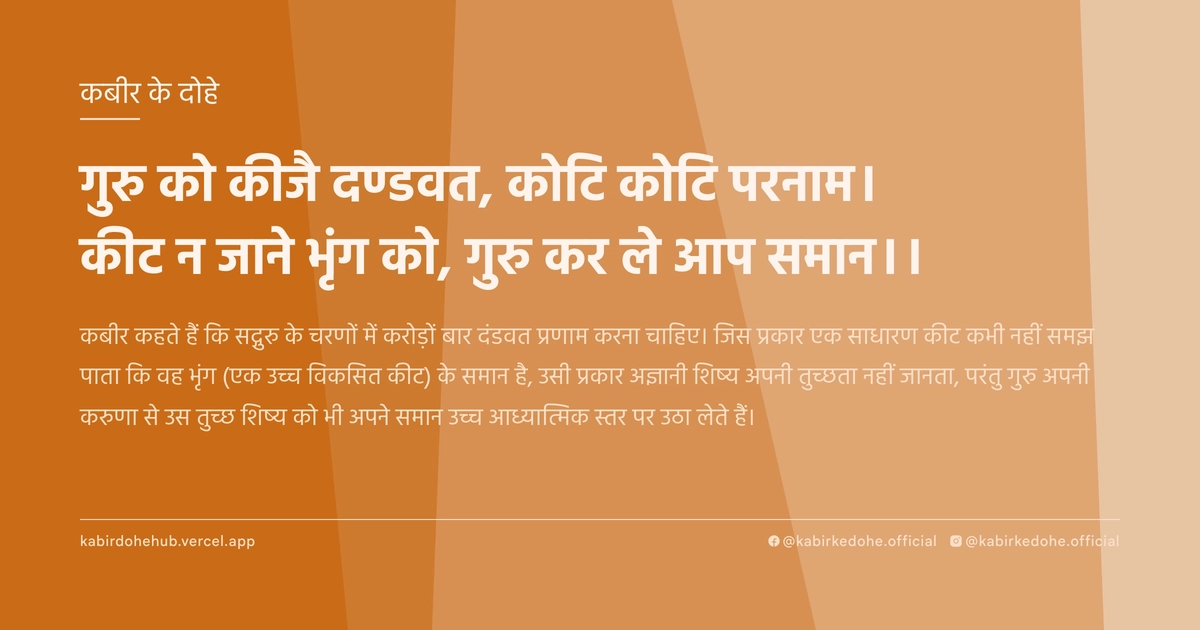
गुरु को कीजै दण्डवत, कोटि कोटि परनाम।
कीट न जाने भृंग को, गुरु कर ले आप समान।।
Guru ko keeje dandavat, koti koti parnaam. Keet na jaane bhring ko, guru kar le aap samaan.
इस पृष्ठ पर इस कबीर दोहे का अर्थ (meaning), हिंदी व्याख्या और अंग्रेज़ी अनुवाद, दार्शनिक विश्लेषण और व्यावहारिक जीवन सीख दी गई है। यह दोहा गुरु महत्व (The Guru's Importance) विषय से जुड़ा है — Kabir doha meaning and explanation in Hindi and English.
अर्थ (Meaning):
कबीर कहते हैं कि सद्गुरु के चरणों में करोड़ों बार दंडवत प्रणाम करना चाहिए। जिस प्रकार एक साधारण कीट कभी नहीं समझ पाता कि वह भृंग (एक उच्च विकसित कीट) के समान है, उसी प्रकार अज्ञानी शिष्य अपनी तुच्छता नहीं जानता, परंतु गुरु अपनी करुणा से उस तुच्छ शिष्य को भी अपने समान उच्च आध्यात्मिक स्तर पर उठा लेते हैं।
Kabir urges the seeker to offer millions of prostrations to the true spiritual guide. Just as a common insect cannot comprehend the nature of the evolved beetle (bhring), an ignorant seeker remains unaware of their own spiritual poverty; however, the Guru, through boundless compassion, elevates the lowly disciple to be equal to themselves in spiritual realization.
व्याख्या (Interpretation):
यह दोहा गुरु की असीम अनुकंपा और शिष्य के अहंकार के विसर्जन की बात करता है। 'दंडवत' केवल शारीरिक झुकना नहीं, बल्कि अहंकार का पूर्ण समर्पण है। यहाँ 'कीट' (insect) माया और अज्ञान के प्रभाव में फंसे जीव का प्रतीक है, जबकि 'भृंग' उस जाग्रत आत्मा का प्रतीक है जिसने सत्य को पा लिया है। यह निरगुण भक्ति का सार है जहाँ गुरु बाहरी व्यक्ति नहीं, बल्कि वह शक्ति है जो आत्मा को ब्रह्म के साथ एकाकार करती है। अद्वैत वेदांत के अनुसार, जब तक 'मैं' का भाव है, तब तक जीव कीट के समान है, लेकिन गुरु की कृपा इस द्वैत को मिटाकर शिष्य को उसी अनंत चेतना का हिस्सा बना देती है। यह विरोधाभास है कि जो सबसे तुच्छ है, वह भी गुरु के स्पर्श से सर्वोच्च बन जाता है।
This couplet emphasizes the infinite compassion of the Guru and the necessary dissolution of the disciple's ego. 'Dandavat' is not merely a physical act of bowing but a total surrender of the 'I-sense'. Here, the 'keet' (insect) symbolizes the soul trapped in Maya and ignorance, while the 'bhring' (evolved beetle) represents the awakened spirit that has realized the Truth. This aligns with Nirgun Bhakti, where the Guru is not just a person but the catalyst that merges the Atman with Brahman. According to Advaita Vedanta, as long as the sense of separation exists, the soul is like a lowly insect; however, the Guru's grace erases this duality, making the disciple equal to the enlightened state. It presents the spiritual paradox: the most insignificant being can be elevated to the highest state through the Guru's alchemy.
दार्शनिक विश्लेषण (Philosophical Analysis):
कबीर का यह दृष्टिकोण उनके समय के कर्मकांडीय और औपचारिक गुरु-शिष्य संबंधों के विरुद्ध एक विद्रोह था। उस युग में गुरु केवल वे थे जो शास्त्र पढ़ाते थे, लेकिन कबीर 'सद्गुरु' की बात करते हैं जो आंतरिक रूपांतरण लाते हैं। वे जाति और सामाजिक स्तर को पूरी तरह नकारते हैं, यह मानते हुए कि आध्यात्मिक पात्रता का संबंध जन्म से नहीं, बल्कि समर्पण से है।
दार्शनिक रूप से, यह सूफीवाद के 'पीर' और वेदांत के 'गुरु' के मिलन बिंदु पर स्थित है। सूफी मत में 'फना' (अहंकार का विनाश) अनिवार्य है, ठीक वैसे ही जैसे यहाँ कीट का भृंग में बदलना है। यह रूपांतरण तब होता है जब शिष्य यह स्वीकार कर लेता है कि उसकी अपनी बुद्धि उसे सत्य तक नहीं ले जा सकती।
अद्वैत वेदांत के संदर्भ में, गुरु वह दर्पण है जो शिष्य को उसकी वास्तविक पहचान—ब्रह्म—दिखाता है। कीट और भृंग वास्तव में एक ही प्रजाति के अलग-अलग स्तर हैं; इसी तरह, जीव और ईश्वर में कोई मौलिक अंतर नहीं है, केवल ज्ञान का अभाव है। गुरु इस अज्ञान के पर्दे को हटा देते हैं।
कबीर यहाँ मनोवैज्ञानिक रूपांतरण की बात कर रहे हैं। जब एक व्यक्ति पूरी तरह से समर्पित होता है, तो उसके भीतर का प्रतिरोध समाप्त हो जाता है। यह 'शून्य' की स्थिति है जहाँ गुरु का ज्ञान बिना किसी बाधा के प्रवाहित हो सकता है।
अंततः, यह दोहा यह संदेश देता है कि आध्यात्मिक उत्थान के लिए विनम्रता प्राथमिक शर्त है। बिना विनम्रता के, ज्ञान केवल बौद्धिक अहंकार को बढ़ाता है, जबकि समर्पण आत्मा को मुक्त करता है।
Kabir's perspective is a rebellion against the ritualistic and formal teacher-disciple relationships of his era. In those times, gurus were often seen as mere instructors of scripture, but Kabir speaks of the 'Sadguru' who facilitates an internal alchemy. He completely rejects caste and social hierarchy, asserting that spiritual eligibility is born of surrender, not lineage.
Philosophically, this sits at the intersection of the Sufi 'Pir' and the Vedantic 'Guru'. In Sufism, 'Fana' (the annihilation of the ego) is essential, mirroring the transformation of the insect into the evolved beetle. This metamorphosis occurs only when the disciple accepts that their own intellect is insufficient to reach the Truth.
In the context of Advaita Vedanta, the Guru is the mirror reflecting the disciple's true identity as Brahman. The insect and the beetle are essentially the same essence at different stages of evolution; similarly, there is no fundamental difference between the Jiva (individual soul) and Ishvara (Universal Soul), only a veil of ignorance. The Guru lifts this veil.
Kabir is addressing a psychological transformation. When a person surrenders completely, their internal resistance vanishes. This is the state of 'Shunya' (void), where the Guru's wisdom can flow without obstruction.
Ultimately, the couplet teaches that humility is the primary prerequisite for spiritual ascent. Without humility, knowledge only inflates the intellectual ego, whereas surrender liberates the soul.
मूल संदेश (Core Message):
- अहंकार वह पर्दा है जो शिष्य को गुरु से अलग करता है।
- पूर्ण समर्पण ही आध्यात्मिक रूपांतरण की एकमात्र कुंजी है।
- विनम्रता कमजोरी नहीं, बल्कि उच्च चेतना का प्रवेश द्वार है।
- बाहरी झुकना आंतरिक उत्थान का पहला कदम है।
- सद्गुरु की कृपा अज्ञानी को भी प्रबुद्ध बना सकती है।
- Ego is the veil that separates the disciple from the Master.
- Total surrender is the only key to spiritual metamorphosis.
- Humility is not weakness, but the gateway to higher consciousness.
- External bowing is the first step toward internal ascension.
- The grace of a Sadguru can enlighten even the most ignorant.
व्यावहारिक उदाहरण (Practical Example):
वाराणसी के एक पुराने घाट पर रामदीन नाम का एक वृद्ध नाविक रहता था। वह अपनी छोटी सी नाव और अपने सीमित ज्ञान पर बहुत गर्व करता था। वह मानता था कि उसने गंगा की हर लहर को समझ लिया है और उसे किसी की सलाह की आवश्यकता नहीं है। वह अन्य नाविकों को तुच्छ समझता था और स्वयं को सर्वश्रेष्ठ मानता था।
एक दिन, शहर में एक शांत स्वभाव के संत आए। रामदीन ने उनका उपहास किया और कहा कि एक सन्यासी को लहरों का क्या ज्ञान होगा। संत मुस्कुराए और रामदीन को एक ऐसी जगह ले गए जहाँ गंगा का बहाव अत्यंत तीव्र और भ्रामक था। वहाँ रामदीन की नाव अनियंत्रित हो गई और वह डूबने की कगार पर था।
उस संकट की घड़ी में, संत ने केवल एक शब्द कहा और रामदीन को नाव चलाने का एक ऐसा सूक्ष्म तरीका बताया जिसे उसने कभी सोचा ही नहीं था। उस एक निर्देश ने रामदीन की जान बचा ली। रामदीन को अचानक अहसास हुआ कि जिसे वह अपना 'पूर्ण ज्ञान' समझ रहा था, वह वास्तव में एक कीट की सीमित दृष्टि थी।
उस क्षण रामदीन का अहंकार टूट गया। उसने संत के चरणों में गिरकर दंडवत प्रणाम किया। उसने महसूस किया कि वह अब तक केवल सतह को देख रहा था, जबकि संत गहराई के स्वामी थे।
अगले कुछ महीनों तक, रामदीन ने अपनी नाव चलाना छोड़कर संत की सेवा की। उसने सीखा कि चुप रहकर सुनना, बोलने से अधिक शक्तिशाली होता है।
उसका व्यवहार बदल गया। वह अब अन्य नाविकों के साथ विनम्रता से पेश आने लगा। उसने अपनी श्रेष्ठता का दावा छोड़ दिया और दूसरों की मदद करने लगा।
रामदीन ने पाया कि जब उसने खुद को 'छोटा' स्वीकार किया, तभी वह वास्तव में 'बड़ा' बन पाया। उसका जीवन अब केवल आजीविका कमाने का साधन नहीं, बल्कि सेवा का मार्ग बन गया।
अंत में, वह नाविक जो कभी अहंकारी था, अब घाट का सबसे प्रिय व्यक्ति बन गया क्योंकि उसके भीतर का 'कीट' मर चुका था और एक 'भृंग' जैसी प्रबुद्ध चेतना जागृत हुई थी।
On an ancient ghat in Varanasi lived an elderly boatman named Ramdeen. He took immense pride in his small boat and his limited knowledge, believing he had mastered every current of the Ganges and needed no guidance. He looked down upon other boatmen, considering himself superior.
One day, a serene saint arrived in the city. Ramdeen mocked him, questioning how a monk could possibly understand the dynamics of the river. The saint smiled and led Ramdeen to a stretch of the river where the current was deceptively swift and treacherous.
In that moment of crisis, Ramdeen's boat spun out of control, and he was on the verge of drowning. The saint spoke a single word and guided Ramdeen to use a subtle steering technique he had never imagined.
That one instruction saved Ramdeen's life. He suddenly realized that what he had deemed 'complete knowledge' was actually the limited vision of an insect.
In that instant, Ramdeen's ego shattered. He fell at the saint's feet in a full prostration (dandavat). He realized he had only been seeing the surface, while the saint commanded the depths.
For the next few months, Ramdeen set aside his boat to serve the saint. He learned that listening in silence is far more powerful than speaking.
His behavior transformed. He began treating other boatmen with genuine humility, abandoning his claims of superiority and helping others in need.
Ramdeen discovered that only by accepting his 'smallness' could he truly become 'great'. His life was no longer just about earning a living, but about a path of service.
Eventually, the boatman who was once arrogant became the most beloved person on the ghat, for the 'insect' within him had died, and a conscious, 'beetle-like' enlightenment had awakened.
अभ्यास मार्गदर्शन (Practice Guidance):
- प्रतिदिन 15 मिनट मौन रहकर यह चिंतन करें कि आपके जीवन में वह कौन सा 'अहंकार' है जो आपको सत्य देखने से रोक रहा है।
- एक डायरी लिखें जिसमें आप उन क्षणों को दर्ज करें जब आपने अपनी गलती मानी और किसी की सलाह को स्वीकार किया, यह विश्लेषण करें कि उस समय आपके मन में क्या द्वंद्व था।
- व्यवहार परिवर्तन: दिन में कम से कम एक बार किसी ऐसे व्यक्ति से कुछ सीखने का प्रयास करें जिसे आप सामाजिक या बौद्धिक रूप से अपने से छोटा समझते हैं।
- निदान चेकलिस्ट: क्या आप दूसरों की आलोचना करते समय संतुष्टि महसूस करते हैं? क्या आप सलाह लेने में हिचकिचाते हैं? यदि हाँ, तो आप अभी भी 'कीट' अवस्था में हैं।
- Spend 15 minutes daily in silence, contemplating which specific 'ego-construct' is preventing you from seeing the Truth.
- Maintain a journal recording moments where you admitted a mistake and accepted guidance; analyze the internal conflict experienced during that surrender.
- Behavioral Shift: Once a day, consciously try to learn something from someone you perceive as socially or intellectually 'inferior' to you.
- Diagnostic Checklist: Do you feel a sense of satisfaction while criticizing others? Do you hesitate to seek advice? If yes, you are still operating in the 'insect' state of ego.
चिंतन प्रश्न (Reflection Questions):
- क्या मेरा 'ज्ञान' वास्तव में सत्य है, या यह केवल मेरी पूर्वग्रहों की एक सुरक्षित दीवार है?
- मैं अपनी सार्वजनिक छवि (Digital Ego) को बनाए रखने के लिए अपने वास्तविक स्वरूप को कितना दबाता हूँ?
- यदि आज मेरा सारा पद, प्रतिष्ठा और ज्ञान छीन लिया जाए, तो मेरे भीतर क्या बचेगा?
- क्या मैं वास्तव में मार्गदर्शन चाहता हूँ, या मैं केवल अपनी मान्यताओं की पुष्टि करने वाले व्यक्ति की तलाश में हूँ?
- मेरे जीवन में 'कीट' कौन है—मेरा अहंकार, मेरा क्रोध, या मेरी संकीर्ण सोच?
- Is my 'knowledge' truly Truth, or is it merely a protective wall of my own prejudices?
- How much of my authentic self do I suppress to maintain my public image (Digital Ego)?
- If all my titles, prestige, and knowledge were stripped away today, what would remain within me?
- Do I truly seek guidance, or am I merely looking for someone to validate my existing beliefs?
- Who is the 'insect' in my life—my ego, my anger, or my narrow way of thinking?