
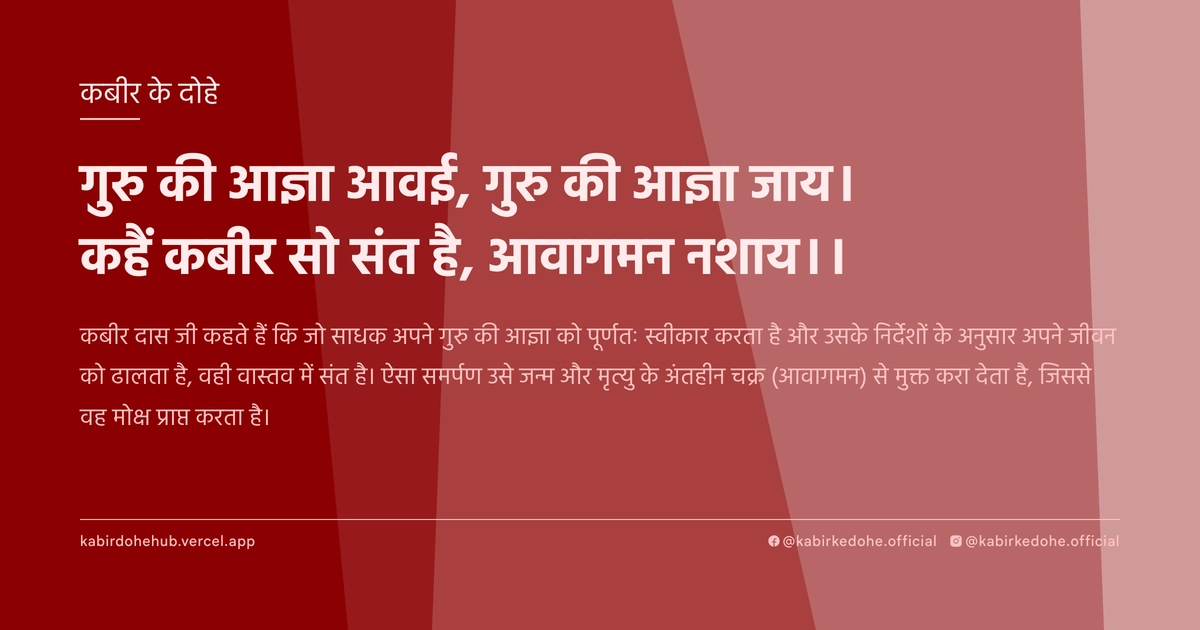
गुरु की आज्ञा आवई, गुरु की आज्ञा जाय।
कहैं कबीर सो संत है, आवागमन नशाय।।
Guru ki aagya aavai, guru ki aagya jaaye. Kahein Kabir so sant hai, aavagaman nashaye.
इस पृष्ठ पर इस कबीर दोहे का अर्थ (meaning), हिंदी व्याख्या और अंग्रेज़ी अनुवाद, दार्शनिक विश्लेषण और व्यावहारिक जीवन सीख दी गई है। यह दोहा गुरु महत्व (The Guru's Importance) विषय से जुड़ा है — Kabir doha meaning and explanation in Hindi and English.
अर्थ (Meaning):
कबीर दास जी कहते हैं कि जो साधक अपने गुरु की आज्ञा को पूर्णतः स्वीकार करता है और उसके निर्देशों के अनुसार अपने जीवन को ढालता है, वही वास्तव में संत है। ऐसा समर्पण उसे जन्म और मृत्यु के अंतहीन चक्र (आवागमन) से मुक्त करा देता है, जिससे वह मोक्ष प्राप्त करता है।
Kabir asserts that a true saint is one who completely aligns their will with the commands of the Guru. By surrendering the ego to the Guru's guidance, the seeker transcends the repetitive cycle of birth and death, eventually achieving liberation from the material world.
व्याख्या (Interpretation):
शाब्दिक अर्थ में यह दोहा गुरु की आज्ञा पालन पर जोर देता है, परंतु गहरा अर्थ 'अहंकार के विसर्जन' में है। यहाँ 'आज्ञा' केवल बाहरी आदेश नहीं, बल्कि वह आध्यात्मिक अनुशासन है जो साधक के 'मैं' को मिटाता है। निर्गुण भक्ति में, गुरु वह माध्यम है जो जीव को माया के पर्दे से हटाकर ब्रह्म के साथ एकाकार करता है। जब साधक की व्यक्तिगत इच्छाएं गुरु की इच्छा में विलीन हो जाती हैं, तो द्वैत समाप्त हो जाता है। यह अद्वैत वेदांत के उस सत्य को दर्शाता है जहाँ आत्मा और परमात्मा के बीच का अंतर केवल अज्ञानता है। आवागमन का नाश तब होता है जब वासनाएं और अहंकार समाप्त हो जाते हैं, क्योंकि यही वे बंधन हैं जो आत्मा को पुनः शरीर धारण करने पर विवश करते हैं।
Literally, the verse emphasizes obedience to the teacher, but metaphorically, it speaks of the 'dissolution of the ego.' The 'command' is not a mere external order but a spiritual discipline designed to erode the 'I'. In Nirgun Bhakti, the Guru is the catalyst who strips away the veil of Maya, revealing the non-duality of Atman and Brahman. When the seeker's personal desires merge into the Guru's will, the duality of subject and object vanishes. This aligns with Advaita Vedanta, suggesting that the separation between the soul and the Absolute is an illusion. The cessation of 'aavagaman' (the cycle of birth and death) occurs only when the latent desires and egoic attachments—the very chains that bind the soul to materiality—are incinerated in the fire of total surrender.
दार्शनिक विश्लेषण (Philosophical Analysis):
कबीर का यह दोहा उस युग का है जब धर्म कर्मकांडों और बाहरी आडंबरों में जकड़ा हुआ था। कबीर ने मंदिर, मस्जिद और जातिगत श्रेष्ठता को नकारते हुए 'आंतरिक अनुभव' को प्राथमिकता दी। यहाँ गुरु की आज्ञा का अर्थ किसी व्यक्ति की गुलामी नहीं, बल्कि उस 'परम ज्ञान' के प्रति समर्पण है जो गुरु द्वारा प्रेषित किया जाता है। यह सूफी मत के 'फना' (अहंकार का विनाश) के सिद्धांत के समान है, जहाँ साधक स्वयं को मिटाकर ईश्वर में समा जाता है।
दार्शनिक रूप से, यह दोहा 'शरणागति' के मनोविज्ञान पर आधारित है। जब मनुष्य अपनी बुद्धि और तर्क को छोड़कर पूर्ण विश्वास के साथ गुरु के मार्ग पर चलता है, तो वह मानसिक संघर्षों से मुक्त हो जाता है। कबीर का तर्क है कि तर्क बुद्धि (Intellect) सीमित है, जबकि गुरु का ज्ञान असीम है। इसलिए, तर्क के बजाय समर्पण ही मोक्ष का द्वार है।
अद्वैत वेदांत के परिप्रेक्ष्य में, गुरु वह दर्पण है जो साधक को उसका वास्तविक स्वरूप दिखाता है। जब साधक गुरु की आज्ञा का पालन करता है, तो वह वास्तव में अपनी अंतरात्मा की पुकार सुन रहा होता है। यह प्रक्रिया उसे 'माया' के भ्रम से बाहर निकालती है, जहाँ वह स्वयं को शरीर मानता था, और उसे इस सत्य तक ले जाती है कि वह शुद्ध चेतना है।
कबीर ने जाति और धर्म के भेदों को मिटाने के लिए गुरु की आज्ञा को एक सार्वभौमिक उपकरण बनाया। उनके लिए गुरु वह नहीं जो केवल शास्त्र पढ़ाए, बल्कि वह जो साधक के भीतर के अंधकार को मिटा दे। यह एक क्रांतिकारी दृष्टिकोण था जिसने तत्कालीन समाज में व्याप्त पुरोहितवाद और धार्मिक कट्टरता को चुनौती दी।
अंततः, आवागमन का नाश केवल बाहरी क्रियाओं से नहीं, बल्कि आंतरिक रूपांतरण से होता है। जब साधक यह समझ जाता है कि वह और उसका गुरु (जो वास्तव में परमात्मा का ही रूप है) एक ही हैं, तब वह संसार की नश्वरता को पहचान लेता है। यही वह बिंदु है जहाँ जन्म और मृत्यु का खेल समाप्त होता है और शाश्वत शांति की प्राप्ति होती है।
This Doha emerges from an era where religion was stifled by rigid rituals and external pomposity. Kabir rejected the hegemony of temples, mosques, and caste hierarchies, prioritizing 'internal realization' over outward performance. The 'command of the Guru' here is not an endorsement of blind servitude to a person, but a total surrender to the 'Supreme Knowledge' transmitted through the teacher. This mirrors the Sufi concept of 'Fana' (annihilation of the self), where the seeker dissolves their identity to merge with the Divine.
Philosophically, the verse is rooted in the psychology of 'Sharanagati' (absolute surrender). When a human ceases to rely solely on limited intellectual reasoning and trusts the Guru's path, they are liberated from the torment of mental conflict. Kabir posits that the human intellect is finite and often deceptive, whereas the Guru's insight is infinite. Thus, surrender is the strategic gateway to liberation.
From the lens of Advaita Vedanta, the Guru acts as a mirror reflecting the seeker's true nature. By obeying the Guru, the seeker is actually aligning with the highest truth of their own being. This process dismantles the illusion of Maya, shifting the identity from the transient physical body to the eternal, pure consciousness.
Kabir utilized the concept of the Guru's command as a universal tool to erase caste and sectarian divides. For him, a true Guru is not one who merely recites scriptures, but one who incinerates the darkness within the disciple. This was a revolutionary stance that challenged the priestly class and the religious orthodoxy of the time.
Ultimately, the cessation of the cycle of birth and death (Samsara) is not achieved through ritualistic purity but through internal transmutation. When the seeker realizes that they and the Guru (who represents the Absolute) are one and the same, the attachment to the ephemeral world vanishes. This is the precise moment where the game of birth and death ends, and eternal peace is attained.
मूल संदेश (Core Message):
- अहंकार ही वह पर्दा है जो आत्मा को परमात्मा से अलग करता है।
- पूर्ण समर्पण ही मानसिक द्वंद्वों का एकमात्र समाधान है।
- गुरु की आज्ञा वास्तव में स्वयं के उच्चतम स्वरूप की पुकार है।
- जब 'मैं' मिटता है, तब अनंत की यात्रा शुरू होती है।
- मोक्ष बाहरी यात्रा नहीं, बल्कि आंतरिक विसर्जन की प्रक्रिया है।
- The ego is the only veil separating the soul from the Absolute.
- Total surrender is the sole resolution to internal mental conflict.
- The Guru's command is actually the call of your own highest self.
- When the 'I' dissolves, the journey into the infinite begins.
- Liberation is not an external journey, but a process of internal dissolution.
व्यावहारिक उदाहरण (Practical Example):
वाराणसी के एक पुराने घाट पर माधव नाम का एक वृद्ध बुनकर रहता था। माधव अपनी कला में निपुण था, लेकिन उसका मन हमेशा इस बात से अशांत रहता था कि वह जीवन में क्या हासिल कर पाया। वह स्वयं को बहुत बड़ा कलाकार मानता था और अक्सर अन्य बुनकरों को नीचा दिखाता था। उसके भीतर का अहंकार उसकी शांति का सबसे बड़ा शत्रु था।
एक दिन उसकी मुलाकात एक शांत स्वभाव के संत से हुई। संत ने माधव की कला की प्रशंसा नहीं की, बल्कि उसे एक सरल आज्ञा दी: 'अगले एक महीने तक, तुम जो भी कपड़ा बुनो, उसे अपना नहीं बल्कि किसी और का समझकर बुनो, और हर दिन शाम को उसे एक जरूरतमंद को मुफ्त में दे दो।'
माधव को यह बात अजीब लगी। उसकी बुद्धि ने कहा कि यह घाटा है, लेकिन उसने संत के प्रति श्रद्धावश इस आज्ञा को स्वीकार किया। पहले हफ्ते में उसे बहुत कठिनाई हुई। उसका अहंकार चिल्ला रहा था कि उसकी मेहनत बेकार जा रही है। वह बेचैन रहता था और उसे लगता था कि वह अपनी पहचान खो रहा है।
दूसरे हफ्ते तक आते-आते, माधव ने महसूस किया कि जब वह यह सोचकर बुनता था कि यह कपड़ा उसका नहीं है, तो उसकी बुनाई में एक अद्भुत सहजता आ गई। वह अब परिणाम की चिंता नहीं कर रहा था। वह केवल उस प्रक्रिया का आनंद लेने लगा।
तीसरे हफ्ते में, जब वह कपड़े दान करता, तो उसे प्राप्त होने वाली मुस्कुराहटें उसके भीतर के खालीपन को भरने लगीं। उसे एहसास हुआ कि जिसे वह अपनी 'पहचान' समझ रहा था—उसकी श्रेष्ठता का अहंकार—वह वास्तव में एक बोझ था जिसने उसे दूसरों से अलग कर दिया था।
चौथे हफ्ते के अंत तक, माधव का 'मैं' पूरी तरह मिट चुका था। वह अब केवल एक माध्यम बन गया था। उसने पाया कि जब उसने अपनी इच्छा को संत की आज्ञा में विलीन कर दिया, तो उसके जीवन का सारा तनाव समाप्त हो गया।
एक दिन संत वापस आए और पूछा, 'माधव, क्या तुमने अपनी कला खो दी?' माधव ने मुस्कुराकर उत्तर दिया, 'नहीं महाराज, मैंने अपनी कला नहीं, बल्कि उस कलाकार के अहंकार को खो दिया जिसने मुझे अब तक कैद कर रखा था।'
माधव अब केवल कपड़े नहीं बुनता था, वह प्रेम बुनता था। उसका जीवन अब आवागमन के मानसिक द्वंद्वों से मुक्त था। उसने समझ लिया था कि समर्पण ही वास्तविक स्वतंत्रता है।
On an ancient ghat in Varanasi lived an elderly weaver named Madhav. Madhav was a master of his craft, yet his mind was perpetually restless, haunted by the question of his legacy. He harbored a deep sense of superiority, often belittling other weavers. His ego was the primary architect of his inner turmoil.
One day, he encountered a serene saint. Instead of praising Madhav's skill, the saint gave him a simple command: 'For the next month, whatever fabric you weave, do not consider it yours. Weave it as if it belongs to another, and every evening, give it away for free to someone in need.'
Madhav found this request absurd. His intellect argued that this was a financial disaster, but out of reverence for the saint, he accepted the command. During the first week, he struggled immensely. His ego screamed that his hard work was being wasted; he felt he was losing his identity.
By the second week, Madhav noticed a strange shift. When he wove with the intention that the cloth did not belong to him, a profound fluidity entered his work. He stopped worrying about the outcome and began to enjoy the pure process of creation.
In the third week, the smiles of the recipients began to fill a void within him. He realized that what he had mistaken for his 'identity'—his pride in superiority—was actually a burden that had isolated him from humanity.
By the end of the fourth week, Madhav's 'I' had completely dissolved. He had become a mere conduit for the art. He discovered that by merging his will with the saint's command, the lifelong tension in his heart had vanished.
When the saint returned and asked, 'Madhav, have you lost your art?' Madhav smiled and replied, 'No, Maharaj. I have not lost my art; I have lost the ego of the artist that had kept me imprisoned.'
Madhav no longer just wove fabric; he wove love. His life was now free from the mental oscillations of gain and loss. He understood that total surrender is the only true path to freedom.
अभ्यास मार्गदर्शन (Practice Guidance):
- प्रतिदिन 20 मिनट मौन साधना करें, जहाँ आप अपने विचारों को केवल साक्षी भाव से देखें और उन्हें 'मैं' से जोड़ना बंद करें।
- एक 'समर्पण पत्रिका' (Surrender Journal) बनाएँ। प्रतिदिन लिखें कि आपने अपनी किस व्यक्तिगत इच्छा या अहंकार को किसी उच्च उद्देश्य या गुरु के निर्देश के लिए त्यागा।
- स्वयं से प्रश्न करें: 'यदि मेरी सारी उपलब्धियाँ और पहचान छीन ली जाएँ, तो मैं वास्तव में कौन हूँ?'
- निदान चेकलिस्ट: क्या आप अभी भी दूसरों को सुधारने की कोशिश कर रहे हैं? क्या आप अपनी राय को सत्य मानकर अड़े रहते हैं? यदि हाँ, तो आपका अहंकार अभी भी सक्रिय है।
- Practice 20 minutes of silent meditation daily, observing your thoughts as a witness without attaching them to the 'I'.
- Maintain a 'Surrender Journal'. Record daily instances where you relinquished a personal desire or egoic impulse in favor of a higher purpose or a mentor's guidance.
- Engage in self-inquiry: 'If all my achievements and social identities were stripped away, who would I truly be?'
- Diagnostic Checklist: Are you still trying to 'correct' others? Do you cling to your opinions as absolute truths? If yes, your ego is still dominating your consciousness.
चिंतन प्रश्न (Reflection Questions):
- आपकी कौन सी ऐसी मान्यता है जिसे आप सत्य मानते हैं, लेकिन वह वास्तव में आपके अहंकार का पोषण कर रही है?
- क्या आप वास्तव में किसी के मार्गदर्शन को स्वीकार कर सकते हैं, या आप केवल वही सुनते हैं जो आपकी पूर्व-धारणाओं की पुष्टि करता है?
- आपकी डिजिटल पहचान (Social Media Ego) आपके वास्तविक स्वरूप को कितना ढक रही है?
- यदि आपको आज अपनी सबसे प्रिय वस्तु या पद त्यागना पड़े, तो आपके भीतर कितनी पीड़ा होगी? वह पीड़ा किसकी है—आत्मा की या अहंकार की?
- क्या आप अपनी गलतियों को स्वीकार करते हैं, या आप उन्हें सही ठहराने के लिए तर्क गढ़ते हैं?
- Which of your deeply held beliefs is actually serving as a fuel for your ego rather than a path to truth?
- Can you truly accept guidance, or do you only listen to those who confirm your existing biases?
- To what extent does your digital persona (social media ego) obscure your authentic self?
- If you were asked to relinquish your most prized possession or title today, where would the pain reside—in the soul or the ego?
- Do you genuinely acknowledge your mistakes, or do you construct elaborate rationales to justify them?