
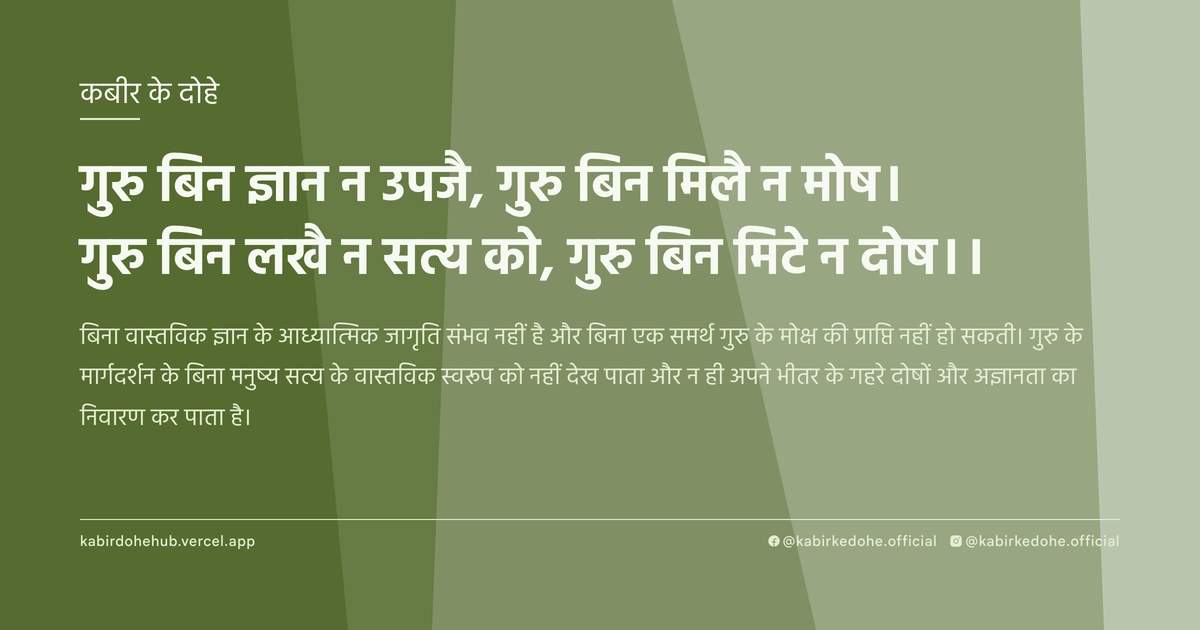
गुरु बिन ज्ञान न उपजै, गुरु बिन मिलै न मोष।
गुरु बिन लखै न सत्य को, गुरु बिन मिटे न दोष।।
Guru bin gyan na upjai, guru bin milai na mosh. Guru bin lakhai na satya ko, guru bin mite na dosh.
इस पृष्ठ पर इस कबीर दोहे का अर्थ (meaning), हिंदी व्याख्या और अंग्रेज़ी अनुवाद, दार्शनिक विश्लेषण और व्यावहारिक जीवन सीख दी गई है। यह दोहा गुरु महत्व (The Guru's Importance) विषय से जुड़ा है — Kabir doha meaning and explanation in Hindi and English.
अर्थ (Meaning):
बिना वास्तविक ज्ञान के आध्यात्मिक जागृति संभव नहीं है और बिना एक समर्थ गुरु के मोक्ष की प्राप्ति नहीं हो सकती। गुरु के मार्गदर्शन के बिना मनुष्य सत्य के वास्तविक स्वरूप को नहीं देख पाता और न ही अपने भीतर के गहरे दोषों और अज्ञानता का निवारण कर पाता है।
Without true spiritual knowledge, awakening cannot arise, and without a realized Guru, liberation (Moksha) remains unattainable. In the absence of a guide, one cannot perceive the ultimate Truth nor eradicate the deep-seated flaws and ignorance residing within the soul.
व्याख्या (Interpretation):
यह दोहा गुरु की अपरिहार्यता पर बल देता है। शाब्दिक अर्थ में, यह गुरु को मोक्ष का द्वार बताता है, लेकिन रूपकात्मक रूप से 'गुरु' वह प्रकाश है जो अज्ञान के अंधकार को मिटाता है। निर्गुण भक्ति के संदर्भ में, गुरु केवल एक व्यक्ति नहीं, बल्कि वह चेतना है जो साधक को माया के भ्रम से मुक्त कर आत्मा और ब्रह्म की एकता (अद्वैत) का अनुभव कराती है। यहाँ 'दोष' का अर्थ केवल पाप नहीं, बल्कि वह अहंकार है जो जीव को परमात्मा से अलग महसूस कराता है। बिना इस मार्गदर्शन के, मनुष्य केवल बौद्धिक चर्चाओं में उलझा रहता है, जबकि सत्य का अनुभव केवल समर्पण और सही दिशा से होता है।
This couplet emphasizes the indispensability of the Guru. Literally, it positions the Guru as the gateway to liberation, but metaphorically, the 'Guru' represents the illuminating consciousness that dispels the darkness of ignorance. In the context of Nirgun Bhakti, the Guru is not merely a physical person but the catalyst that frees the seeker from the illusions of Maya, facilitating the realization of non-duality (Advaita) between the Atman and Brahman. The 'flaws' mentioned are not mere sins, but the egoic constructs that create a perceived separation between the individual and the Divine. Without this guidance, one remains trapped in intellectual discourse, whereas the actual experience of Truth requires surrender and precise direction.
दार्शनिक विश्लेषण (Philosophical Analysis):
कबीर का यह दृष्टिकोण उस समय के सामाजिक और धार्मिक ढांचे पर एक प्रहार था जहाँ मोक्ष को केवल कर्मकांडों, तीर्थों या जातिगत विशेषाधिकारों से जोड़ा जाता था। कबीर ने स्पष्ट किया कि मोक्ष किसी बाहरी अनुष्ठान से नहीं, बल्कि आंतरिक ज्ञान (Gnosis) से आता है। यह विचार सूफीवाद के 'पीर' और अद्वैत वेदांत के 'गुरु-शिष्य' परंपरा से मेल खाता है, जहाँ गुरु का कार्य शिष्य के अहंकार को नष्ट करना है।
ऐतिहासिक रूप से, कबीर ने उस पाखंड का विरोध किया जहाँ पंडित और मुल्ला केवल शास्त्रों का पाठ करते थे लेकिन उनके भीतर करुणा और सत्य का अभाव था। उनके लिए, वास्तविक गुरु वह है जो स्वयं सत्य को जी चुका हो। यह विश्लेषण दर्शाता है कि ज्ञान केवल सूचना नहीं है, बल्कि एक रूपांतरण है।
दार्शनिक स्तर पर, यह दोहा 'अविद्या' (Ignorance) के सिद्धांत को संबोधित करता है। अविद्या वह पर्दा है जो सत्य को ढकता है। गुरु वह दर्पण है जिसमें शिष्य अपनी वास्तविक स्थिति और अपने अहंकार के सूक्ष्म रूपों को देख पाता है।
यहाँ 'मोक्ष' का अर्थ मृत्यु के बाद की कोई स्थिति नहीं, बल्कि जीवित रहते हुए इसी क्षण में बंधनों से मुक्ति है। यह 'जीवन्मुक्ति' की अवधारणा है, जहाँ व्यक्ति संसार में रहते हुए भी उससे अप्रभावित रहता है।
अंततः, कबीर यह समझाते हैं कि बिना गुरु के प्रयास दिशाहीन होते हैं। जैसे एक अंधे व्यक्ति को रास्ता दिखाने के लिए दूसरे मार्गदर्शक की आवश्यकता होती है, वैसे ही माया के जाल में फंसे मनुष्य को एक जागृत चेतना के मार्गदर्शन की आवश्यकता होती है ताकि वह स्वयं को पहचान सके।
Kabir's perspective serves as a critique of the socio-religious structures of his era, where liberation was tethered to rituals, pilgrimages, or caste privileges. He asserts that Moksha is not achieved through external rites but through internal Gnosis. This aligns with the Sufi concept of the 'Pir' and the Advaita Vedanta tradition of the Guru-Shishya relationship, where the Guru's primary role is the annihilation of the disciple's ego.
Historically, Kabir opposed the hypocrisy of the clergy who recited scriptures without embodying compassion or truth. For him, a true Guru is one who has lived the Truth. This analysis reveals that knowledge is not mere information, but a profound transformation of being.
Philosophically, the couplet addresses the principle of 'Avidya' (Ignorance)—the veil that obscures reality. The Guru acts as a mirror, allowing the disciple to perceive their actual state and the subtle manifestations of their ego.
'Moksha' here is not a post-mortem destination but a state of liberation while alive—the concept of 'Jivanmukti'. It is the ability to exist within the world without being entangled by its illusions.
Ultimately, Kabir suggests that efforts without a guide are directionless. Just as a blind person requires a guide to navigate, a human trapped in the web of Maya requires an awakened consciousness to recognize their own divine nature.
मूल संदेश (Core Message):
- बौद्धिक ज्ञान और आध्यात्मिक बोध के बीच का अंतर समझें।
- अहंकार का विसर्जन ही वास्तविक ज्ञान की पहली सीढ़ी है।
- गुरु वह माध्यम है जो दर्पण दिखाकर आपकी कमियाँ उजागर करता है।
- सत्य कोई गंतव्य नहीं, बल्कि एक निरंतर चलने वाली जागरूकता है।
- बाहरी अनुष्ठानों से ऊपर उठकर आंतरिक रूपांतरण को प्राथमिकता दें।
- Distinguish between intellectual information and spiritual realization.
- The dissolution of ego is the first step toward authentic knowledge.
- The Guru is the medium who reveals your flaws by acting as a mirror.
- Truth is not a destination, but a continuous state of awareness.
- Prioritize internal transformation over external ritualistic adherence.
व्यावहारिक उदाहरण (Practical Example):
वाराणसी के घाटों पर रहने वाली एक वृद्ध विधवा, जानकी, अपना पूरा जीवन केवल मंदिर जाने और माला जपने में बिता चुकी थी। वह मानती थी कि मोक्ष केवल कठोर तप और नियमों के पालन से मिलता है। वह स्वभाव से कठोर थी और छोटे बच्चों या अन्य महिलाओं की गलतियों पर उन्हें कोसती रहती थी, यह सोचकर कि वह धर्म का पालन कर रही है।
एक दिन उसकी मुलाकात एक फकीर से हुई जो घाट के किनारे चुपचाप बैठा रहता था। जानकी ने उससे पूछा कि मोक्ष का सबसे छोटा रास्ता क्या है। फकीर ने उसे कोई मंत्र नहीं दिया, बल्कि केवल एक बात कही: 'तुम्हारी माला के मनकों से ज्यादा तुम्हारी जीभ की कड़वाहट तुम्हें बांधे हुए है। जब तक तुम अपने भीतर के क्रोध को नहीं देखोगी, ईश्वर तुम्हें नहीं दिखेगा।'
जानकी को पहले यह बात अपमानजनक लगी। उसने सोचा कि एक साधारण फकीर उसे धर्म सिखा रहा है। लेकिन फकीर की आँखों में एक ऐसी शांति थी जिसे उसने बड़े-बड़े पंडितों में नहीं देखा था। उसने फकीर को अपना मार्गदर्शक मान लिया और उसकी बातों पर विचार करना शुरू किया।
फकीर ने उसे सिखाया कि वास्तविक पूजा मंदिर में नहीं, बल्कि दूसरों के प्रति करुणा में है। उसने जानकी को निर्देश दिया कि वह हर दिन किसी ऐसे व्यक्ति की मदद करे जिससे वह नफरत करती हो। यह उसके लिए सबसे कठिन तप था।
धीरे-धीरे, जानकी ने महसूस किया कि उसका 'धर्म' वास्तव में उसका अहंकार था। वह खुद को दूसरों से श्रेष्ठ मानती थी क्योंकि वह अधिक पूजा करती थी। जब उसने इस सत्य को स्वीकार किया, तो उसके भीतर का भारीपन कम होने लगा।
उसने देखा कि जब वह किसी भूखे को भोजन कराती थी, तो उसे वही शांति मिलती थी जो उसे घंटों मंदिर में बैठने से नहीं मिली थी। उसका क्रोध धीरे-धीरे करुणा में बदलने लगा।
एक दिन, जब वह एक बीमार बच्चे की सेवा कर रही थी, उसे अचानक महसूस हुआ कि वह और वह बच्चा अलग नहीं हैं। वह अद्वैत का अनुभव था, जहाँ 'मैं' और 'तू' का भेद मिट गया था।
जानकी को समझ आया कि फकीर ही उसका वास्तविक गुरु था, जिसने उसे बाहरी कर्मकांडों से हटाकर आंतरिक सत्य की ओर मोड़ा। उसका मोक्ष किसी स्वर्ग की प्राप्ति में नहीं, बल्कि उसके अहंकार के मिटने में था।
Janaki, an elderly widow living on the ghats of Varanasi, had spent her entire life in temple visits and chanting beads. She believed liberation was achieved only through rigorous penance and strict adherence to rules. She was stern, often berating children or other women for their mistakes, believing this was the path of righteousness.
One day, she encountered a wandering Fakir who sat silently by the river. Janaki asked him for the shortest path to Moksha. The Fakir gave her no mantra, but a single observation: 'Your tongue's bitterness binds you more than the beads of your rosary. Until you see the anger within, you will not see the Divine.'
Initially, Janaki found this insulting. She wondered how a simple Fakir could teach her religion. However, there was a serenity in his eyes that she had never seen in the most learned priests. She decided to treat him as her guide and began contemplating his words.
The Fakir taught her that true worship is not in the temple, but in compassion for others. He instructed her to help one person every day whom she genuinely disliked. This became her most difficult penance.
Gradually, Janaki realized that her 'religion' was actually her ego. She had felt superior to others because of her piety. Once she accepted this truth, the heaviness within her began to lift.
She discovered that feeding a hungry person brought her a peace that hours of temple rituals never could. Her anger slowly transformed into empathy.
One day, while tending to a sick child, she suddenly felt that she and the child were not separate. It was an experience of non-duality, where the distinction between 'I' and 'Thou' vanished.
Janaki realized the Fakir was her true Guru, who had diverted her from external rituals toward internal truth. Her liberation was not in reaching a heaven, but in the annihilation of her ego.
अभ्यास मार्गदर्शन (Practice Guidance):
- प्रतिदिन 20 मिनट मौन रहकर यह विचार करें कि आपके जीवन में 'गुरु' की भूमिका क्या है—चाहे वह कोई व्यक्ति हो, कोई पुस्तक हो या आपकी अपनी अंतरात्मा।
- एक 'अहंकार डायरी' बनाएँ जिसमें उन क्षणों को लिखें जब आपने स्वयं को दूसरों से श्रेष्ठ महसूस किया। विश्लेषण करें कि वह श्रेष्ठता किस भ्रम पर आधारित थी।
- व्यवहार परिवर्तन: किसी ऐसे व्यक्ति की निस्वार्थ सेवा करें जिसके प्रति आपके मन में पूर्वाग्रह हो, यह देखते हुए कि वह भी उसी सार्वभौमिक चेतना का हिस्सा है।
- निदान चेकलिस्ट: क्या आप अभी भी सत्य को केवल तर्कों से खोज रहे हैं? क्या आप अपनी गलतियों के लिए दूसरों को दोष देते हैं? यदि हाँ, तो आप अभी भी अज्ञान के प्रभाव में हैं।
- Spend 20 minutes daily in silence, contemplating the role of the 'Guru' in your life—whether it be a person, a sacred text, or your own inner intuition.
- Maintain an 'Ego Diary' to record moments when you felt superior to others. Analyze the illusion upon which that perceived superiority was based.
- Behavioral Shift: Perform selfless service for someone you hold a prejudice against, recognizing that they are a manifestation of the same universal consciousness.
- Diagnostic Checklist: Are you still seeking truth solely through intellectual arguments? Do you blame others for your shortcomings? If yes, you are still under the influence of Avidya.
चिंतन प्रश्न (Reflection Questions):
- क्या मेरा 'आध्यात्मिक मार्ग' वास्तव में मुझे विनम्र बना रहा है, या यह मेरे अहंकार को एक नया 'धार्मिक' रूप दे रहा है?
- मैं किन गुणों को दूसरों में खोजता हूँ और क्या मैं उन गुणों को अपने भीतर विकसित करने का साहस रखता हूँ?
- यदि मेरे जीवन से सभी बाहरी पहचान (पद, प्रतिष्ठा, धर्म) हटा दी जाएँ, तो मेरे भीतर क्या शेष बचेगा?
- क्या मैं सत्य को सुनने के लिए तैयार हूँ, या मैं केवल वही सुनना चाहता हूँ जो मेरे मौजूदा विश्वासों की पुष्टि करे?
- मेरे जीवन का वह कौन सा 'दोष' है जिसे मैं स्वीकार करने से सबसे अधिक डरता हूँ?
- Is my 'spiritual path' truly making me humble, or is it merely giving my ego a new 'religious' identity?
- What qualities do I seek in others, and do I have the courage to cultivate those same qualities within myself?
- If all external identities (status, prestige, religion) were stripped away, what would remain of me?
- Am I actually ready to hear the Truth, or am I only seeking confirmation of my existing beliefs?
- What is the one 'flaw' in my character that I am most afraid to acknowledge?