
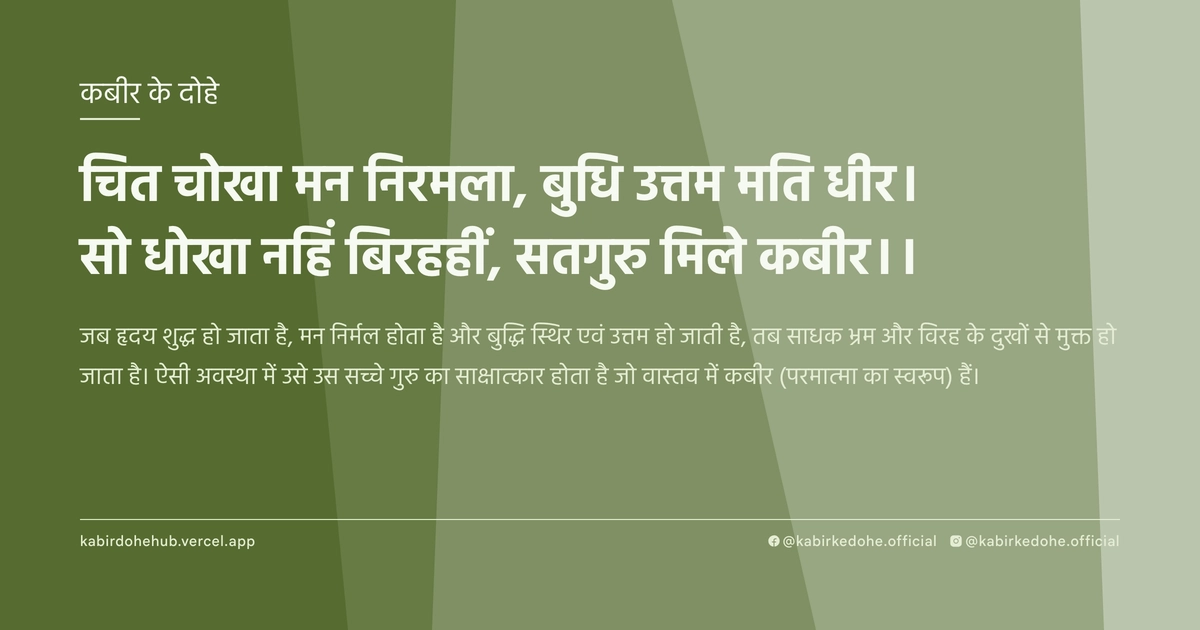
चित चोखा मन निरमला, बुधि उत्तम मति धीर।
सो धोखा नहिं बिरहहीं, सतगुरु मिले कबीर।।
Chit chokha man nirmala, budhi uttam mati dheer. So dhokha nahin birahin, satguru mile Kabir.
इस पृष्ठ पर इस कबीर दोहे का अर्थ (meaning), हिंदी व्याख्या और अंग्रेज़ी अनुवाद, दार्शनिक विश्लेषण और व्यावहारिक जीवन सीख दी गई है। यह दोहा गुरु महत्व (The Guru's Importance) विषय से जुड़ा है — Kabir doha meaning and explanation in Hindi and English.
अर्थ (Meaning):
जब हृदय शुद्ध हो जाता है, मन निर्मल होता है और बुद्धि स्थिर एवं उत्तम हो जाती है, तब साधक भ्रम और विरह के दुखों से मुक्त हो जाता है। ऐसी अवस्था में उसे उस सच्चे गुरु का साक्षात्कार होता है जो वास्तव में कबीर (परमात्मा का स्वरूप) हैं।
When the consciousness becomes pure, the mind becomes stainless, and the intellect attains a state of steady, superior wisdom, the seeker is liberated from all delusions and the agony of separation. In this state of absolute clarity, one encounters the True Guru, the eternal essence represented by Kabir.
व्याख्या (Interpretation):
यह दोहा आंतरिक शुद्धि की प्रक्रिया का वर्णन करता है। 'चित चोखा' का अर्थ है वह चेतना जो सांसारिक वासनाओं से मुक्त है। यहाँ कबीर बताते हैं कि जब तक मन दर्पण की तरह साफ नहीं होता, तब तक सत्य का प्रतिबिंब नहीं दिखता। यह निर्गुण भक्ति का मार्ग है जहाँ बाहरी कर्मकांडों के बजाय आंतरिक रूपांतरण पर जोर दिया गया है। जब अहंकार का विसर्जन होता है, तब 'अद्वैत' की स्थिति उत्पन्न होती है, जहाँ साधक और सद्गुरु के बीच का भेद समाप्त हो जाता है। यह विरह की समाप्ति और मिलन की पराकाष्ठा है।
This couplet delineates the process of internal alchemy. 'Chit chokha' refers to a consciousness scrubbed clean of worldly cravings. Kabir posits that until the mind is as clear as a polished mirror, the reflection of Truth remains obscured. This is the path of Nirgun Bhakti, emphasizing internal transmutation over external ritualism. As the ego dissolves, a state of Advaita (non-duality) emerges, erasing the distinction between the seeker and the Satguru. It marks the cessation of the agony of separation and the attainment of ultimate union.
दार्शनिक विश्लेषण (Philosophical Analysis):
कबीर का यह दर्शन मध्यकालीन भारत के सामाजिक और धार्मिक संघर्षों की उपज है, जहाँ धर्म केवल बाहरी दिखावे और जातिगत श्रेष्ठता तक सीमित था। उन्होंने 'शुद्धि' को स्नान या तीर्थयात्रा से नहीं, बल्कि मन के परिष्कार से जोड़ा। यह दृष्टिकोण अद्वैत वेदांत के करीब है, जहाँ आत्मा और ब्रह्म की एकता को मान्यता दी गई है।
सूफी मत के 'फना' (अहंकार का विनाश) की तरह, कबीर यहाँ मन की निर्मलता की बात करते हैं। उनके अनुसार, जब तक 'मैं' मौजूद है, तब तक 'वह' (ईश्वर) नहीं मिल सकता। यह एक मनोवैज्ञानिक रूपांतरण है जहाँ बुद्धि केवल सूचनाओं का संग्रह नहीं, बल्कि 'धीर' (धैर्य और स्थिरता) का स्रोत बनती है।
कबीर ने ritualism का पुरजोर विरोध किया क्योंकि उनका मानना था कि पत्थर की मूर्तियों या कठिन उपवासों से मन शुद्ध नहीं होता। वास्तविक शुद्धि केवल सत्य के प्रति समर्पण और आत्म-निरीक्षण से आती है। यह दर्शन व्यक्ति को सामाजिक बंधनों से ऊपर उठाकर एक वैश्विक चेतना से जोड़ता है।
यहाँ 'सतगुरु' केवल एक व्यक्ति नहीं, बल्कि वह आंतरिक प्रकाश है जो अज्ञान के अंधकार को मिटाता है। जब बुद्धि उत्तम होती है, तब वह बाहरी गुरु की खोज छोड़कर अपने भीतर के गुरु को पहचान लेती है। यह ज्ञान की वह अवस्था है जहाँ द्वैत समाप्त हो जाता है।
अंततः, यह दोहा यह स्पष्ट करता है कि आध्यात्मिक उपलब्धि किसी बाहरी कृपा का परिणाम नहीं, बल्कि निरंतर आत्म-शुद्धि का परिणाम है। जब पात्रता (purity) आती है, तब साक्षात्कार स्वतः घटित होता है।
Kabir's philosophy is a product of the socio-religious frictions of medieval India, where religion had devolved into superficial displays and caste superiority. He decoupled 'purification' from ritual baths or pilgrimages, linking it instead to the refinement of the mind. This perspective aligns closely with Advaita Vedanta, which recognizes the fundamental unity of Atman and Brahman.
Similar to the Sufi concept of 'Fana' (the annihilation of the ego), Kabir emphasizes the stainlessness of the mind. He asserts that as long as the 'I' persists, the 'Thou' (Divine) remains elusive. This is a psychological transformation where the intellect ceases to be a mere repository of information and becomes a source of 'Dheer' (steadfastness and equanimity).
Kabir vehemently rejected ritualism, believing that stone idols or rigorous fasting could not purify the heart. True purity arises only through surrender to Truth and rigorous self-inquiry. This philosophy elevates the individual above social stratifications, connecting them to a universal consciousness.
In this context, the 'Satguru' is not merely a human teacher but the inner light that dispels the darkness of ignorance. When the intellect reaches its peak, it ceases the external search and recognizes the Guru within. This is the state of knowledge where duality vanishes.
Ultimately, the couplet clarifies that spiritual attainment is not a result of external grace but the fruit of continuous internal purification. When the capacity (purity) is developed, the realization occurs spontaneously.
मूल संदेश (Core Message):
- बाहरी दिखावा सत्य की राह में सबसे बड़ी बाधा है।
- मन की निर्मलता ही परमात्मा के साक्षात्कार की एकमात्र शर्त है।
- बुद्धि जब स्थिर होती है, तब वह ज्ञान बन जाती है।
- अहंकार का विसर्जन ही वास्तविक मिलन है।
- सच्चा गुरु हमारे भीतर की शुद्ध चेतना है।
- External ostentation is the greatest hurdle on the path to Truth.
- Purity of mind is the sole prerequisite for Divine realization.
- When the intellect becomes steady, it transforms into Wisdom.
- The dissolution of ego is the only true union.
- The True Guru is the purified consciousness within us.
व्यावहारिक उदाहरण (Practical Example):
वाराणसी के घाटों पर रहने वाले एक वृद्ध विधवा, जानकी, का जीवन केवल दूसरों की सेवा और मंदिर की सीढ़ियों पर बैठकर माला जपने में बीत रहा था। वह मानती थी कि उसकी भक्ति केवल नियमों के पालन में है।
एक दिन उसने देखा कि एक छोटा बच्चा, जिसे समाज 'अछूत' मानता था, एक घायल पक्षी की सेवा कर रहा था, बिना किसी फल की इच्छा के। जानकी ने महसूस किया कि उसकी अपनी भक्ति में 'अहंकार' था कि वह 'पवित्र' है और अन्य 'अपवित्र'।
उसने अपनी आँखें बंद कीं और महसूस किया कि उसका मन वास्तव में निर्मल नहीं था, बल्कि वह अपनी धार्मिक श्रेष्ठता के भ्रम में जी रही थी। यह उसके लिए एक गहरा झटका था।
उसने माला जपना छोड़कर, अपने भीतर के क्रोध और निर्णय लेने की आदत (judgment) को देखना शुरू किया। उसने महसूस किया कि असली 'शुद्धि' दूसरों को नीचा दिखाने में नहीं, बल्कि सबके भीतर उसी एक नूर को देखने में है।
धीरे-धीरे, उसकी बुद्धि 'धीर' होने लगी। वह अब छोटी बातों पर विचलित नहीं होती थी। उसने मंदिर की दीवारों से बाहर निकलकर उन लोगों की मदद करना शुरू किया जिन्हें समाज ने त्याग दिया था।
उसकी सेवा अब एक 'कर्तव्य' नहीं, बल्कि एक 'प्रेम' बन गई थी। उसने पाया कि जब उसने अपने मन से 'मैं पवित्र हूँ' का भ्रम हटाया, तो उसे हर इंसान में वही दिव्य प्रकाश दिखने लगा।
एक शाम, जब वह शांत बैठी थी, उसे महसूस हुआ कि वह अब किसी बाहरी गुरु की तलाश में नहीं है। उसके भीतर एक असीम शांति व्याप्त थी, जैसे वह स्वयं कबीर के शब्दों का जीवित प्रमाण बन गई हो।
यह 'कबीर ट्विस्ट' था—जहाँ बाहरी धार्मिकता का अंत हुआ और आंतरिक सत्य का जन्म हुआ। जानकी अब एक 'भक्त' नहीं, बल्कि स्वयं 'भक्ति' बन गई थी।
Janaki, an elderly widow living on the ghats of Varanasi, spent her days in ritualistic service and chanting beads on temple steps. She believed her devotion lay solely in the strict adherence to religious rules.
One day, she observed a small child, shunned by society as 'untouchable,' tending to an injured bird with selfless devotion, seeking no reward. Janaki realized that her own devotion was laced with the ego of being 'pure' while others were 'impure.'
She closed her eyes and acknowledged that her mind was not truly stainless; she was living in the illusion of her own religious superiority. This was a profound psychological shock for her.
She stopped the mechanical chanting and began observing the anger and judgment residing within her. She realized that true 'purification' was not in distancing herself from the 'unclean,' but in seeing the same Divine Light in everyone.
Gradually, her intellect attained 'Dheer' (steadfastness). She was no longer agitated by trivialities. She stepped beyond the temple walls to help those whom society had discarded.
Her service ceased to be a 'duty' and became an act of 'love.' She discovered that once she removed the delusion of 'I am pure,' the divine spark became visible in every human being.
One evening, in deep silence, she felt that she no longer needed to search for an external guru. An infinite peace pervaded her, as if she had become a living testament to Kabir's words.
This was the 'Kabir Twist'—where external religiosity ended and internal truth was born. Janaki was no longer a 'devotee'; she had become 'devotion' itself.
अभ्यास मार्गदर्शन (Practice Guidance):
- प्रतिदिन 20 मिनट मौन रहकर अपने विचारों के आने और जाने को देखें, बिना किसी निर्णय के।
- एक डायरी लिखें जिसमें आप उन क्षणों को दर्ज करें जब आपका अहंकार (Ego) आपको दूसरों से श्रेष्ठ महसूस कराता है।
- व्यवहार परिवर्तन: दिन में कम से कम एक बार किसी ऐसे व्यक्ति की निस्वार्थ मदद करें जिससे आप वैचारिक रूप से असहमत हों।
- निदान चेकलिस्ट: क्या मैं अभी भी सही और गलत के द्वंद्व में फंसा हूँ? क्या मेरी शांति बाहरी परिस्थितियों पर निर्भर है? क्या मैं दूसरों में दोष देख रहा हूँ?
- Practice 20 minutes of daily silence, observing thoughts arise and vanish without judgment.
- Maintain a journal recording moments where the ego creates a sense of superiority over others.
- Behavioral Shift: Perform one act of selfless service daily for someone with whom you fundamentally disagree.
- Diagnostic Checklist: Am I still trapped in the duality of right and wrong? Is my peace dependent on external conditions? Am I projecting faults onto others?
चिंतन प्रश्न (Reflection Questions):
- मेरी 'पवित्रता' की परिभाषा क्या है, और क्या यह दूसरों को छोटा महसूस कराने का एक साधन है?
- यदि मेरा सामाजिक पद और पहचान छीन ली जाए, तो मेरे भीतर क्या शेष बचेगा?
- मैं अपनी डिजिटल पहचान (Social Media Ego) को कितना सच मानता हूँ और यह मेरे वास्तविक स्वरूप को कैसे ढक रहा है?
- क्या मेरी भक्ति वास्तव में समर्पण है, या यह केवल एक मानसिक सुरक्षा कवच है?
- मेरे जीवन का वह कौन सा 'कचरा' है जिसे मैं सबसे ज्यादा छिपाने की कोशिश करता हूँ?
- What is my definition of 'purity,' and is it merely a tool to make others feel inferior?
- If my social status and identity were stripped away, what would remain of me?
- How much do I believe in my digital persona, and how does this mask obscure my authentic self?
- Is my devotion truly a surrender, or is it just a psychological security blanket?
- What is the specific 'debris' within my mind that I struggle most to hide from the world?