
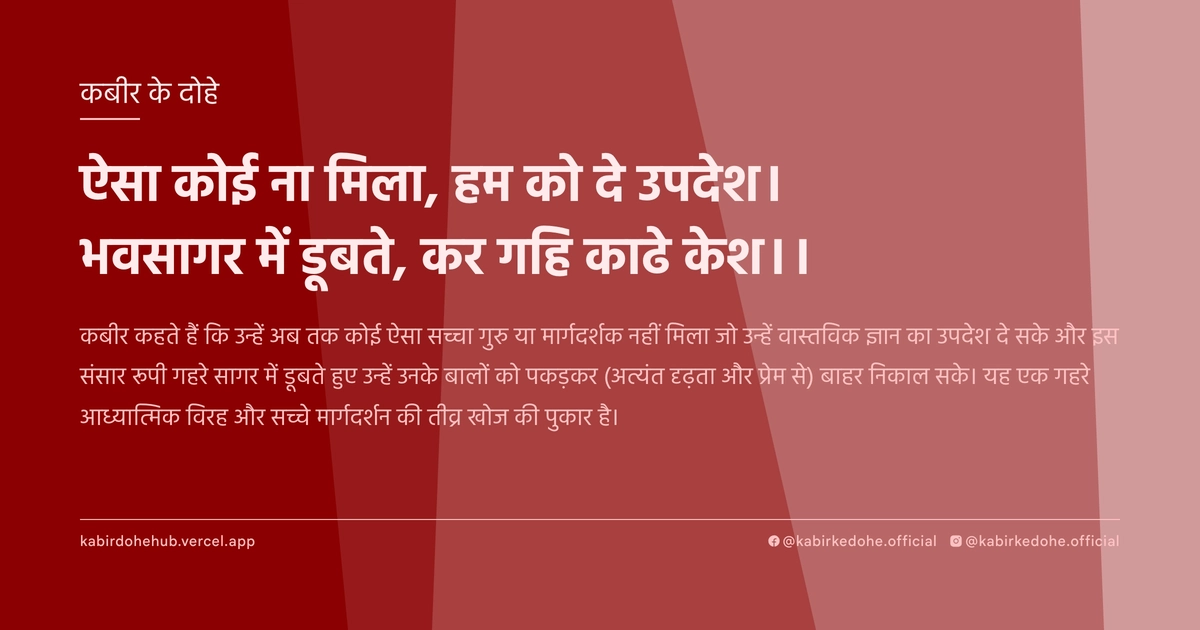
ऐसा कोई ना मिला, हम को दे उपदेश।
भवसागर में डूबते, कर गहि काढे केश।।
Aisa koi na mila, hum ko de updesh. Bhavsagar mein doobte, kar gahi kaadhe kesh.
इस पृष्ठ पर इस कबीर दोहे का अर्थ (meaning), हिंदी व्याख्या और अंग्रेज़ी अनुवाद, दार्शनिक विश्लेषण और व्यावहारिक जीवन सीख दी गई है। यह दोहा गुरु महत्व (The Guru's Importance) विषय से जुड़ा है — Kabir doha meaning and explanation in Hindi and English.
अर्थ (Meaning):
कबीर कहते हैं कि उन्हें अब तक कोई ऐसा सच्चा गुरु या मार्गदर्शक नहीं मिला जो उन्हें वास्तविक ज्ञान का उपदेश दे सके और इस संसार रूपी गहरे सागर में डूबते हुए उन्हें उनके बालों को पकड़कर (अत्यंत दृढ़ता और प्रेम से) बाहर निकाल सके। यह एक गहरे आध्यात्मिक विरह और सच्चे मार्गदर्शन की तीव्र खोज की पुकार है।
Kabir expresses a profound longing for a true spiritual guide, stating that he has found no one capable of providing the authentic instruction needed to rescue him. He envisions the world as a vast, drowning ocean (Bhavsagar), seeking a savior who would grasp him by the hair—a metaphor for an uncompromising, forceful, and absolute rescue from the cycle of birth and death.
व्याख्या (Interpretation):
शाब्दिक अर्थ में, यह एक डूबते हुए व्यक्ति की पुकार है। रूपक के स्तर पर, 'भवसागर' माया और सांसारिक मोह का प्रतीक है जिसमें आत्मा निरंतर विस्मृति और दुख के कारण डूब रही है। 'केश' (बाल) को पकड़ना इस बात का संकेत है कि जब अहंकार पूरी तरह टूट जाता है और व्यक्ति पूरी तरह समर्पित होता है, तब गुरु का हस्तक्षेप अत्यंत तीव्र और निर्णायक होता है। यह निर्गुण भक्ति की उस अवस्था को दर्शाता है जहाँ केवल पूर्ण समर्पण ही मुक्ति का मार्ग है। यहाँ अद्वैत वेदांत का प्रभाव दिखता है, जहाँ जीव अपनी पृथकता के भ्रम को तोड़कर ब्रह्म में विलीन होना चाहता है। यह विरोधाभास है कि जिसे हम अपना 'अस्तित्व' समझते हैं, वही डूबने का कारण है, और जिसे हम 'बाहरी' समझते हैं, वही एकमात्र रक्षक है।
Literally, this is the cry of a drowning man. Metaphorically, 'Bhavsagar' represents the ocean of worldly existence, characterized by Maya (illusion) and the endless cycle of Samsara. The act of grasping the 'kesh' (hair) signifies a rescue that is not gentle or superficial, but urgent and absolute, occurring only when the ego has been completely stripped away. In the context of Nirgun Bhakti, it highlights the necessity of a Satguru who can pull the seeker out of the depths of ignorance. This reflects the Advaita Vedanta concept of the Atman's struggle to realize its non-duality with Brahman while trapped in the illusion of separation. The paradox lies in the fact that the very identity the seeker clings to is the weight that drowns them, and the rescue requires a force that transcends the seeker's own will.
दार्शनिक विश्लेषण (Philosophical Analysis):
कबीर का यह दोहा उस कालखंड का प्रतिबिंब है जब धर्म केवल कर्मकांडों और बाहरी दिखावे तक सीमित था। कबीर ने मंदिर-मस्जिद के औपचारिक उपदेशों को नकार दिया क्योंकि वे केवल बौद्धिक थे, आध्यात्मिक नहीं। उनका 'उपदेश' वह नहीं है जो किताबों से आता है, बल्कि वह है जो अनुभव (Anubhava) से उपजता है।
यहाँ सूफीवाद का गहरा प्रभाव दिखता है, जहाँ 'पीर' या 'मुर्शिद' के बिना आध्यात्मिक यात्रा अधूरी मानी जाती है। सूफी परंपरा में 'फना' (अहंकार का विनाश) की प्रक्रिया ठीक वैसी ही है जैसे डूबते हुए व्यक्ति को बाहर निकालना। कबीर यहाँ यह स्पष्ट कर रहे हैं कि केवल शास्त्रों का ज्ञान पर्याप्त नहीं है; जब तक कोई ऐसा जीवंत मार्गदर्शक न मिले जो आत्मा की गहराई को पहचान सके, तब तक मोक्ष असंभव है।
अद्वैत वेदांत के दृष्टिकोण से, यह दोहा 'अविद्या' (अज्ञान) के अंधकार को दर्शाता है। संसार एक मायाजाल है, और हम इसमें इसलिए डूबते हैं क्योंकि हम स्वयं को शरीर और मन मानते हैं। कबीर का विलाप वास्तव में उस 'परम सत्य' की खोज है जो व्यक्ति को उसके सीमित स्वरूप से मुक्त कर उसे अनंत बना दे।
सामाजिक स्तर पर, कबीर जाति और वर्ण व्यवस्था के उस अहंकार को चुनौती देते हैं जो खुद को 'गुरु' मानता है। वे कहते हैं कि असली गुरु वह नहीं है जिसके पास ऊँची उपाधियाँ हैं, बल्कि वह है जो वास्तव में डूबते हुए को बचाने की क्षमता रखता है। यह एक क्रांतिकारी विचार था जिसने भक्ति आंदोलन को लोकतांत्रिक बनाया।
अंततः, यह मनोवैज्ञानिक रूपांतरण की बात है। जब तक मनुष्य यह महसूस नहीं करता कि वह वास्तव में 'डूब' रहा है, तब तक वह बचाने वाले की तलाश नहीं करेगा। यह 'आध्यात्मिक हताशा' ही वास्तव में जागृति का पहला कदम है, जहाँ अहंकार का अंत होता है और वास्तविक खोज शुरू होती है।
This couplet reflects an era where religion had devolved into mere ritualism and external displays of piety. Kabir rejects the formal sermons of temples and mosques because they were intellectual exercises rather than spiritual transformations. His 'updesh' (instruction) is not one derived from texts, but from direct, lived experience (Anubhava).
There is a profound influence of Sufism here, where the role of the 'Pir' or 'Murshid' is indispensable. In the Sufi path, the process of 'Fana' (annihilation of the self) is akin to being pulled out of a drowning state. Kabir emphasizes that scriptural knowledge is insufficient; without a living guide who can perceive the depths of the soul, liberation remains an elusive dream.
From the lens of Advaita Vedanta, the 'Bhavsagar' is the manifestation of 'Avidya' (ignorance). The world is a web of Maya, and we drown because we misidentify ourselves with the physical body and the transient mind. Kabir's longing is actually a quest for the 'Ultimate Truth' that liberates the individual from their limited identity and merges them into the Infinite.
On a social level, Kabir challenges the arrogance of the caste system and the priestly class who claimed spiritual authority based on birth. He asserts that a true Guru is not defined by titles or lineage, but by the actual capacity to rescue a soul from the depths of suffering. This was a revolutionary stance that democratized the Bhakti movement.
Psychologically, this doha addresses the necessity of 'spiritual desperation.' Until a human being realizes they are truly drowning in the illusions of the world, they will not seek a savior. This state of crisis is, in reality, the first step toward awakening, where the ego finally collapses and the authentic search for the Divine begins.
मूल संदेश (Core Message):
- बाहरी ज्ञान केवल सूचना है, वास्तविक उपदेश वह है जो अहंकार को मिटा दे।
- संसार का मोह एक ऐसा सागर है जहाँ तर्क नहीं, केवल समर्पण काम आता है।
- सच्चा गुरु वह नहीं जो रास्ता बताए, बल्कि वह है जो आपको स्वयं से मिला दे।
- जब तक आप अपनी डूबती अवस्था को स्वीकार नहीं करेंगे, तब तक बचाव संभव नहीं।
- मुक्ति का मार्ग बाहरी अनुष्ठानों में नहीं, बल्कि आंतरिक जागरण में निहित है।
- External knowledge is mere information; true instruction is that which annihilates the ego.
- The attachment to the world is an ocean where logic fails and only surrender prevails.
- A true Guru does not merely show the path but connects you to your own essence.
- Rescue is impossible until you acknowledge the reality of your own drowning.
- Liberation lies not in external rituals, but in the awakening of inner consciousness.
व्यावहारिक उदाहरण (Practical Example):
वाराणसी के घाटों पर रहने वाली एक वृद्ध विधवा, जानकी, का जीवन केवल अभाव और अकेलेपन का एक अंतहीन सिलसिला था। वह हर दिन मंदिर जाती, घंटों प्रार्थना करती और पंडितों के कठिन उपदेश सुनती, लेकिन उसके मन की गहरी उदासी और जीवन की निरर्थकता का बोझ कम नहीं होता था।
वह मानती थी कि उसकी गरीबी और अकेलापन उसके पिछले जन्मों के पापों का फल है। वह शास्त्रों के उन शब्दों में उलझी रही जो उसे केवल 'सहन' करना सिखाते थे, लेकिन उसे वह शांति नहीं मिली जिसकी उसे तलाश थी। वह आध्यात्मिक रूप से एक ऐसे सागर में डूब रही थी जहाँ उम्मीद की कोई किरण नहीं थी।
एक दिन, घाट की सीढ़ियों पर एक फकीर बैठा था, जो न तो कोई माला फेर रहा था और न ही कोई मंत्र पढ़ रहा था। वह बस शांत था। जानकी उसके पास गई और अपनी व्यथा सुनाई। उसने कहा, 'मैंने बड़े-बड़े विद्वानों के उपदेश सुने, पर मेरा दुख कम नहीं हुआ।'
फकीर ने उसकी ओर देखा और बस इतना कहा, 'तू उस किनारे को ढूँढ रही है जो तेरे अंदर ही है, लेकिन तूने अपनी आँखें बाहर की दुनिया पर टिका रखी हैं। तू डूब नहीं रही, तू बस तैरना भूल गई है क्योंकि तूने बोझ बहुत ज्यादा उठा रखा है।'
यह साधारण सा वाक्य जानकी के लिए वह 'केश' बन गया जिसे पकड़कर उसे बाहर निकाला गया। फकीर ने उसे कोई जटिल योग या तपस्या नहीं बताई, बल्कि उसे सिखाया कि कैसे अपने वर्तमान दुख को बिना किसी निर्णय के स्वीकार किया जाए।
जानकी ने महसूस किया कि वह अब तक जिन उपदेशों को सत्य मान रही थी, वे केवल मानसिक बोझ थे। उसने अपनी पहचान एक 'बेचारी विधवा' के रूप में देखना बंद कर दिया और खुद को उस अनंत चेतना का हिस्सा माना जो कभी दुखी नहीं होती।
उसने अपने जीवन के शेष वर्ष अन्य असहाय महिलाओं की मदद करने में बिताए। अब वह मंदिर की दीवारों में नहीं, बल्कि लोगों की सेवा में ईश्वर को ढूँढती थी।
उसका रूपांतरण यह था कि उसने बाहरी रक्षकों की उम्मीद छोड़कर अपने भीतर के उस मौन को खोज लिया, जिसने उसे जीवन के गहरे सागर से बाहर निकाल लिया था।
Janaki, an elderly widow living on the ghats of Varanasi, spent her life in a relentless cycle of deprivation and loneliness. Every day she visited the temple, prayed for hours, and listened to the complex discourses of priests, yet the heavy burden of sadness and the perceived meaninglessness of her life never lifted.
She believed her poverty and solitude were the fruits of sins from past lives. She remained entangled in scriptural words that taught her only how to 'endure,' but she never found the peace she craved. Spiritually, she was drowning in an ocean where no ray of hope seemed to penetrate.
One day, she encountered a wandering dervish sitting on the stone steps of the ghat. He wore no religious symbols, chanted no mantras, and held no beads; he was simply present in a state of profound stillness. Janaki approached him and poured out her grief, saying, 'I have heard the sermons of the greatest scholars, yet my sorrow remains untouched.'
The dervish looked at her and said simply, 'You are searching for a shore that exists within you, yet your eyes are fixed on the external world. You are not drowning; you have simply forgotten how to float because you are carrying too many burdens.'
This simple observation became the 'hair' that pulled Janaki out of her despair. The dervish did not prescribe complex yoga or rigorous penance; instead, he taught her how to accept her current suffering without judgment and without the label of 'victim.'
Janaki realized that the sermons she had clung to were merely mental weights. She stopped identifying herself as a 'pitiful widow' and began to see herself as a spark of that infinite consciousness which is inherently beyond sorrow.
She spent the remainder of her years serving other destitute women. No longer seeking God within the walls of a temple, she found the Divine in the act of selfless service.
Her transformation lay in shifting her gaze from external saviors to the inner silence, which finally rescued her from the suffocating depths of her own perceived misery.
अभ्यास मार्गदर्शन (Practice Guidance):
- प्रतिदिन 20 मिनट का मौन अभ्यास करें, जहाँ आप किसी भी विचार को पकड़ने के बजाय केवल अपने 'डूबने' (अशांति) के अहसास को बिना निर्णय के देखें।
- एक डायरी लिखें जिसमें आप उन 'मानसिक बोझों' की सूची बनाएँ जिन्हें आप वर्षों से ढो रहे हैं और पूछें: 'क्या यह बोझ मेरा है या समाज द्वारा दिया गया है?'
- व्यवहार परिवर्तन: जब भी आप किसी से सलाह मांगें, तो केवल शब्दों को न सुनें, बल्कि यह देखें कि क्या वह व्यक्ति स्वयं उस शांति में स्थित है जिसे वह आपको देने का दावा कर रहा है।
- निदान चेकलिस्ट: क्या मैं अभी भी बाहरी समाधानों (पैसे, पद, प्रशंसा) में अपनी शांति ढूँढ रहा हूँ? क्या मैं अपनी समस्याओं को 'भाग्य' मानकर निष्क्रिय हूँ? यदि हाँ, तो आप अभी भी भवसागर में डूब रहे हैं।
- Practice 20 minutes of daily silence, where instead of clinging to thoughts, you simply observe the sensation of 'drowning' (restlessness) without judgment.
- Maintain a journal to list the 'mental burdens' you have carried for years, asking: 'Is this burden truly mine, or was it imposed by society?'
- Behavioral Shift: Whenever you seek advice, look beyond the words to see if the advisor is themselves anchored in the peace they claim to offer.
- Diagnostic Checklist: Am I still seeking peace in external solutions (money, status, praise)? Am I passively attributing my struggles to 'fate'? If yes, you are still drowning in the Bhavsagar.
चिंतन प्रश्न (Reflection Questions):
- मैं अपनी पहचान बनाने के लिए किन 'मुखौटों' का उपयोग कर रहा हूँ, और क्या ये मुखौटे मुझे डूबने से बचा रहे हैं या और गहरा ले जा रहे हैं?
- यदि आज मेरे जीवन से मेरी सभी सामाजिक उपलब्धियाँ और पद छीन लिए जाएँ, तो क्या मेरे पास ऐसा कोई आंतरिक आधार बचेगा जो मुझे स्थिर रख सके?
- क्या मेरी आध्यात्मिक खोज वास्तव में सत्य की प्यास है, या यह केवल वर्तमान जीवन के दुखों से भागने का एक तरीका है?
- मैं किन लोगों को अपना 'गुरु' मान बैठा हूँ—उनको जो मुझे खुश करते हैं, या उनको जो मुझे मेरी कड़वी सच्चाई दिखाते हैं?
- मेरे भीतर का वह कौन सा हिस्सा है जो अभी भी यह मानता है कि कोई 'बाहरी' शक्ति आकर मुझे बचा लेगी?
- Which 'masks' am I using to construct my identity, and are these masks saving me or pulling me deeper into the abyss?
- If all my social achievements and titles were stripped away today, would there be an internal foundation left to keep me stable?
- Is my spiritual quest a genuine thirst for Truth, or is it merely a sophisticated escape from the pains of current existence?
- Whom have I designated as my 'Guru'—those who flatter my ego, or those who mirror my harshest truths?
- Which part of me still clings to the delusion that an 'external' force will arrive to rescue me?