
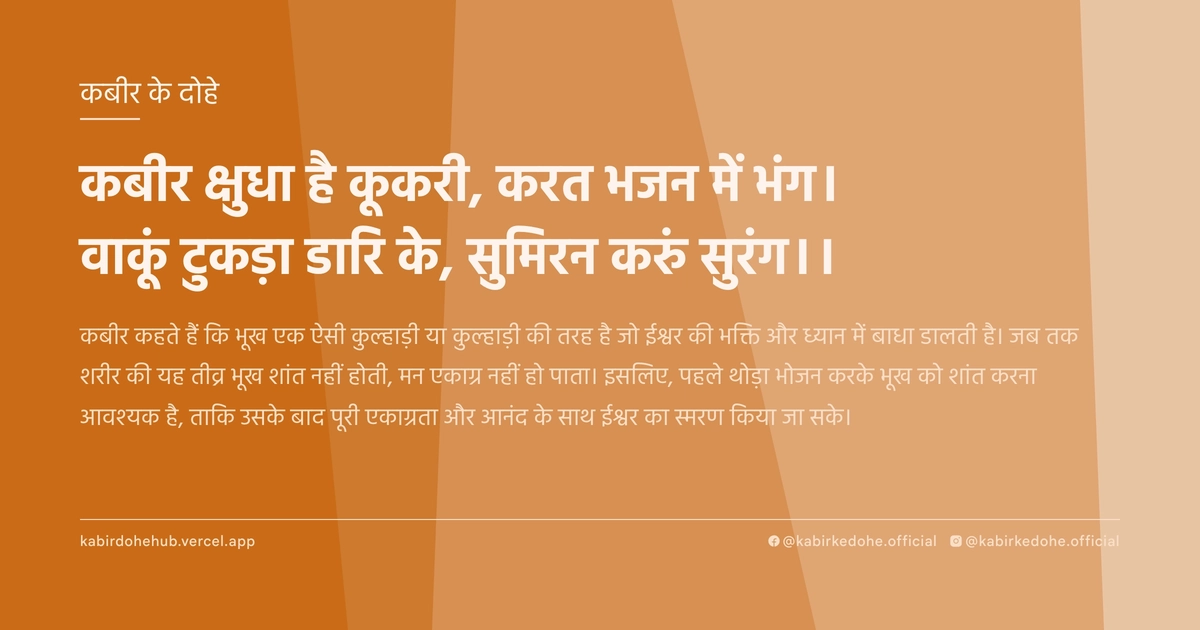
कबीर क्षुधा है कूकरी, करत भजन में भंग।
वाकूं टुकड़ा डारि के, सुमिरन करुं सुरंग।।
Kabir kshudha hai kukri, karat bhajan me bhang. Wakun tukda darr ke, sumiran karun surang.
इस पृष्ठ पर इस कबीर दोहे का अर्थ (meaning), हिंदी व्याख्या और अंग्रेज़ी अनुवाद, दार्शनिक विश्लेषण और व्यावहारिक जीवन सीख दी गई है। यह दोहा संयम (Self-discipline) विषय से जुड़ा है — Kabir doha meaning and explanation in Hindi and English.
अर्थ (Meaning):
कबीर कहते हैं कि भूख एक ऐसी कुल्हाड़ी या कुल्हाड़ी की तरह है जो ईश्वर की भक्ति और ध्यान में बाधा डालती है। जब तक शरीर की यह तीव्र भूख शांत नहीं होती, मन एकाग्र नहीं हो पाता। इसलिए, पहले थोड़ा भोजन करके भूख को शांत करना आवश्यक है, ताकि उसके बाद पूरी एकाग्रता और आनंद के साथ ईश्वर का स्मरण किया जा सके।
Kabir asserts that hunger is like a sharp axe that disrupts the flow of devotion and meditation. As long as the physical body is tormented by intense hunger, the mind cannot achieve the stillness required for spiritual ascent. Therefore, one must first satisfy the hunger with a small morsel of food, ensuring the body is quiescent so that the soul can immerse itself in the divine remembrance with complete serenity.
व्याख्या (Interpretation):
यहाँ 'क्षुधा' (भूख) केवल शारीरिक भूख नहीं, बल्कि इंद्रियों की अतृप्ति का प्रतीक है। कबीर इसे 'कूकरी' (कुल्हाड़ी) कहते हैं क्योंकि यह ध्यान की निरंतरता को काट देती है। यह दोहा शरीर और आत्मा के अंतर्संबंध को दर्शाता है। निरगुण भक्ति में जहाँ मन की शुद्धि पर जोर है, वहाँ कबीर यह स्वीकार करते हैं कि शरीर की बुनियादी आवश्यकताएं उपेक्षा नहीं की जा सकतीं। माया यहाँ शारीरिक अभाव के रूप में प्रकट होती है जो साधक को वर्तमान क्षण से भटकाती है। जब साधक अपनी शारीरिक आवश्यकताओं का संतुलन बना लेता है, तब वह 'सुरंग' यानी गहरे और आनंदमय आध्यात्मिक मार्ग में प्रवेश कर पाता है। यह द्वैत और अद्वैत के बीच का संतुलन है—शरीर का सम्मान करते हुए आत्मा की खोज करना।
In this verse, 'Kshudha' (hunger) serves as a metaphor for the insatiable cravings of the senses. Kabir describes it as a 'Kukri' (axe) because it violently severs the continuity of meditative focus. The doha illuminates the symbiotic relationship between the physical vessel and the spiritual essence. Within the framework of Nirgun Bhakti, while the emphasis is on the formless, Kabir acknowledges that the physical body cannot be entirely ignored. Maya manifests here as physical deprivation, which distracts the seeker from the present moment. Once the seeker balances these primal needs, they can enter the 'Surang'—the deep, resonant tunnel of divine remembrance. It is a delicate balance between duality and non-duality: honoring the body's existence to facilitate the soul's transcendence.
दार्शनिक विश्लेषण (Philosophical Analysis):
कबीर का यह दोहा उस समय के कठोर तपस्वी दृष्टिकोण पर एक प्रहार है जो शरीर को पूरी तरह कष्ट देने को ही मोक्ष का मार्ग मानते थे। कबीर ने यहाँ 'मध्यम मार्ग' का समर्थन किया है, जो बौद्ध धर्म और बाद में कई सूफी परंपराओं में देखा गया। वे बताते हैं कि अत्यधिक उपवास या शरीर का उत्पीड़न आध्यात्मिक प्रगति के बजाय मानसिक व्याकुलता पैदा करता है।
अद्वैत वेदांत के नजरिए से, शरीर और मन एक ही चेतना के विभिन्न स्तर हैं। यदि शरीर अत्यधिक पीड़ा में है, तो मन का 'चित्त' शांत नहीं हो सकता। कबीर यहाँ यह स्पष्ट करते हैं कि भक्ति कोई बाहरी प्रदर्शन नहीं है, बल्कि एक आंतरिक स्थिति है। जब भूख जैसी बुनियादी जरूरतें पूरी नहीं होतीं, तो अहंकार (Ego) केवल जीवित रहने की चिंता में डूब जाता है, जिससे 'अहम' का विसर्जन असंभव हो जाता है।
सूफीवाद में भी 'नफ्स' (इच्छाओं) के नियंत्रण की बात कही गई है, लेकिन पूर्ण विनाश की नहीं, बल्कि संतुलन की। कबीर का दृष्टिकोण व्यावहारिक है; वे ritualism (कर्मकांड) और कठोर तप की तुलना में सहज साधना को प्राथमिकता देते हैं। वे सिखाते हैं कि ईश्वर को पाने के लिए शरीर को नष्ट करना आवश्यक नहीं है, बल्कि उसे एक साधन के रूप में उपयोग करना आवश्यक है।
ऐतिहासिक रूप से, कबीर ने जाति और धर्म के बंधनों को तोड़ा था। यहाँ वे उस धार्मिक कट्टरता को भी तोड़ रहे हैं जो यह मानती थी कि केवल कष्ट सहकर ही पवित्रता प्राप्त की जा सकती है। वे यह स्थापित करते हैं कि पवित्रता मन की स्थिति में है, न कि शरीर के भूखे रहने में।
अंततः, यह विश्लेषण हमें सिखाता है कि आध्यात्मिक यात्रा में 'अति' वर्जित है। शरीर को पर्याप्त पोषण देना और फिर मन को ईश्वर में लीन करना ही वास्तविक साधना है। यह भौतिकता और आध्यात्मिकता के बीच एक सेतु का निर्माण करता है, जहाँ भौतिक आवश्यकताएं आध्यात्मिक लक्ष्य की बाधा नहीं, बल्कि उसकी सीढ़ी बन जाती हैं।
Kabir’s doha serves as a critique of the rigorous asceticism prevalent in his era, where extreme self-mortification was often mistaken for the path to liberation. By acknowledging the disruptive nature of hunger, Kabir advocates for a 'Middle Path,' echoing Buddhist sensibilities and certain Sufi traditions. He posits that excessive fasting or bodily torture creates mental agitation rather than spiritual progress.
From the perspective of Advaita Vedanta, the body and mind are different layers of the same consciousness. If the physical vessel is in acute distress, the 'Chitta' (consciousness-mind) cannot achieve the stillness required for Samadhi. Kabir clarifies that devotion is not an external performance but an internal state. When basic needs are unmet, the ego becomes preoccupied with survival, making the annihilation of the 'I' impossible.
In Sufism, the concept of disciplining the 'Nafs' (desires) is central, yet it emphasizes balance over total eradication. Kabir’s approach is profoundly pragmatic; he prioritizes spontaneous, heartfelt devotion over rigid ritualism and severe penance. He teaches that attaining the Divine does not require the destruction of the body, but rather its mindful utilization as a vehicle for grace.
Historically, Kabir dismantled caste and religious hierarchies. Here, he dismantles the spiritual hierarchy that suggests holiness is proportional to physical suffering. He establishes that purity resides in the state of the heart, not in the emptiness of the stomach.
Ultimately, this analysis reveals that extremes are detrimental to the spiritual journey. Providing the body with sufficient sustenance and then immersing the mind in the Divine is the true practice. It builds a bridge between materialism and spirituality, where physical needs are not obstacles but prerequisites for a stable meditative state.
मूल संदेश (Core Message):
- शारीरिक संतुलन ही मानसिक शांति की पहली सीढ़ी है।
- अत्यधिक तपस्या अक्सर अहंकार का एक सूक्ष्म रूप होती है।
- शरीर को प्रताड़ित करना ईश्वर को पाने का मार्ग नहीं है।
- इंद्रियों की अतृप्ति ध्यान की निरंतरता को काट देती है।
- सहज साधना ही सबसे स्थायी और प्रभावी मार्ग है।
- आत्मा की यात्रा के लिए शरीर का स्वस्थ होना अनिवार्य है।
- Physical balance is the first step toward mental tranquility.
- Extreme austerity is often a subtle mask for the ego.
- Torturing the body is not the path to attaining the Divine.
- Unsatisfied senses sever the continuity of deep meditation.
- Spontaneous, balanced practice is the most sustainable path.
- A healthy body is essential for the soul's journey.
व्यावहारिक उदाहरण (Practical Example):
वाराणसी के एक पुराने घाट पर माधव नाम का एक वृद्ध बुनकर रहता था। माधव अपनी पूरी जिंदगी कबीर के भजनों में लीन रहा, लेकिन उसके मन में एक गहरी छटपटाहट थी। वह मानता था कि जितना अधिक वह भूखा रहेगा और कष्ट सहेगा, उतनी ही जल्दी उसे मोक्ष मिलेगा। वह कई दिनों तक केवल पानी पीकर रहता और घंटों ध्यान लगाने की कोशिश करता।
लेकिन जैसे-जैसे दिन बीतते, उसका ध्यान ईश्वर में लगने के बजाय उसकी भूख की तड़प में उलझ जाता। जब वह आँखें बंद करता, तो उसे मंत्रों के बजाय भोजन की गंध आने लगती। उसका मन चिड़चिड़ा हो गया और वह अपने पड़ोसियों पर चिल्लाने लगा। वह जिसे 'तप' समझ रहा था, वह वास्तव में उसके अहंकार का एक नया रूप था—'मैं सबसे बड़ा तपस्वी हूँ'।
एक दिन, एक घुमक्कड़ सूफी संत उसके पास आए। उन्होंने देखा कि माधव का चेहरा पीला पड़ गया है और उसकी आँखों में शांति के बजाय बेचैनी है। संत ने उसे एक छोटा सा टुकड़ा रोटी दिया और कहा, 'माधव, इस शरीर को थोड़ा भोजन दे, ताकि यह शांत हो सके और तुम्हारी आत्मा को बोलने का मौका मिले।'
माधव ने पहले तो संकोच किया, लेकिन फिर उस रोटी का एक टुकड़ा खाया। जैसे ही उसकी भूख शांत हुई, उसके मन का शोर अचानक थम गया। उसे महसूस हुआ कि पिछले कई वर्षों से वह भूख से लड़ रहा था, न कि अपने अहंकार से।
रोटी के उस छोटे से टुकड़े ने उसके भीतर एक बड़ा बदलाव लाया। उसने महसूस किया कि शरीर को प्रताड़ित करना भक्ति नहीं, बल्कि एक भ्रम है। उसने अपनी दिनचर्या बदली—वह अब सादा भोजन करता और फिर शांत मन से सुमिरन करता।
उसकी भक्ति अब प्रदर्शन नहीं, बल्कि एक गहरा अनुभव बन गई। वह अब दूसरों की मदद करने लगा क्योंकि उसके भीतर करुणा जागृत हुई थी, जो पहले भूख की चिड़चिड़ाहट में दबी हुई थी।
उसने सीखा कि जब शरीर संतुष्ट होता है, तब मन वास्तव में मुक्त हो सकता है। उसकी बुनाई में अब एक नई लय थी और उसके भजनों में एक ऐसी शांति थी जो पहले कभी नहीं थी।
माधव की कहानी हमें सिखाती है कि आध्यात्मिक ऊंचाई तक पहुँचने के लिए जमीन पर पैर टिकाना जरूरी है। शरीर की उपेक्षा करना आत्मा का अपमान है।
अंत में, माधव ने समझा कि 'सुरंग' (दिव्य मार्ग) तक पहुँचने के लिए पहले उस 'कुल्हाड़ी' (भूख/अतृप्ति) को शांत करना पड़ता है जो हमें वर्तमान क्षण से काट देती है।
On an ancient ghat in Varanasi lived an elderly weaver named Madhav. Madhav had spent his entire life immersed in Kabir’s verses, yet a deep restlessness plagued him. He believed that the more he fasted and suffered, the faster he would attain liberation. He would go days drinking only water, attempting to force his mind into deep meditation.
However, as days passed, his focus shifted from the Divine to the agonizing pangs of hunger. Whenever he closed his eyes, instead of mantras, he smelled food. His mind became irritable, and he began snapping at his neighbors. What he perceived as 'Tapasya' (penance) was actually a new mask for his ego—the pride of being the 'greatest ascetic.'
One day, a wandering Sufi saint visited him. The saint noticed Madhav’s pallid face and the anxiety flickering in his eyes, which lacked true peace. The saint handed him a small piece of bread and said, 'Madhav, give this body a little sustenance so it may fall silent, allowing your soul the space to speak.'
Madhav hesitated at first, but then ate the morsel. As his hunger subsided, the noise in his mind abruptly ceased. He realized that for years, he had been fighting hunger, not his ego.
That small piece of bread triggered a profound transformation. He understood that torturing the body is not devotion, but a delusion. He altered his routine—eating simple meals and then engaging in remembrance with a tranquil mind.
His devotion ceased to be a performance and became a deep, lived experience. He began helping others as compassion awoke within him, a feeling that had previously been buried under the irritability of starvation.
He learned that only when the body is content can the mind truly become free. There was now a new rhythm in his weaving and a serenity in his hymns that had been absent before.
Madhav’s story teaches us that to reach spiritual heights, one must keep their feet firmly on the ground. Neglecting the body is an insult to the soul.
Ultimately, Madhav understood that to enter the 'Surang' (the divine tunnel), one must first quiet the 'Kukri' (the axe of hunger/unsatisfied desire) that severs us from the present moment.
अभ्यास मार्गदर्शन (Practice Guidance):
- दैनिक अभ्यास: ध्यान शुरू करने से पहले सुनिश्चित करें कि आपकी बुनियादी शारीरिक आवश्यकताएं (भूख, प्यास, नींद) पूरी हों। शरीर को शांत करें ताकि मन एकाग्र हो सके।
- आत्म-पूछताछ जर्नल: लिखें कि जब आप तनाव में या चिड़चिड़े होते हैं, तो क्या वह वास्तव में आध्यात्मिक संकट है या केवल शारीरिक थकान/भूख का परिणाम? अपनी 'शारीरिक बाधाओं' को पहचानें।
- व्यवहार परिवर्तन: भोजन को केवल पेट भरने का साधन न मानें, बल्कि इसे एक 'प्रसाद' के रूप में देखें जो आपकी साधना के लिए ऊर्जा प्रदान करता है। भोजन के प्रति कृतज्ञता का भाव विकसित करें।
- डायग्नोस्टिक चेकलिस्ट: क्या मैं ध्यान के दौरान शरीर के दर्द या भूख से विचलित हो रहा हूँ? क्या मेरी आध्यात्मिक प्रैक्टिस मुझे दूसरों के प्रति अधिक सहिष्णु बना रही है या अधिक कठोर? क्या मैं अपनी तपस्या पर गर्व कर रहा हूँ?
- Daily Practice: Before beginning meditation, ensure basic physical needs (hunger, thirst, sleep) are met. Quiet the body so the mind can concentrate.
- Self-Inquiry Journal: Document instances where stress or irritability was not a spiritual crisis but a result of physical exhaustion or hunger. Identify your 'physical anchors.'
- Behavioral Change: View food not just as fuel, but as 'Prasad' (divine offering) that provides the energy for your spiritual practice. Cultivate a sense of gratitude toward sustenance.
- Diagnostic Checklist: Am I distracted by bodily pain or hunger during meditation? Is my spiritual practice making me more tolerant of others or more rigid? Am I taking pride in my austerity?
चिंतन प्रश्न (Reflection Questions):
- क्या मेरी आध्यात्मिक उपलब्धियों का दावा वास्तव में मेरी आंतरिक शांति है, या केवल एक 'पवित्र' छवि बनाने का प्रयास?
- मैं अपनी शारीरिक जरूरतों को कितना नजरअंदाज करता हूँ, और क्या यह नजरअंदाजी मुझे दूसरों के प्रति कठोर बनाती है?
- क्या मैं वास्तव में ईश्वर की खोज कर रहा हूँ, या मैं केवल अपनी इच्छाओं को दबाकर उन्हें 'तप' का नाम दे रहा हूँ?
- मेरे जीवन में वह कौन सी 'भूख' (मानसिक या भौतिक) है जो मुझे वर्तमान क्षण में पूरी तरह उपस्थित होने से रोकती है?
- यदि मैं अपनी सभी धार्मिक पहचान और तपस्या को छोड़ दूँ, तो मेरे भीतर क्या बचेगा?
- Is my claim of spiritual achievement true inner peace, or merely an attempt to construct a 'holy' persona?
- To what extent do I ignore my physical needs, and does this neglect make me more rigid or harsh toward others?
- Am I truly seeking the Divine, or am I simply suppressing my desires and labeling it as 'penance'?
- What is the 'hunger' (mental or physical) in my life that prevents me from being fully present in the moment?
- If I were to strip away all my religious identities and austerities, what would remain within me?