
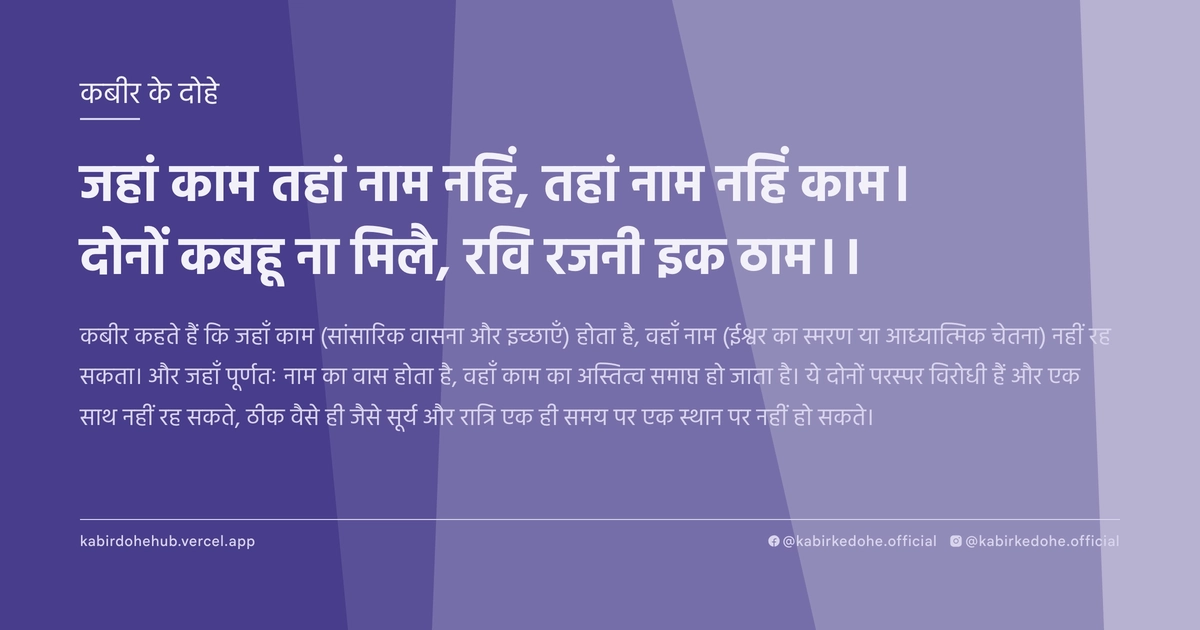
जहां काम तहां नाम नहिं, तहां नाम नहिं काम।
दोनों कबहू ना मिलै, रवि रजनी इक ठाम।।
Jahan kaam tahan naam nahin, tahan naam nahin kaam. Dono kabahu na milai, ravi rajni ik thaam.
इस पृष्ठ पर इस कबीर दोहे का अर्थ (meaning), हिंदी व्याख्या और अंग्रेज़ी अनुवाद, दार्शनिक विश्लेषण और व्यावहारिक जीवन सीख दी गई है। यह दोहा संयम (Self-discipline) विषय से जुड़ा है — Kabir doha meaning and explanation in Hindi and English.
अर्थ (Meaning):
कबीर कहते हैं कि जहाँ काम (सांसारिक वासना और इच्छाएँ) होता है, वहाँ नाम (ईश्वर का स्मरण या आध्यात्मिक चेतना) नहीं रह सकता। और जहाँ पूर्णतः नाम का वास होता है, वहाँ काम का अस्तित्व समाप्त हो जाता है। ये दोनों परस्पर विरोधी हैं और एक साथ नहीं रह सकते, ठीक वैसे ही जैसे सूर्य और रात्रि एक ही समय पर एक स्थान पर नहीं हो सकते।
Kabir asserts that where 'Kaam' (worldly desire and lust) resides, 'Naam' (the Divine Name or spiritual consciousness) cannot exist. Conversely, where the Divine Name is fully established, desire vanishes. These two forces are mutually exclusive and can never coexist in the same space, just as the sun and the night cannot occupy the same moment in one place.
व्याख्या (Interpretation):
इस दोहे का शाब्दिक अर्थ वासना और भक्ति के बीच के द्वंद्व को दर्शाता है। यहाँ 'काम' केवल यौन इच्छा नहीं, बल्कि अहंकार से प्रेरित हर वह इच्छा है जो मनुष्य को बाहरी दुनिया से बांधती है। 'नाम' वह निराकार ब्रह्म है जो आत्मा को मुक्त करता है। कबीर एक गहरे विरोधाभास का उपयोग करते हुए बताते हैं कि मन एक समय में केवल एक ही दिशा में उन्मुख हो सकता है। जब मन इंद्रियों के सुख में लीन होता है, तो वह परमात्मा की सूक्ष्म उपस्थिति को महसूस नहीं कर पाता। यह निर्गुण भक्ति का मूल है, जहाँ साधक को यह समझना होता है कि माया (भ्रम) और सत्य एक साथ नहीं रह सकते। जैसे सूर्य के उदय होते ही अंधकार मिट जाता है, वैसे ही वास्तविक ज्ञान के उदय से वासना का अंत होता है। यह आत्मा और ब्रह्म की अद्वैत स्थिति की ओर संकेत है, जहाँ द्वैत का अंत ही मोक्ष है।
The literal meaning of this couplet highlights the conflict between desire and devotion. Here, 'Kaam' does not merely signify sexual lust, but every ego-driven craving that binds the human to the external world. 'Naam' represents the formless Brahman, the cosmic vibration that liberates the soul. Kabir employs a profound paradox, suggesting that the mind can only orient itself in one direction at a time. When the mind is immersed in sensory pleasures, it becomes blind to the subtle presence of the Divine. This is the essence of Nirgun Bhakti, where the seeker must realize that Maya (illusion) and Satya (Truth) are mutually exclusive. Just as the rising sun inevitably dissolves the darkness of night, the awakening of true spiritual knowledge annihilates desire. This points toward the Advaita state of non-duality, where the cessation of duality is the only path to liberation.
दार्शनिक विश्लेषण (Philosophical Analysis):
कबीर का यह दृष्टिकोण उनके युग के धार्मिक पाखंड और कर्मकांडों के विरुद्ध एक सशक्त प्रहार था। उन्होंने देखा कि लोग बाहरी पूजा-पाठ करते थे, लेकिन उनके भीतर वासना और अहंकार का वास था। कबीर ने स्पष्ट किया कि ईश्वर किसी मंदिर या मस्जिद में नहीं, बल्कि मन की शुद्धि में है। यह विचार अद्वैत वेदांत के करीब है, जहाँ यह माना जाता है कि अज्ञान (Avidya) के कारण ही हम स्वयं को शरीर और इच्छाओं से जोड़ते हैं। जब यह अज्ञान मिटता है, तो केवल शुद्ध चेतना शेष रहती है।
सूफी मत के 'फना' (अहंकार का विनाश) की अवधारणा यहाँ स्पष्ट दिखती है। जब तक 'मैं' और मेरी इच्छाएँ जीवित हैं, तब तक 'वह' (परमात्मा) प्रकट नहीं हो सकता। कबीर का तर्क है कि आध्यात्मिक यात्रा वास्तव में 'अन-लर्निंग' की प्रक्रिया है—उन इच्छाओं को छोड़ना जो हमें सीमित करती हैं। वे ritualism को इसलिए नकारते हैं क्योंकि कर्मकांड अक्सर अहंकार को और पुष्ट करते हैं, जबकि 'नाम' का वास्तविक अर्थ है स्वयं के भीतर की शून्यता को पहचानना।
मनोवैज्ञानिक स्तर पर, यह दोहा संज्ञानात्मक विसंगति (cognitive dissonance) की बात करता है। मनुष्य अक्सर चाहता है कि वह भौतिक सुखों का उपभोग भी करे और आध्यात्मिक शांति भी प्राप्त करे। कबीर इसे असंभव बताते हैं। वे कहते हैं कि एकाग्रता का नियम यह है कि यदि आप एक बिंदु पर केंद्रित हैं, तो आप दूसरे से दूर हैं। वासना का केंद्र 'बाहर' है, जबकि नाम का केंद्र 'भीतर' है।
ऐतिहासिक रूप से, कबीर ने जाति और धर्म की दीवारों को तोड़कर एक ऐसे मार्ग का 제시 किया जो केवल व्यक्तिगत अनुभव और आंतरिक अनुशासन पर आधारित था। उन्होंने यह समझाया कि मोक्ष किसी विशेष जाति या धर्म के लिए आरक्षित नहीं है, बल्कि वह हर उस व्यक्ति के लिए उपलब्ध है जो अपनी वासनाओं पर विजय प्राप्त कर सकता है।
अंततः, यह विश्लेषण हमें बताता है कि 'नाम' कोई शब्द नहीं, बल्कि एक अवस्था है। यह वह स्थिति है जहाँ व्यक्ति अपनी पहचान को अपनी इच्छाओं से अलग कर लेता है। जब इच्छा का अंत होता है, तो जो शेष बचता है, वही शाश्वत सत्य है। यह द्वंद्व नहीं, बल्कि एक रूपांतरण है—अंधकार से प्रकाश की ओर, और सीमित अहंकार से असीमित ब्रह्म की ओर।
Kabir's perspective serves as a powerful critique of the religious hypocrisy and ritualism prevalent during his era. He observed people engaging in external worship while their inner selves remained enslaved to desire and ego. Kabir clarified that the Divine is not found in temples or mosques, but in the purification of the mind. This aligns closely with Advaita Vedanta, which posits that it is only due to Avidya (ignorance) that we identify ourselves with the body and its cravings. When this ignorance is dissolved, only pure consciousness remains.
The Sufi concept of 'Fana' (the annihilation of the self) is evident here. As long as the 'I' and its desires persist, the 'He' (the Divine) cannot manifest. Kabir argues that the spiritual journey is essentially a process of 'un-learning'—shedding the desires that limit our existence. He rejects ritualism because rituals often reinforce the ego, whereas the true meaning of 'Naam' is to recognize the void within oneself.
On a psychological level, this doha addresses cognitive dissonance. Humans often strive to consume material pleasures while simultaneously seeking spiritual peace. Kabir declares this impossible. He suggests that the law of concentration dictates that if you are focused on one point, you are necessarily distant from another. The center of desire is 'external,' while the center of the Name is 'internal.'
Historically, Kabir broke the barriers of caste and creed to propose a path based solely on personal experience and internal discipline. He demonstrated that liberation is not reserved for a specific caste or religion but is accessible to anyone capable of conquering their desires.
Ultimately, this analysis reveals that 'Naam' is not a word, but a state of being. It is the condition where an individual detaches their identity from their cravings. When desire ends, what remains is the eternal truth. This is not a conflict, but a transformation—from darkness to light, and from the limited ego to the limitless Brahman.
मूल संदेश (Core Message):
- वासना और शांति एक ही हृदय में नहीं रह सकते।
- बाहरी शोर को कम करें ताकि आंतरिक सत्य सुनाई दे।
- अहंकार का विसर्जन ही परमात्मा का वास्तविक आगमन है।
- इच्छाओं का त्याग अभाव नहीं, बल्कि पूर्णता की ओर कदम है।
- सत्य का अनुभव केवल शून्य होने पर ही संभव है।
- Lust and peace cannot coexist within a single heart.
- Quiet the external noise to hear the internal truth.
- The dissolution of ego is the true arrival of the Divine.
- Renouncing desire is not a lack, but a step toward wholeness.
- The experience of Truth is possible only when one becomes void.
व्यावहारिक उदाहरण (Practical Example):
एक समय की बात है, वाराणसी के घाटों पर माधव नाम का एक वृद्ध बुनकर रहता था। माधव अपनी कला में निपुण था, लेकिन उसका मन हमेशा इस बात की चिंता में रहता था कि वह और अधिक धन कैसे कमाए ताकि वह शहर के सबसे बड़े व्यापारी की तरह विलासिता का जीवन जी सके। उसकी यह लालसा उसे बेचैन रखती थी; वह दिन भर काम करता, लेकिन रात को नींद नहीं आती थी।
माधव अक्सर कबीर के भजनों को सुनता था, लेकिन वह उन्हें केवल कविता मानता था। एक दिन, उसकी मुलाकात एक फकीर से हुई जिसने उसे एक चुनौती दी। फकीर ने कहा, "माधव, तुम जिस रेशम को बुनते हो, वह तो सुंदर है, लेकिन क्या तुमने अपने मन के धागों को सुलझाया है? तुम एक ही समय में अमीर बनने की इच्छा और ईश्वर की शांति, दोनों चाहते हो। यह वैसा ही है जैसे तुम एक ही कपड़े को काला और सफेद एक साथ रंगना चाहो।"
माधव को यह बात चुभी। उसने सोचा कि वह तो धार्मिक है, वह रोज पूजा करता है, फिर भी वह इतना अशांत क्यों है? उसने महसूस किया कि उसकी पूजा केवल एक औपचारिकता थी, जबकि उसका पूरा ध्यान 'काम' यानी धन की लालसा पर था। वह जितना अधिक धन के बारे में सोचता, उसकी आंतरिक शांति उतनी ही कम होती जाती।
उसने तय किया कि वह एक महीने तक अपनी इच्छाओं का निरीक्षण करेगा। जब भी उसके मन में लालच आता, वह रुक जाता और खुद से पूछता, "क्या इस समय मैं शांति चाहता हूँ या यह लालच?" उसने पाया कि जब लालच हावी होता, तो उसके भीतर का आध्यात्मिक केंद्र पूरी तरह मौन हो जाता।
धीरे-धीरे, माधव ने अपनी जरूरतों और अपनी लालसाओं के बीच का अंतर समझना शुरू किया। उसने महसूस किया कि उसकी बेचैनी धन की कमी से नहीं, बल्कि 'और अधिक' पाने की अंतहीन इच्छा से थी। उसने अपनी कला को केवल लाभ के लिए नहीं, बल्कि समर्पण के लिए बुनना शुरू किया।
एक दिन, उसने एक गरीब अनाथ बच्चे के लिए एक सुंदर वस्त्र मुफ्त में बनाया। उस क्षण, उसे जो आनंद मिला, वह उस सुख से कहीं अधिक था जो उसने अब तक धन संचय की कल्पना करके महसूस किया था। उसे समझ आया कि जब उसने 'पाने' की इच्छा (काम) को छोड़ा, तो उसके भीतर एक असीम तृप्ति (नाम) का उदय हुआ।
उसकी नींद वापस आ गई। अब वह रात को शांति से सोता था क्योंकि उसने यह जान लिया था कि सूर्य और रात्रि एक साथ नहीं रह सकते। यदि वह शांति का सूर्य चाहता था, तो उसे लालसा की रात्रि को विदा करना ही होगा।
माधव अब केवल एक बुनकर नहीं रहा, वह एक जागृत आत्मा बन गया। उसने सीखा कि वास्तविक समृद्धि वह नहीं है जो तिजोरी में हो, बल्कि वह है जो मन की शून्यता और संतोष में निहित है। उसका जीवन अब एक जीवित प्रमाण था कि वासना का त्याग ही परमात्मा का वास्तविक मिलन है।
Once, on the ghats of Varanasi, lived an elderly weaver named Madhav. Madhav was skilled in his craft, but his mind was perpetually consumed by the desire to earn more wealth so he could live a life of luxury like the city's wealthiest merchants. This craving kept him restless; he worked all day, yet sleep eluded him at night.
Madhav often listened to Kabir's bhajans, but he viewed them merely as poetry. One day, he encountered a wandering fakir who gave him a challenge. The fakir said, "Madhav, the silk you weave is beautiful, but have you untangled the threads of your own mind? You desire both the wealth of a merchant and the peace of a saint. This is like trying to dye a single piece of cloth both black and white simultaneously."
These words stung Madhav. He wondered why, despite his daily prayers and religious identity, he remained so unsettled. He realized that his worship was a mere formality, while his entire consciousness was anchored in 'Kaam'—the lust for gold.
He decided to observe his desires for one month. Whenever greed surfaced, he would pause and ask himself, "In this moment, do I seek peace or this craving?" He discovered that whenever greed dominated, his internal spiritual center went completely silent.
Gradually, Madhav began to distinguish between his needs and his cravings. He realized his restlessness stemmed not from a lack of money, but from the endless desire for 'more.' He stopped weaving for profit alone and began weaving as an act of surrender.
One day, he crafted a beautiful garment for a poor orphan child and gave it away for free. In that moment, he experienced a joy far deeper than any he had imagined through the accumulation of wealth. He understood that when he let go of the desire to 'acquire' (Kaam), an infinite contentment (Naam) arose within him.
His sleep returned. He now slept peacefully, knowing that the sun and the night cannot coexist. If he wanted the sun of peace, he had to bid farewell to the night of craving.
Madhav was no longer just a weaver; he became an awakened soul. He learned that true prosperity is not what is stored in a vault, but what resides in the emptiness and contentment of the mind.
His life became a living testament that the renunciation of desire is the only true union with the Divine.
अभ्यास मार्गदर्शन (Practice Guidance):
- साक्षी भाव का अभ्यास: दिन में तीन बार 10 मिनट के लिए बैठें और अपने मन में उठने वाली इच्छाओं को केवल देखें, बिना उन्हें सही या गलत ठहराए।
- इच्छा-विश्लेषण जर्नल: जब भी आप किसी चीज़ के लिए तीव्र लालसा महसूस करें, उसे लिखें और स्वयं से पूछें—"क्या यह मेरी आवश्यकता है या मेरा अहंकार?"
- मौन साधना: प्रतिदिन एक घंटा पूर्ण मौन रहें, जहाँ न केवल वाणी, बल्कि मानसिक संवाद को भी शांत करने का प्रयास करें, ताकि 'नाम' की सूक्ष्म ध्वनि सुनाई दे।
- डायग्नोस्टिक चेकलिस्ट: यदि आप चिड़चिड़ापन, नींद की कमी या निरंतर तुलना महसूस कर रहे हैं, तो यह संकेत है कि 'काम' हावी है। यदि आप सहजता, करुणा और आंतरिक स्थिरता महसूस कर रहे हैं, तो 'नाम' जागृत है।
- Practice of Witness Consciousness: Sit for 10 minutes three times a day and simply observe the desires arising in your mind without judging them as right or wrong.
- Desire-Analysis Journal: Whenever you feel an intense craving, write it down and ask yourself: "Is this a genuine need or a projection of my ego?"
- Silence Sadhana: Spend one hour in complete silence daily, attempting to quiet not only your speech but also your internal dialogue to hear the subtle vibration of 'Naam'.
- Diagnostic Checklist: If you experience irritability, insomnia, or constant comparison, it is a sign that 'Kaam' is dominant. If you feel ease, compassion, and internal stability, 'Naam' is awakening.
चिंतन प्रश्न (Reflection Questions):
- मेरी कौन सी ऐसी 'पवित्र' इच्छाएँ हैं जो वास्तव में मेरे अहंकार को पोषण दे रही हैं?
- क्या मैं वास्तव में शांति चाहता हूँ, या मैं केवल शांति का ढोंग करके अपनी वासनाओं को छिपा रहा हूँ?
- मेरे जीवन का वह कौन सा क्षेत्र है जहाँ मैं 'सूर्य' (सत्य) को लाने के लिए 'रात्रि' (अंधकार) को छोड़ने से डरता हूँ?
- यदि मेरी सारी सामाजिक पहचान और उपलब्धियाँ छीन ली जाएँ, तो क्या मेरे भीतर 'नाम' का कोई अंश बचेगा?
- मैं अपनी डिजिटल पहचान (सोशल मीडिया) के माध्यम से किस प्रकार की 'काम' या वासना को संतुष्ट कर रहा हूँ?
- Which of my 'sacred' desires are actually nourishing my ego in disguise?
- Do I truly seek peace, or am I merely pretending to be peaceful to mask my cravings?
- In which area of my life am I afraid to let go of the 'night' (darkness) to allow the 'sun' (truth) to rise?
- If all my social identities and achievements were stripped away, would any essence of 'Naam' remain within me?
- Through my digital identity, what form of 'Kaam' or craving am I attempting to satisfy?